 |
|
|
|
Grades/Level: Middle School (6–8), High School (9–12)
Subjects: Visual Arts
Time Required: 3–5–Part Lesson
2 class periods plus 1–2 hours homework
Author: Linda Harris, A.P. U.S. History Teacher, Fairfax Senior High School Magnet Center for Visual Arts, Los Angeles, with J. Paul Getty Museum Education Staff
|
|
|
|
|
|
|
|
|
|
Lesson Overview |
|
Students learn about the relocation of Japanese Americans during World War II. Through an analysis of Dorothea Lange's photographs, the
"Pledge of Allegiance," and a U.S. government flyer from 1942, students discuss the complexities of U.S. history and politics. |
|
|
|
|
|
Learning Objectives |
|
• Students will analyze a photograph and translate the analysis into words.
• Students will understand and explain the impact of governmental decisions made during a specific historical time period.
• Students will be able to transfer that understanding of the past to the present situation.
• Students will understand the importance of an image to an historical situation. |
|
|
|
|
|
|
|
|
|
Materials |
|
|
|
|
|
|
|
|
Lesson Steps |
|
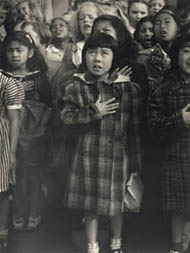
1. Show Pledge of Allegiance image to class. You may wish to have students answer the following questions independently and then discuss them:
• Who do you see in this photograph? What are they doing? Where do you think they are looking?
• Where are they? What clues help you know?
• Where was the photographer standing when she took this photograph? Why do you think the children aren't looking at the camera? Do you think the children were posed for the photograph? If so, why
• would a photographer want to pose them?
• What other details do you notice in the photograph?
• In what decade do you think this picture was made? What clues might help you figure this out?
• Describe the variety of facial expressions that you see in this photograph.
2. Have the class recite the "Pledge of Allegiance." Write the pledge on the blackboard, or have students write it out themselves individually. Go over the pledge line by line, discussing its meaning. Give students time to rewrite the pledge in their own words, in more simple language. They can do this for homework.
I pledge allegiance
to the flag
of the United States of America
and to the Republic
for which it stands,
one nation,
under God,
indivisible,
with liberty and justice for all.
3. Distribute copies of the flyer Instructions to All Persons of Japanese Ancestry. Discuss Japanese internment during World War II. See Lange in U.S. History for historical context.
Students answer the following questions in writing on their own for homework or in class as part of class discussion:
• Where were the headquarters for the Western Defense Command and Fourth Army Wartime Civil Control Administration located?
• How many days were "all persons of Japanese ancestry, both alien and non-alien" given to evacuate the San Fransisco area?
• What items did evacuees have to carry to the Assembly Center?
• What could NOT be taken to the internment camps?
• How were the evacuees to be transported to the Assembly Center?
• How could a person of Japanese ancestry change residence after 12 noon, Tuesday, May 5, 1942? What does P.W.T. stand for?
• Where was the Northern California Sector's Civil Control Station located?
• Why did the government issue such an order?
4. Have students think about the image Pledge of Allegiance in relation to the historical context:
• Look at the exact dates for the flyer and the photograph. How close in time are they?
• Knowing exactly when Lange took this photograph, what message do you think she was presenting to her audience?
• Explain the inconsistency between this photograph and the reality of the time.
• Comment on the line "with liberty and justice for all" in terms of Japanese-American internment.
• If you didn't know the historical context of this photograph, would you have a different impression of the image? Explain.
• What image would you photograph to point out a similarly troubling and ironic situation in today's world? |
|
 |
|
| Pledge of Allegiance, Raphael Weill Elementary School, San Francisco, Dorothea Lange, April 1942 (print 1960s) |
|
|
|
|
|
|
|
|
|
Assessment |
|
Teacher observation of classroom discussion:
• Students should be able to describe at least one element in the photograph.
• Students should be able to explain what the "Pledge of Allegiance" means in their own words.
• Students should be able to explain why Japanese and Japanese Americans were interned during WWII.
• Students should be able to make a clear link between what they see in the photograph or read in the flyer, and historical context.
• Students should be able to explain why internment goes against basic principles of American democracy.
Written work:
• Students should be able to identify specific visual elements in the photograph and answer specific factual questions about the flyer.
• Students should be able to rewrite the "Pledge of Allegiance" using simple language that explains its meaning.
• Students should be able to explain in writing why an image is ironic and connect the image to its historical context.
|
|
|
|
|
|
Extensions |
|
Students can photograph or find current images that represent troubling contradictions like the one depicted in Pledge of Allegiance. Students should write an essay or give a presentation explaining the irony and the historical context of the image. |
|
|
|
|
|
|
|
|
|
Standards Addressed |
|
Common Core Standards for English Language Arts
Grades 6–12
WRITING
Production and Distribution of Writing
4. Produce clear and coherent writing in which the development, organization, and style are appropriate to task, purpose, and audience.
SPEAKING AND LISTENING
Comprehension and Collaboration
1. Prepare for and participate effectively in a range of conversations and collaborations with diverse partners, building on others' ideas and expressing their own clearly and persuasively.
2. Integrate and evaluate information presented in diverse media and formats, including visually, quantitatively, and orally.
History-Social Science Content Standards for California Public Schools
Grades 6-8
Historical and Social-Sciences Analysis Skills
Historical Interpretation
1. Students explain the central issues and problems from the past, placing people and events in a matrix of time and place.
Grades 9-12
Historical and Social-Sciences Analysis Skills
Historical Interpretation
1. Students show the connections, causal and otherwise, between particular historical events and larger social, economic, and political trends and developments.
3. Students interpret past events and issues within the context in which an event unfolded rather than solely in terms of present-day norms and values.
Grade 11
U.S. History and Geography: Continuity and Change in the Twentieth Century
11.7.5 Discuss the constitutional issues and impact of events on the U.S. home front, including the internment of Japanese Americans (e.g., Fred Korematsuv. United States of America) and the restrictions on German and Italian resident aliens; the response of the administration to Hitler's atrocities against Jews and other groups; the roles of women in military production; and the roles and growing political demands of African Americans.
Grade 12
Principles of American Democracy
12.8.3 Explain how public officials use the media to communicate with the citizenry and to shape public opinion.
Visual-Arts Content Standards for California Public Schools
Grades 9-12
Artistic Perception
1.5 Analyze the materials used by a given artist and describe how their use influences the meaning of the work.
National Standards for U.S. History
Grades 5-12
Era 8: The Great Depression and World War II (1929-1945)
3c. The student understands the effects of World War II at home. |
|
|
|
|
|


