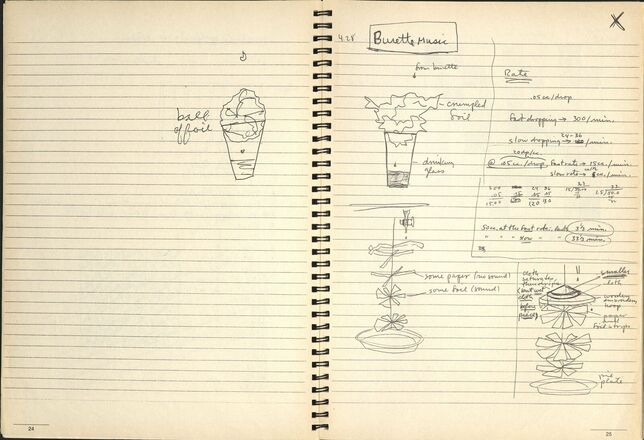
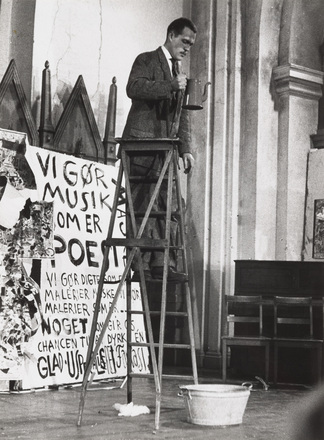
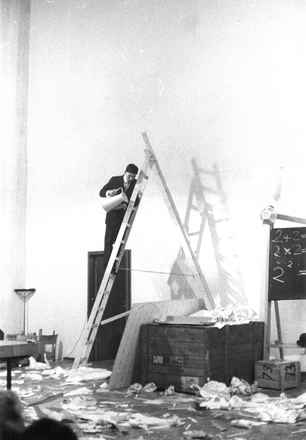
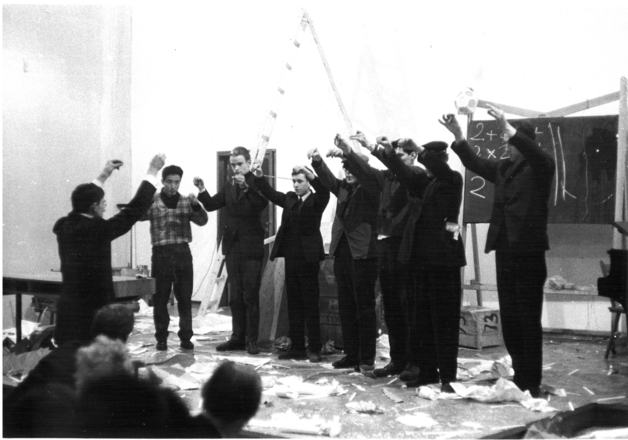
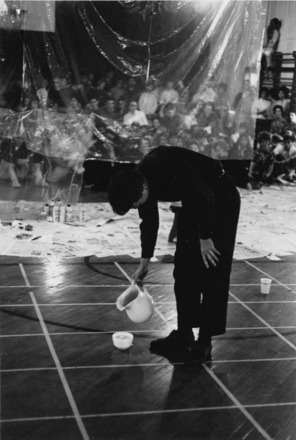
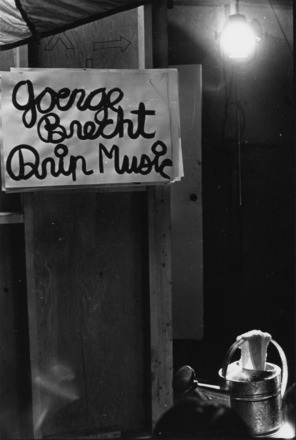
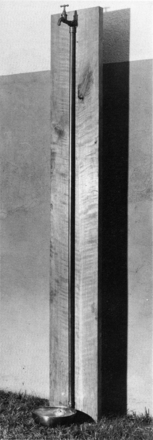
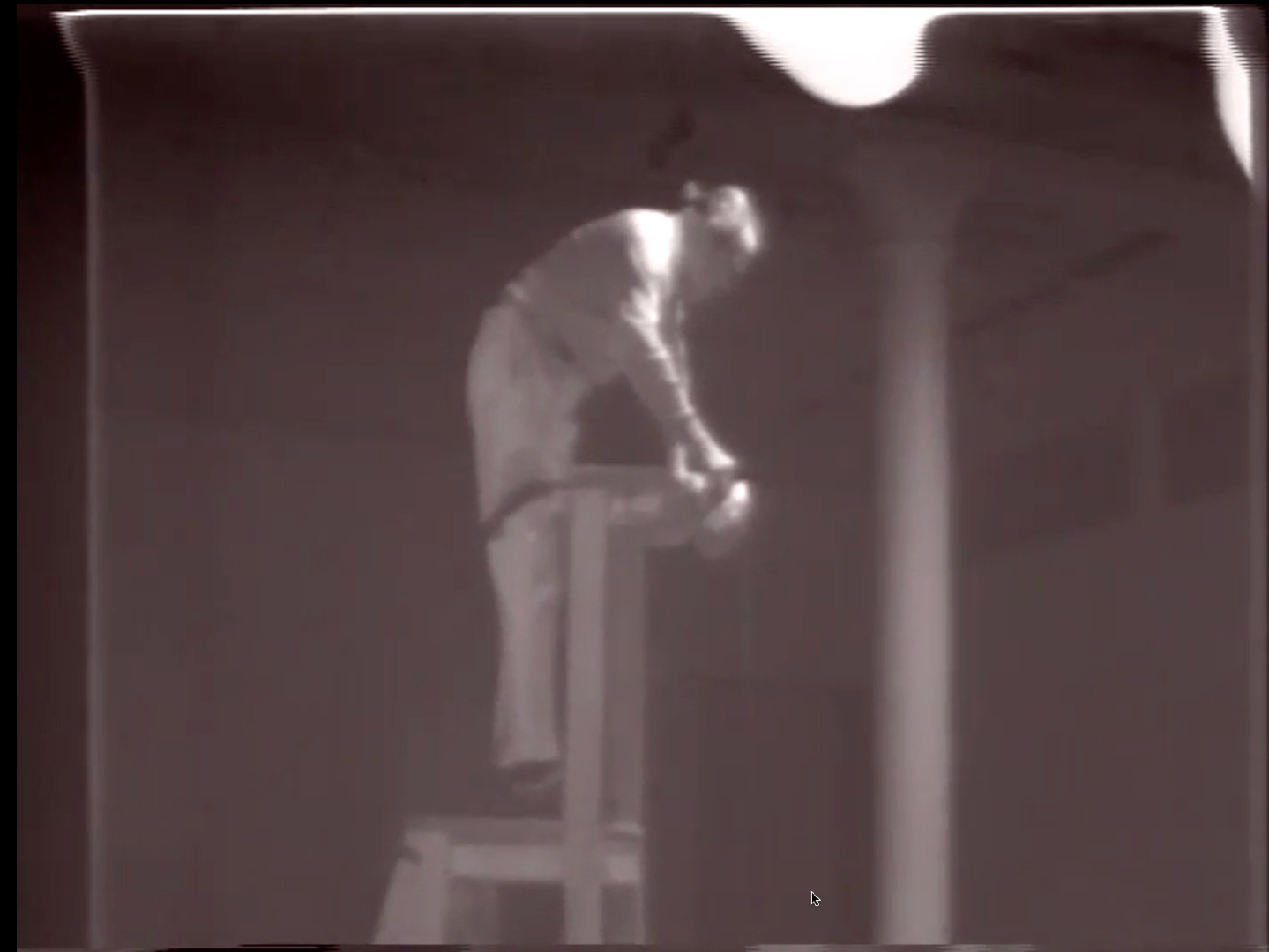
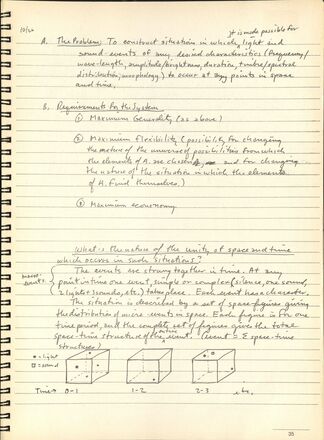
Among George Brecht’s most well-known compositions, Drip Music (Drip Event) (1959–62) bears many characteristics that typify the artist’s event scores, and the way it is dated suggests Brecht honed the text gradually and carefully over the course of his most intensive years of score writing. In 1960, Brecht began to call his works “events” as opposed to “music,” though this score retains both titles. Its first line immediately opens the possibility of the work’s performance to a multiplicity of realizations, by either a solo performer or a group, and even by nonhuman actors. (All possibilities would be experimented with by Fluxus artists, as chapter 6’s Archive section shows.) Notably, the language avoids both an imperative tone as well as outwardly naming the agent of the action. Instead, it describes in a rather passive way the existence of the phenomenon of water dripping, leaving the words “source” and “vessel” open to interpretation. The even more ambiguous “second version” included in the score’s text might be written for more advanced readers familiar with Brecht’s work, such as the virtuoso listener for whom, as the artist described in his 1959 notebook, “all sound may be music” (George Brecht, notebook page ca. late July 1959, from Cage’s course in Experimental Composition, reprinted in George Brecht—Notebooks, ed. Dieter Daniels and Hermann Braun, vol. 3 [Cologne: Walther König, 1991], 123). At this time Brecht also wrote the similar yet slightly more elaborate score Comb Music (Comb Event) (1959–62).
© 2022 Artists Rights Society (ARS), New York / VG Bild-Kunst, Bonn.