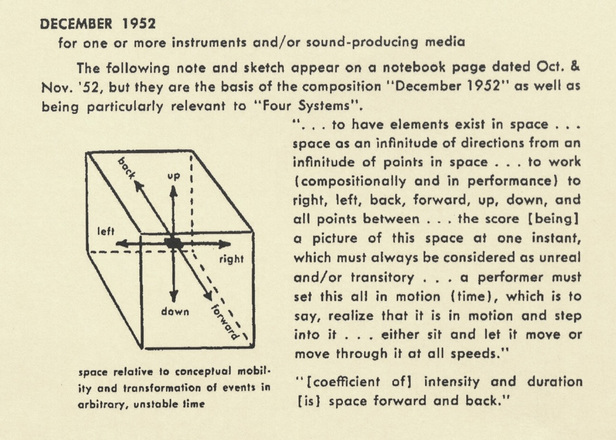
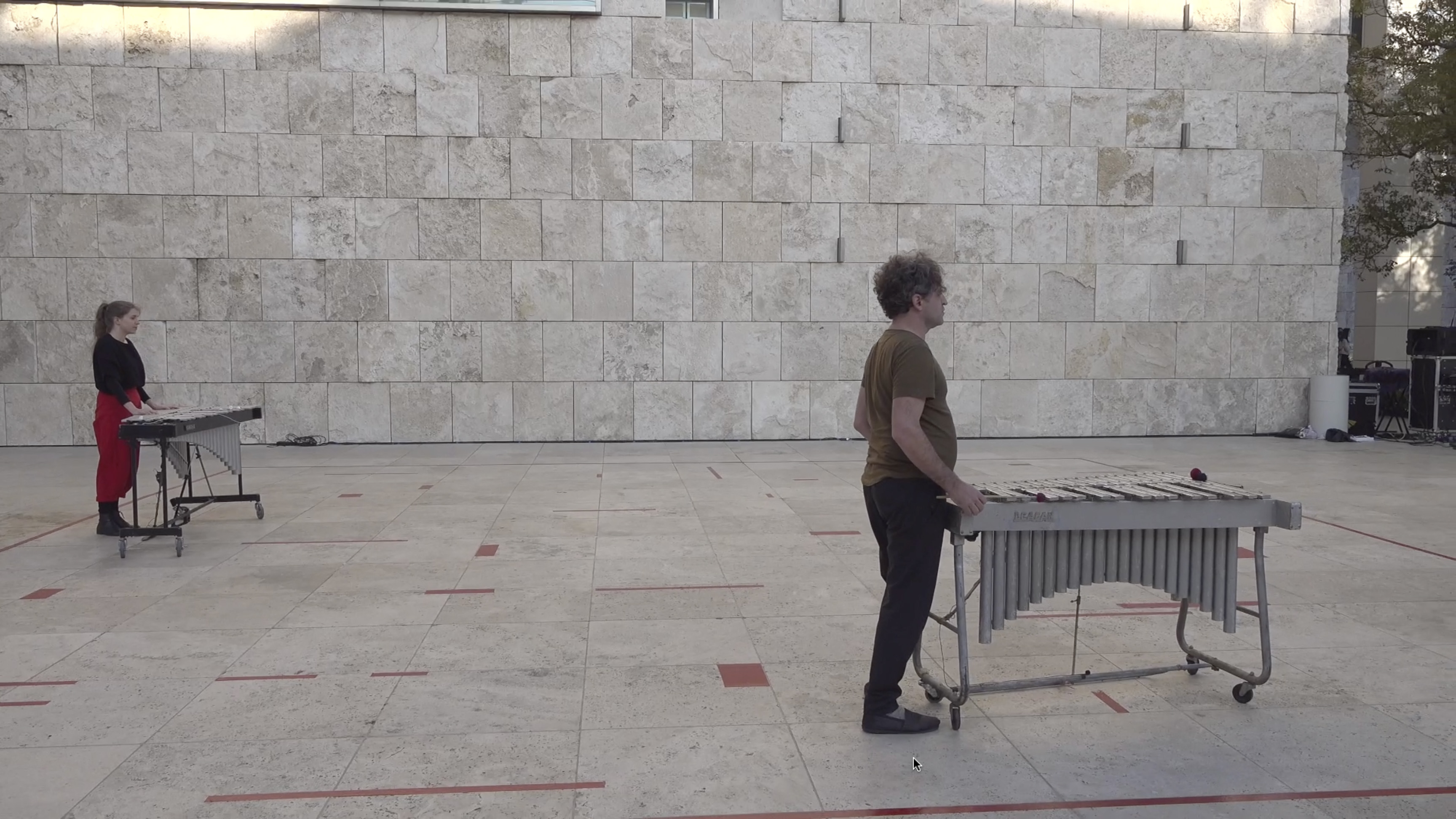
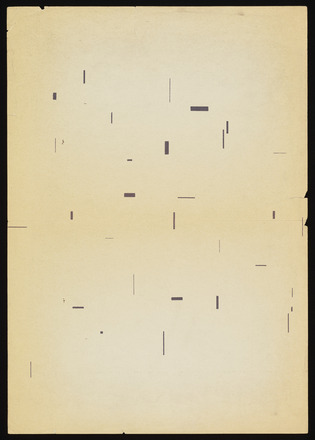
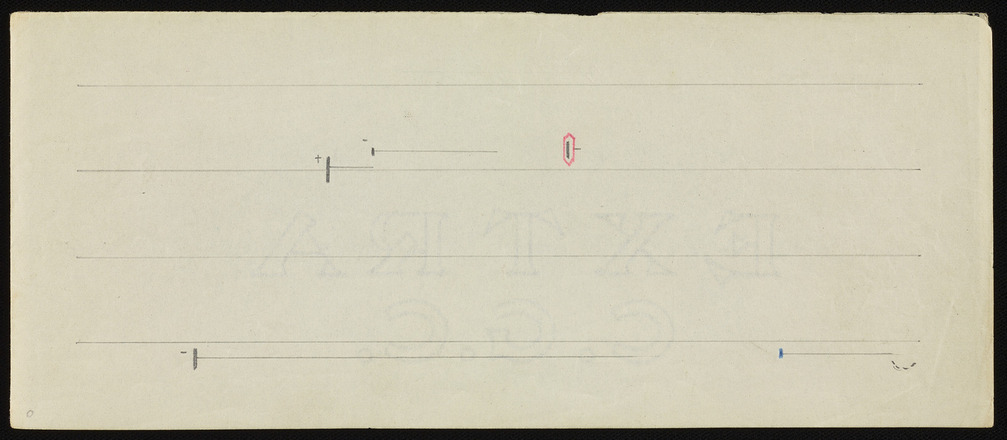
Following the length, width, and height of the score’s rectangles, this realization uses three sonic characters: dopplers, rhythmic clicks, and an arpeggiated bass. The clicks act like a net (infinitely expandable or contractible, and flexible to any topography), the dopplers are the direction and acceleration, and the bass sequences are buoys, constellating the resulting, continuously changing mass. In the same way this score can be infinitely scaled up or down (whether on a piece of paper or in the Getty’s courtyard), this “mass” travels between the extremes of spectrums: left to right, tonal to atonal, high to low frequencies, density to silence, fast to slow, rhythmic to random. By spending so much time in the extremes, this piece intends to join the poles into a circle, resisting linearity. (For example, 20 BPM and 999 BPM have more in common than with most tempos between them: the rhythm is indecipherable, and there are more durations of uniformity, whether of silence or density.) In this way, I hope to honor Earle Brown’s intention to “have elements exist in space . . . space as an infinitude of directions from an infinitude of points in space . . . [and] to work (compositionally and in performance) to right, left, back, forward, up, down, and all points between . . . [with] the score [being] a picture of this space at one instant, which must always be considered as unreal and/or transitory . . . [A] performer must set this all in motion (time), which is to say, realize that it is in motion and step into it . . . either sit and let it move or move through it at all speeds.” (Earle Brown, “Prefatory Note” [1961] to Folio and 4 Systems). —Celia Hollander
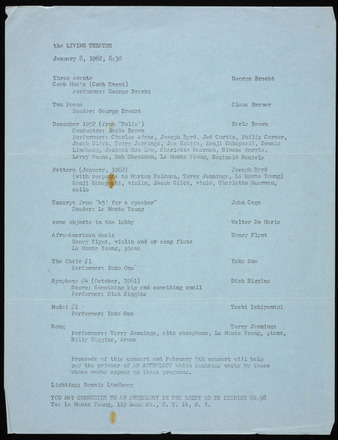
December 1952 can be found in the Getty Research Institute’s unique copy of An Anthology of Chance Operations (1962), published by Jackson Mac Low and George Maciunas and edited by La Monte Young.
Used by permission of the Earle Brown Estate.