Despite a wealth of critical writing about the photographic documentation of the choreographer Yvonne Rainer’s influential performances, surprisingly little attention has been paid to the range and complexity of her dance scores.1 In fact, the term “score” itself has been inconsistently applied to the diverse set of notations she employed to transcribe sequences of bodily actions onto the page (including typed instructions, hand-drawn directional arrows, stick-figure drawings, penciled text on graph paper, gridded boxes listing numbers of steps, and color-coded lines); these have also been called, by Rainer and others, “floorplans,” “people plans,” “sketches,” “diagrams,” “charts,” “patterns,” and “designs.”2
Throughout the 1960s, Rainer experimented with how best to capture gestures on the page. As the proliferating terms for her notational practices suggest, she never landed upon any standardized system. For Rainer, and for others involved in dance in the United States in that decade, the score operated as a tool or device that could cycle between several tenses: in one sense, it was forward-looking, functioning as a motor of composition as it suggested, ordered, and systematized motions to be performed. Rainer’s scores were also backward-facing, used retrospectively to record and preserve what had already occurred so that (reorienting once again toward the future) her dances might be remembered and repeated. An early mention of Rainer’s score-making dates from her formative summer in 1960 at Anna Halprin’s Northern California experimental dance workshop, where Rainer immersed herself in “short projects and assignments involving objects, tasks, fragmented speech or vocal sounds,” resulting in a score titled Sonata for Screen Door, Flashlight, and Dancer (1960), the soundtrack of which was created using a squeaky door hinge.3 Halprin, for her part, had a conflicted relationship to scores, noting they could be used to “generate creativity” but also cautioning that “translating a movement experience into a series of words on the page is so contrary to the kinesthetic experience.”4
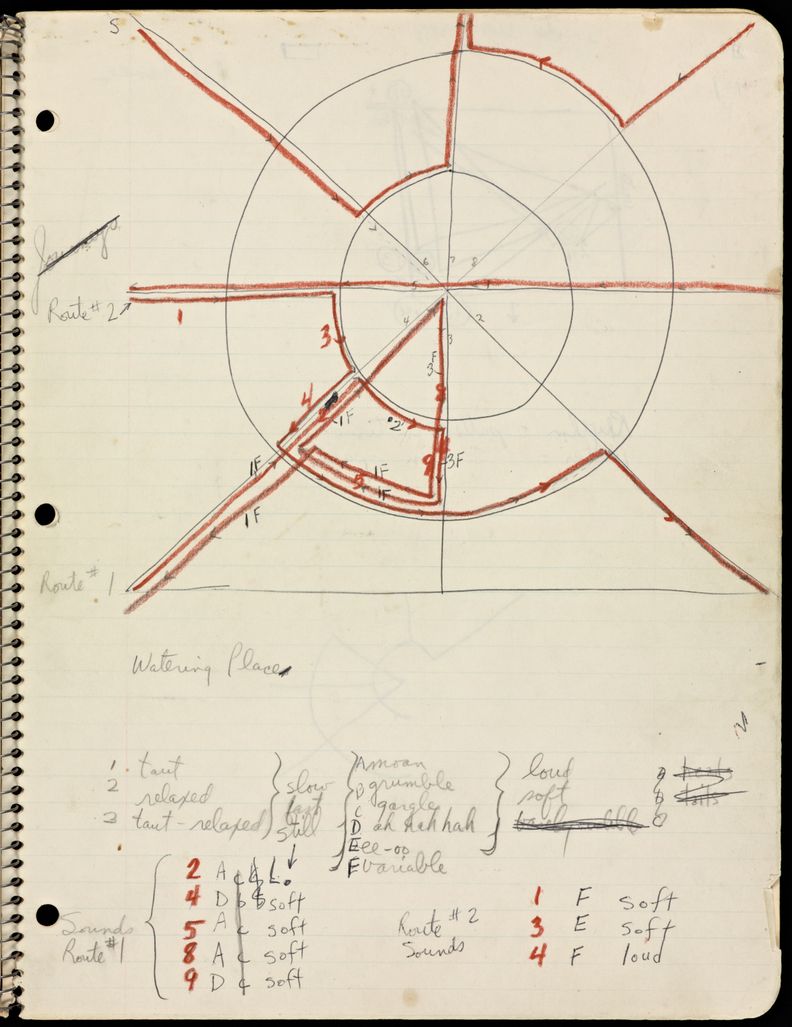
In New York in the fall of 1960, as part of Robert Dunn’s dance composition course conducted at the Merce Cunningham Studio, Rainer pored over John Cage’s musical scores and used them as springboards for her own chance-based operations. Dunn’s assignments circulated around his conviction that the score, understood capaciously as a set of written parameters or guidelines to be interpreted, opened up new possibilities for indeterminacy and could spark evolving vocabularies for movement. As he told the dance historian Sally Banes: “Graphic notation is a way of inventing the dance. It is part of the conception of the dance.”5 Within the context of Dunn’s workshop, Rainer tested out scores such as Watering Place (ca. 1960), in which two concentric circles, bisected by spoke-like radiating lines, appear to spatialize routes traveled across the floor from an aerial perspective. At the bottom of the page are further instructions regarding pace and carriage, for example “taut,” “relaxed,” and “slow” (fig. 8.1).
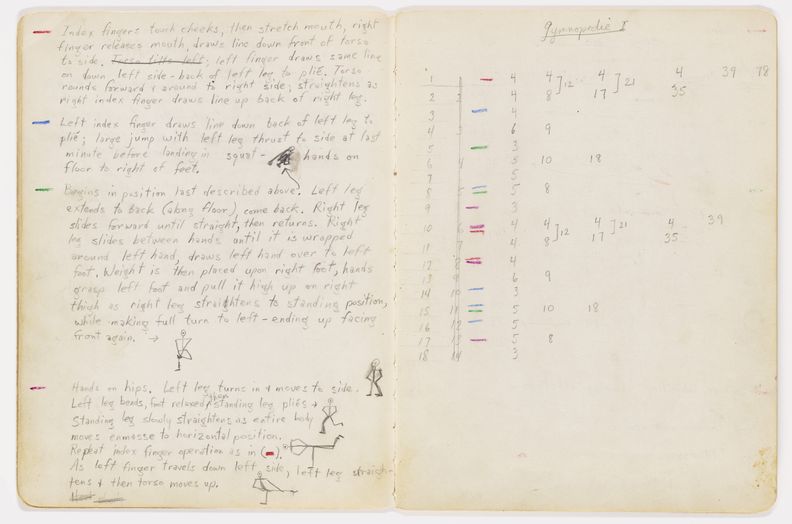
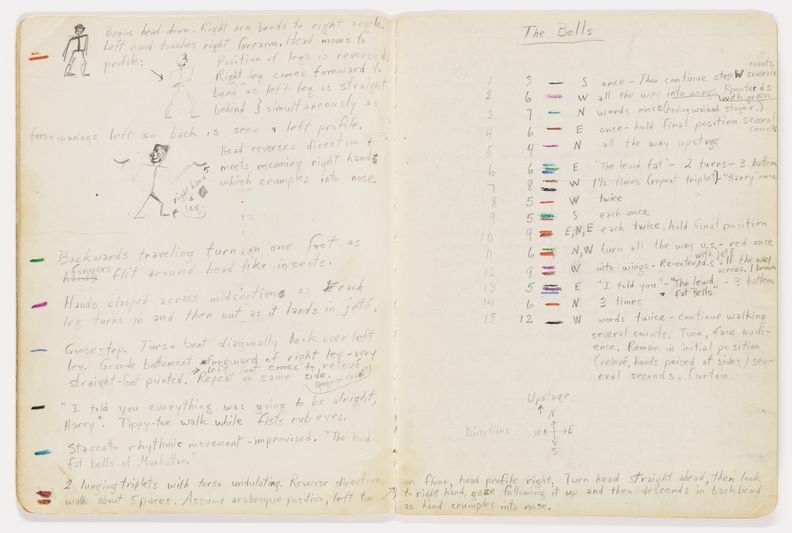
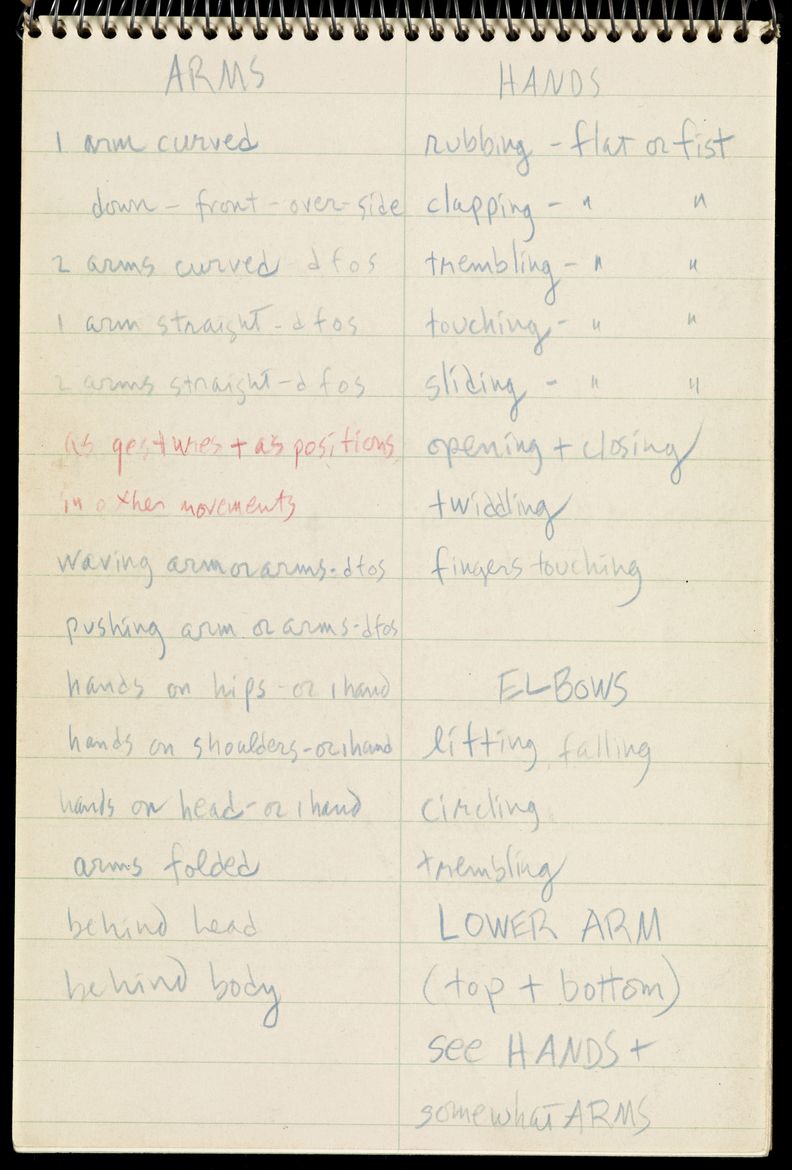
For her breakthrough solo Three Satie Spoons (1961), Rainer worked off of both Cage’s Fontana Mix (1958) and Erik Satie’s Trois Gymnopédies (1888) to produce a multimodal script that included granular textual descriptions of activities—beginning with “index fingers touch cheeks, then stretch mouth, right finger releases mouth”—together with schematic stick figures showing the arrangement of limbs and torso and with color-coded lines indicating movement phrases (fig. 8.2). She used a similar scoring strategy for a solo dance, The Bells, composed the same year (fig. 8.3). Recruiting many representational genres in these early notebooks that span the conceptual and the denotative, she used text, cardinal direction initials, numbers, drawings, and parallel lines to signal orientations, poses, and temporal units; the drawings with abstracted lines are arresting in their own right as visual objects. On other pages, she cataloged body parts (arms, hands, legs, feet) and listed accompanying action verbs—ones recognizably drawn from the repertoire of everyday life rather than ones that require specialized dance expertise—such as, for hands, “rubbing/clapping/trembling/touching/sliding” (figs. 8.4, 8.5).
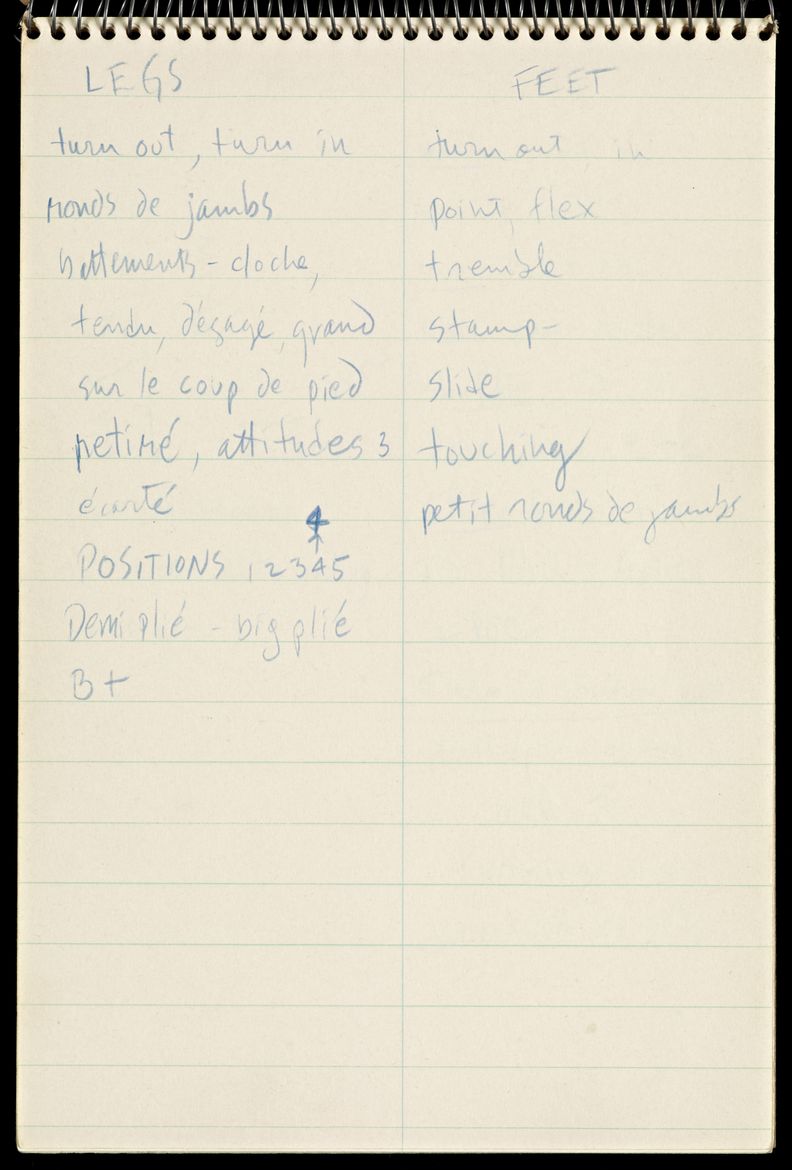
This recruitment of found motion did not mean, however, that Rainer was not concerned with subtle details and controlled execution; in fact, it was quite the contrary. “Emphasis [is] on precision of movement and following of rules rather than humor,” she wrote in her notes and draft instructions from 1962.6 These examples demonstrate how Rainer understood the score as a formal container that could strip dance of its overly expressive and narrative qualities. Indeed, dance scores in the 1960s were understood to have both practical and political implications. As Deborah Jowitt has commented: “Those with no access to studio space could bring in a dance in the form of instructions to be interpreted on the spot. But, more important, scores could undermine habit, artifice, premeditation and present both choreographers and performers in the role of problem-solvers. A score could push art-by-inspiration out of the picture and still foster an individual approach.”7 Eliminating the demand for virtuosity was viewed as a way to allow for different kinds of movement enacted by many types of bodies.
This method of providing stripped-down instructions so that others, including those not familiar with the specialized vocabularies of dance, might follow along, has continued within Rainer’s practice. In March 2020, she adapted her piece Terrain, from 1963, into a dance titled Passing and Jostling While Confined to a Small Apartment, which appeared in the New York Times as a series of written prompts and photographs for readers to enact, as a means to enliven the claustrophobic early days of the COVID-19 lockdown.8 These “rules,” as she called them, and which she emphasized must be “clear and strict,” included directions with variables such as “the walker can choose to bump, lightly, into the standing person; that’s ‘jostling,’ and it can free the standing person to get back in motion.” Performers were welcome to follow the rules in endless permutations provided they adhere to the dance’s parameters.
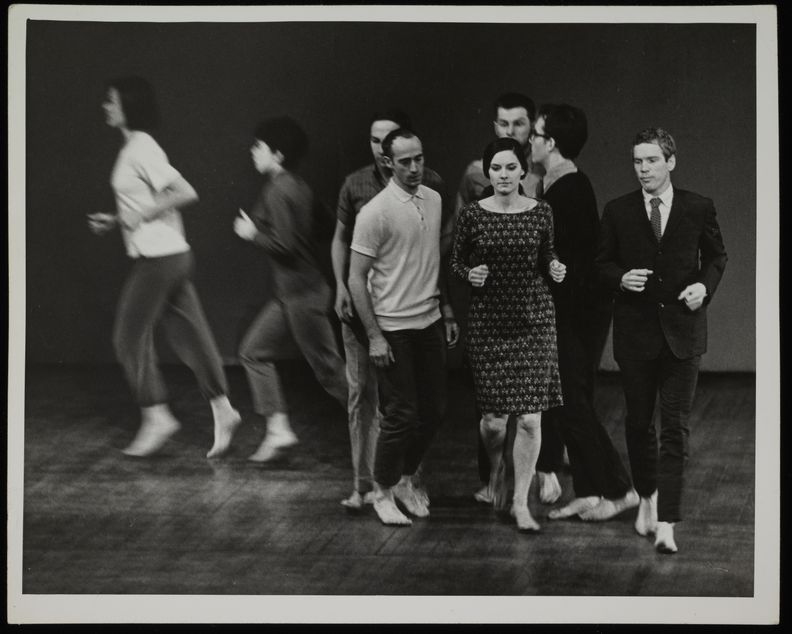
Rainer’s initial exploration of ordinary movements reached a kind of apex with We Shall Run, which premiered at the gym of New York’s Judson Memorial Church. In this dance, twelve performers—a mix of both trained and untrained dancers, all referred to in Rainer’s program notes as “runners”—first stand for about five minutes, then commence jogging with their arms at waist level in choreographed formations that cluster, splinter off, and regroup (fig. 8.6).9 The protracted stillness of the long opening minutes is contrasted by the later brisk, even cadence as the runners swarm in a mass, break apart, and gather again within constantly rearranging energetic patterns. In photographic documentation of a performance from 1965, their non-dancerly, pedestrian motions are emphasized by their sporting of bare feet and street clothes, including Alex Hay in a suit and tie, Sally Gross in a printed dress, and Deborah Hay in a T-shirt and sweatpants. We Shall Run is accompanied by a recording of the “Tuba mirum” passage of Hector Berlioz’s Requiem (1837), a swelling bombastic chorus that was meant as an ironic contrast to the laconic presentation of bodies. Yet, as Carrie Lambert-Beatty has observed, “Despite the simplicity of the jogging motion it deploys, We Shall Run is so complex as to perversely resemble the requiem’s interwoven melodies, repeating lines of text, and groupings of voices and instruments.”10 The organizational elements of We Shall Run are, in fact, notoriously complicated; though it is composed of only one basic step, this does not eliminate its difficulty. Lucinda Childs recalled that it was “hard to keep it in my head,” and Tony Holder created his own flip-card score to help him remember the sequence.11
Rainer’s pencil-on-paper scores for We Shall Run emphasize rather than reduce this difficulty. Using arrows, lines, and numbers, she turns the page into an analogue of the gym floor; she diagrams, via foot-track vectors pictured from above, how the dance sends bodies across space (figs. 8.7, 8.8, and 8.9). Such a movement map does not, however, convey other specific instructions: timing, how arms and hands should be positioned, or where the gaze should be directed. We Shall Run is an example of Rainer’s scores at their most graphically dynamic, with its assured draftsmanship of looping curlicues set against more geometric angles and neatly parallel channels fanning out like fingers on a splayed hand. A scrawled tangle of lines—a mistake seemingly crossed out in haste—is redrawn just below as a careful spiral (see fig. 8.8). Certain clear shorthands that appear here recur across other scores, such as the small letters DS, indicating downstage.
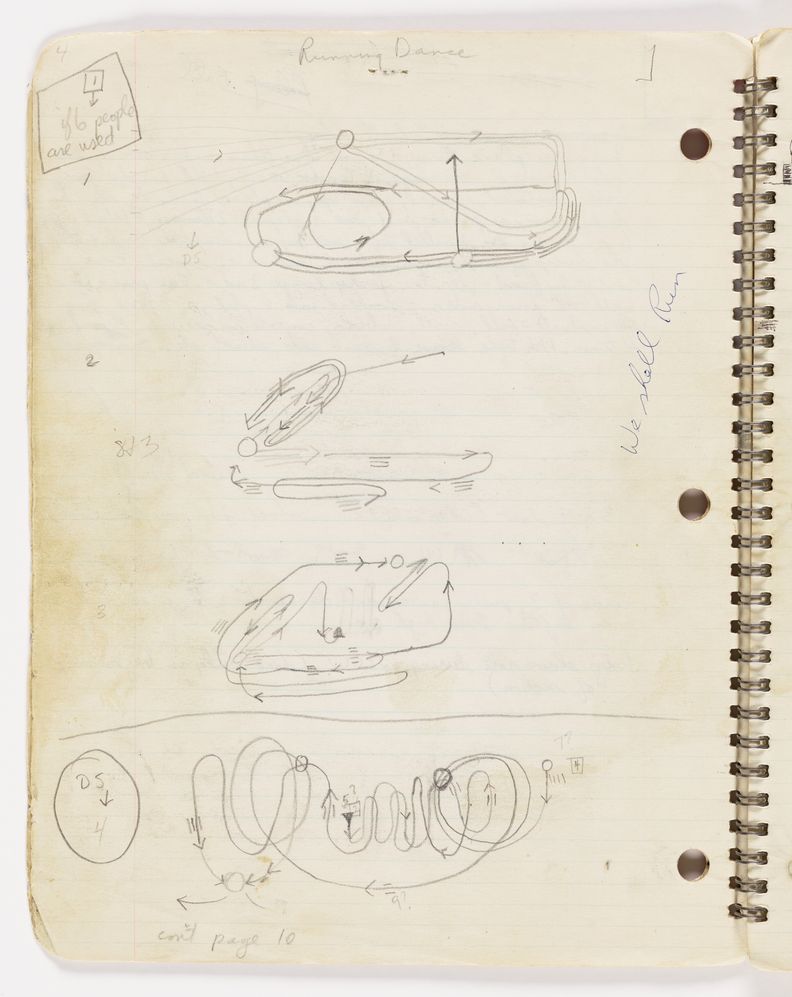
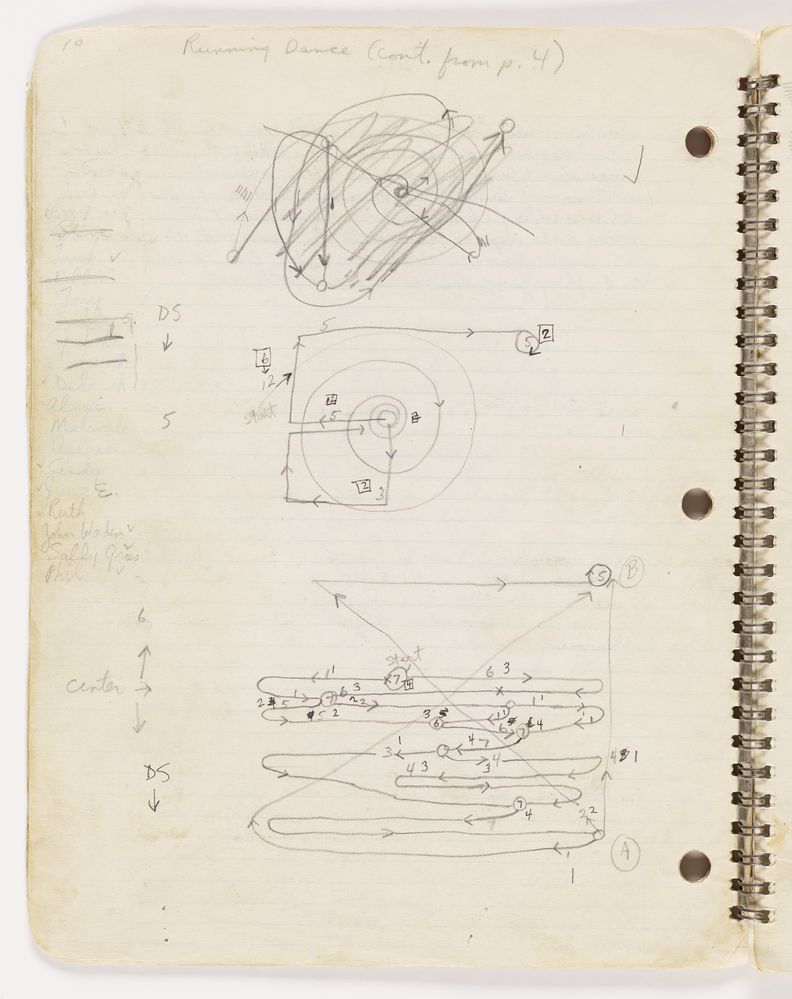
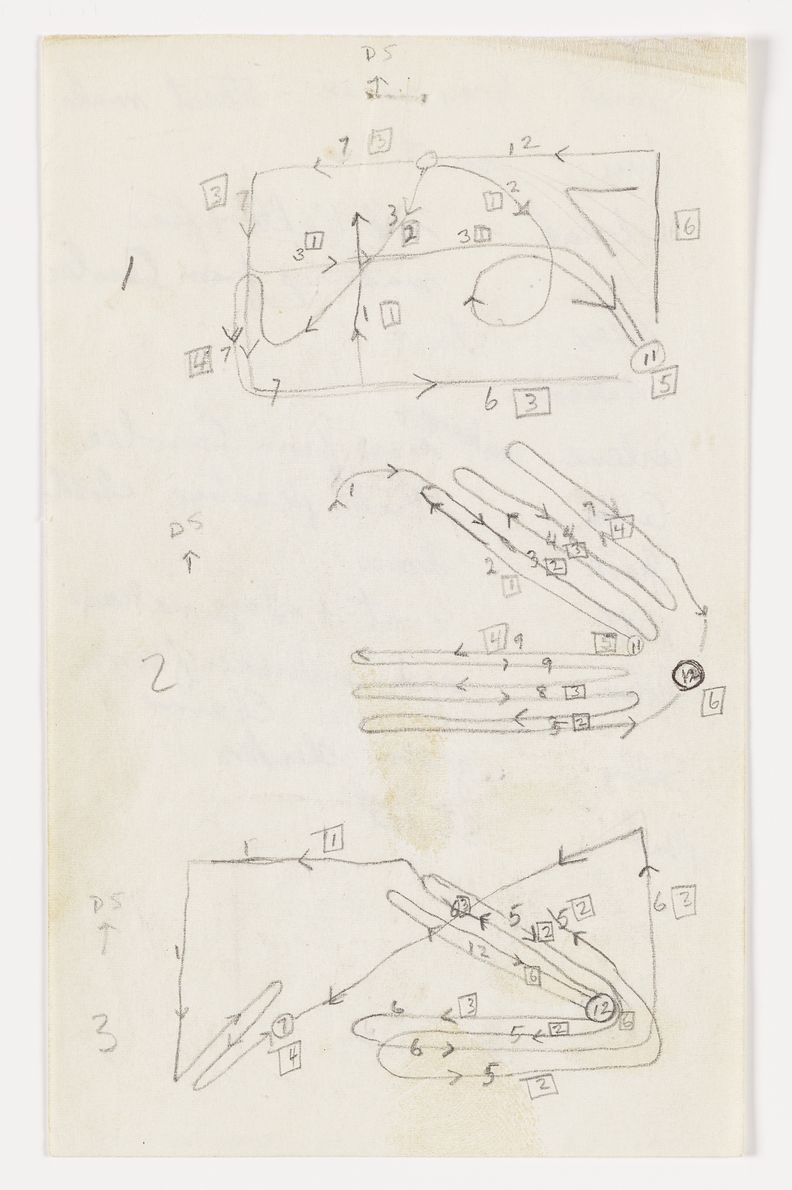
It is worth stressing that Rainer’s scores are by and large not autonomous or transparent; most cannot be picked up and performed correctly on the basis of what is on the page alone. While her written instructions or rules for game-like pieces such as Passing and Jostling can effectively convey her dances, the sketches, charts, and maps are usually not technical drawings that can be used as faithful guides by themselves. For Rainer, such barely denotative jottings indicate that the score functioned conceptually as a broad methodology rather than as a narrowly pedagogical or utilitarian aid. The floorplans for We Shall Run and a later, related dance—the “running” section of Rainer’s Trio B (1968), which uses similar arrows and numbers to indicate how many steps to take in any one direction—retain a large measure of ambiguity and uncertainty, if not actual illegibility with regard to how their procedures or directives might be adequately followed. How can the four elements of durational dance (space, time, force, and shape) be comprehensively translated onto a two-dimensional surface? These notations must be supplemented by moving-image documentation, oral instruction, or other bodily modes of transmission, as well as refined in rehearsals. Because of this they do not as readily circulate to be performed by others as do those scores that can be replicated and distributed with relative ease (such as musical notes on paper). Though Rainer has stated that “in some cases, the scores are indecipherable; in other cases, they will produce the dance accurately,” far fewer of her scores belong in the latter category, in part because she never adheres to any consistent scoring structure.12
In this, Rainer is hardly unique. As the dance historian Mark Franko states, there is no single, widely embraced notational system for contemporary dance.13 Even the Laban system (a standardized vocabulary for notating human movement that has been used to document dance since 1940 by the Dance Notation Bureau) has been viewed as insufficient; Merce Cunningham called it “out of whack,” dismissing it as “symbol syndrome.”14 Rainer, like Halprin and Cunningham before her, has expressed skepticism regarding notation for reconstructing her dances, not least because of the deficits of Labanotation for her iconic dance Trio A (1966).15 In part because the contemporary dance sphere has not regularized its scoring practices, it has infrequently interfaced with the legal apparatus of copyright or with the publication networks that distribute musical scores. “Dance notations have no precise cultural status,” remarks Laurence Louppe, having “never been the object of official interest, and even less of institutional interest.”16 Yet, when assessing the many forms that Rainer’s notations take, their improvised and makeshift quality stands out as a strength rather than a weakness. She was experimenting not only with moving bodies but also with nimbly creating new methods of transmission as she turned to the page for choreographing, communicating, and archiving gestures. The flexibility of her scoring practices meant that Rainer was able to test out the limits of indeterminacy in her compositions, since certain freedoms might be permitted within set parameters while others might be disallowed.
Rainer’s scores—be they patterns, lists, drawings, or maps—make apparent the fundamental frictions involved in charting motion onto the page. As she played with different methods for chronicling action, she underlined how variable the use of the score could be in post-Cagean dance. In doing so, she revealed that the model of the textual score might have been fruitful for 1960s choreographers not despite but because of the fact that it was in some ways a bad fit for dance. Its inadequacies fueled more innovation.
Notes
-
See Carrie Lambert-Beatty’s writings about the challenges of representing Rainer’s dances, especially in her seminal monographic study, Being Watched: Yvonne Rainer and the 1960s (Cambridge, MA: MIT Press, 2008). ↩︎
-
For instance, “pattern” is used to describe the pencil-and-paper version of We Shall Run in Elise Archias, The Concrete Body: Yvonne Rainer, Carolee Schneemann, Vito Acconci (New Haven, CT: Yale University Press, 2016), 54. Peter Eleey calls a very similar plan (for the first part of Trio B, ca. 1968) a “sketch” in “If You Couldn’t See Me,” in Philip Bither, Trisha Brown: So That the Audience Does Not Know Whether I Have Stopped Dancing (Minneapolis: Walker Art Center, 2008), caption for fig. 7. Lambert-Beatty refers to the graph-paper intervals of Parts of Some Sextets (1965) as both a “chart” and a “score” in Being Watched, 87–88. In her compendium Yvonne Rainer: Work 1961–73 (Halifax: Press of the Nova Scotia College of Art and Design, 1974), the artist interchangeably deploys many of these terms. ↩︎
-
Yvonne Rainer, Feelings Are Facts: A Life (Cambridge, MA: MIT Press, 2006), 193. ↩︎
-
Anna Halprin, “Scores” (1969), in Moving toward Life: Five Decades of Transformational Dance, ed. Rachel Kaplan (Hanover, NH: Wesleyan University Press, 1995), 49–50. ↩︎
-
Robert Dunn, quoted in Sally Banes, Democracy’s Body: Judson Dance Theater, 1962–1964 (Durham, NC: Duke University Press, 1993), 7. ↩︎
-
Yvonne Rainer Papers, 1871–2013, bulk 1959–2013, 2006.M.24, box 30, folder 11, Getty Research Institute, Los Angeles. ↩︎
-
Deborah Jowitt, Time and the Dancing Image (Berkeley: University of California Press, 1988), 317. ↩︎
-
Brian Seibert, “A D.I.Y. Dance for Your Home, from Yvonne Rainer,” New York Times, 24 March 2020. ↩︎
-
Published accounts differ as to the exact cast of dancers who participated in the premiere of We Shall Run. Banes’s Democracy’s Body, Rainer’s Work 1961–73, and the published program (reproduced on page 1 of Ana Janevski and Thomas J. Lax, Judson Dance Theater: The Work Is Never Done [New York: Museum of Modern Art, 2018]) offer slightly varying lists. A set of costume descriptions, held in Rainer’s papers at the Getty Research Institute and reproduced in the Archive section of this chapter, suggests this set of runners: Trisha Brown, Lucinda Childs, Philip Corner, June Ekman, Malcolm Goldstein, Sally Gross, Ruth Emerson, Alex Hay, Deborah Hay, Tony Holder, John Worden, and Arlene Rothlein. Later iterations, such as the version performed at the Wadsworth Atheneum in 1965 (see fig. 8.6), had different casts that included Rainer, Robert Rauschenberg, and Robert Morris. ↩︎
-
Carrie Lambert-Beatty, “More or Less Minimalism: Six Notes on Performance and Visual Art in the 1960s,” in A Minimal Future? Art as Object 1958–1968, ed. Ann Goldstein (Cambridge, MA: MIT Press / LA MOCA, 2004), 109. ↩︎
-
Banes, Democracy’s Body, 87. ↩︎
-
Interview with Yvonne Rainer in In Terms of Performance, ed. Shannon Jackson and Paula Marincola (Philadelphia: Pew Center for Arts & Heritage, 2016), http://intermsofperformance.site/interviews/yvonne-rainer. ↩︎
-
Mark Franko, “Writing for the Body: Notation, Reconstruction, and Reinvention in Dance,” Common Knowledge 17, no. 2 (2011): 321–34. ↩︎
-
Ann Hutchinson Guest, Labanotation: The System of Analyzing and Recording Movement (New York: Theatre Arts Books, 1954); and Merce Cunningham, Changes (New York: Something Else Press, 1968), n.p. ↩︎
-
Yvonne Rainer, “Trio A: Genealogy, Documentation, Notation,” Dance Research Journal 41, no. 2 (2009): 12–18. In 2008, I learned Trio A from Rainer in lessons that focused on oral directions, hands-on demonstrations, and the building of muscle memory through practice. Though I did watch moving-image recordings of her performing the dance for reference, at no point did she consult written documents or scores. See Julia Bryan-Wilson, “Practicing Trio A,” October 140 (Spring 2012): 54–74. ↩︎
-
Laurence Louppe, ed., Traces of Dance: Drawings and Notations of Choreographers, trans. Brian Holmes (Paris: Editions Dis Voir, 1994), 5. ↩︎