In 1960, La Monte Young was in his third year of graduate study in composition at University of California at Berkeley, where he represented a strange hybrid of beatnik counterculture and establishment credibility. That fall, he moved to New York City on a pre-doctoral fellowship intending to study experimental music composition with John Cage at the New School for Social Research. Instead, he found Richard Maxfield, who was filling in for Cage with a course on electronic music, which Young took.1
Twenty-five years old, Young arrived on a multiyear wave of West Coast transplants that included the dancers Yvonne Rainer, Trisha Brown, and Simone Forti; musicians Terry Jennings and Joseph Byrd; artists Robert Morris and Walter De Maria; and poet Diane Wakoski.2 As a macher of the highest order, Young knew how to win friends and influence people. Within months, he was at the center of a hopping interdisciplinary arts scene that was composed of musicians, artists, dancers, and writers who were extending Cage’s aesthetic strategies. Populating one corner were the alums of Cage’s New School courses of 1956–59, who included George Brecht, Dick Higgins, Alison Knowles, Allan Kaprow, Jackson Mac Low, and many others. Another of those alums, Robert Ellis Dunn, had begun teaching Cage’s curriculum in 1960 to dancers at Merce Cunningham’s studio, then located above the Living Theatre. Such figures as Forti, Rainer, Steve Paxton, Judith Dunn, David Gordon, Trisha Brown, Elaine Summers, and Deborah Hay participated in these classes, and they would, in 1962, form the Judson Dance Theater. Many of these dancers also continued to perform for the companies of Aileen Passloff and James Waring, for whom Maxfield provided musical scores. Maxfield would become fast friends with Young, who had begun to outline a strong musical aesthetic around static, complex sonic textures that invite focused listening experiences over long durations. Jennings, Terry Riley (who would pass through New York a few years later), and Dennis Johnson (who had stayed in California) shared this aesthetic, as well as Young’s experience with and commitment to various forms of improvised music, chief among them African American and South Asian variants. (The bumping salon centered on Amiri Baraka’s Cooper Square loft and the Five Spot Café had fewer overlaps with this white avant-garde, though collaborations and exchanges did occur.)
Young’s other side—conceptual, anti-art, obsessed with the new—found common cause with such individuals as Morris, De Maria, and Henry Flynt. They sought to distinguish themselves from the older crowd, but those forerunners could still be found at their concerts, openings, and parties: not just Cage and Cunningham but also the composer Earle Brown, Cunningham dancer Carolyn Brown, pianist David Tudor (who would soon begin performing Young’s work in Europe), artist Robert Rauschenberg (who would involve himself with Judson Dance Theater a few years later), and composer Toshi Ichiyanagi.
All these cliques bounced off one another at events in downtown New York. In a letter to Anna Halprin in California, Forti wrote, “N.Y. is full of little ‘movements’ who hate each other and who consider each other’s work worthless.”3 But they showed up and took in concerts that Young organized at Yoko Ono and Toshi Ichiyanagi’s loft on Chambers Street, where Forti, Flynt, Jennings, Byrd, Mac Low, Maxfield, Morris, Dennis Lindberg, and Young himself presented their work from December 1960 to June 1961. They showed up at the Reuben Gallery, where Brecht presented his “events” and Kaprow and Robert Whitman produced some of their big “happenings,” and where Forti debuted Rollers and See-Saw in late 1960.4 And they showed up at AG Gallery on Madison Avenue, where co-owners Almus Salcius and George Maciunas produced several series of concerts and readings in 1961. Their corny “modern art” taste was roundly criticized at the time—“ghastly,” as Cage put it in a letter to Tudor—but Maciunas, in particular, came around quick to the new sensibility.5 From May to July 1961, AG Gallery had presented works, readings, and entire evenings by Cage, Higgins, Mac Low, Ichiyanagi, Byrd, Young, Flynt, De Maria, Morris, Baraka, Diane di Prima, and the artist Ray Johnson.
Amid all this hustle and bustle, Chester Anderson, the San Francisco poet who edited the small zine Beatitude, invited Young to guest edit a special New York version of the journal that Anderson was calling Beatitude East. The composer subsequently spent late 1960 and early 1961 gathering materials from his extensive contacts, many of whom are named above. He had also written to some poets he had met during his visit to the international summer course in new music at Darmstadt in 1959: Emmett Williams, Dieter Roth (a.k.a. Diter Rot), and Claus Bremer.6 The manuscript he assembled became AN ANTHOLOGY of chance operations concept art anti-art indeterminacy improvisation meaningless work natural disasters plans of action stories diagrams music poetry essays dance constructions mathematics compositions.
But by late spring of 1961, Beatitude had gone belly up, and Anderson had disappeared with the materials. He finally returned the collection that June, when Young and Mac Low were at AG Gallery having their photographs taken for promotional materials. Upon hearing Mac Low’s account of the ill-fated magazine issue, Maciunas offered to publish the book himself. That September, Maciunas designed the distinctive cover and front matter (figs. 5.1, 5.2, and 5.3), as well as the individual title pages for each artist entry. (Note how almost every name on an artist title page retains its original position on the page listing all of the contributors [figs. 5.4, 5.5]).
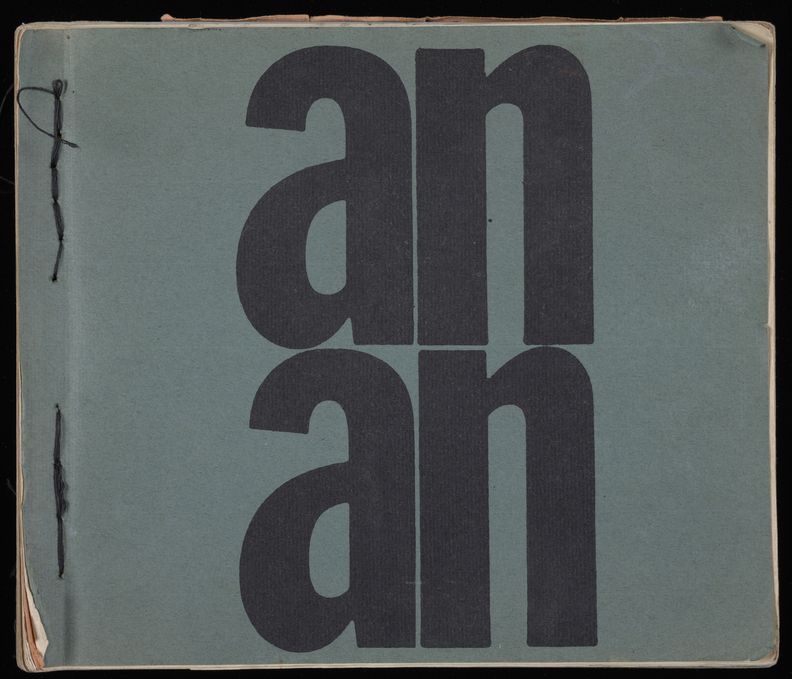
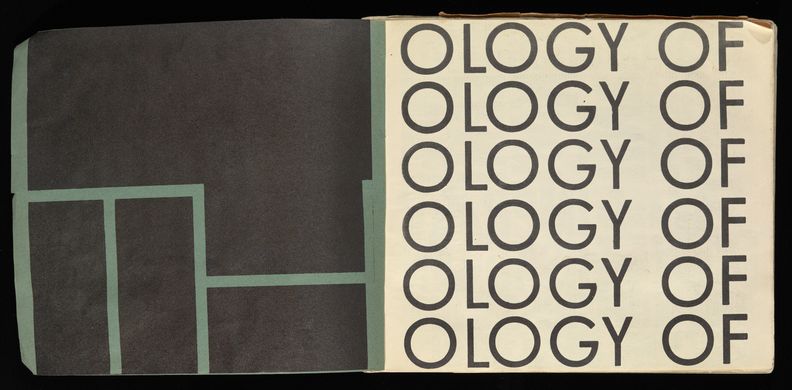
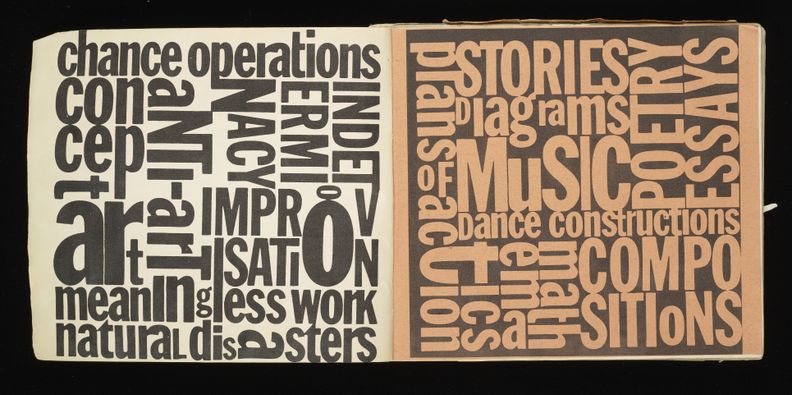
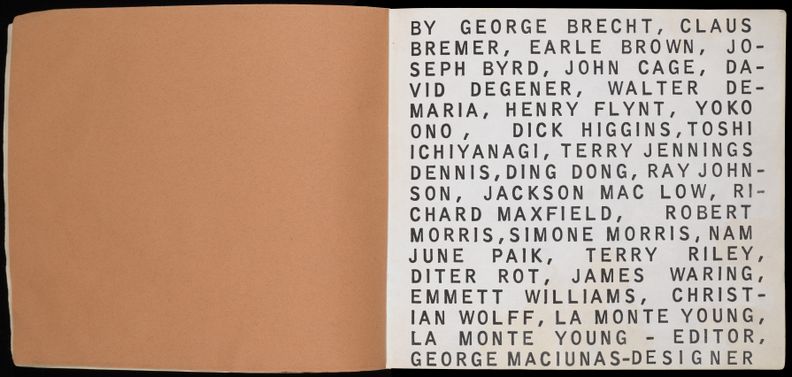
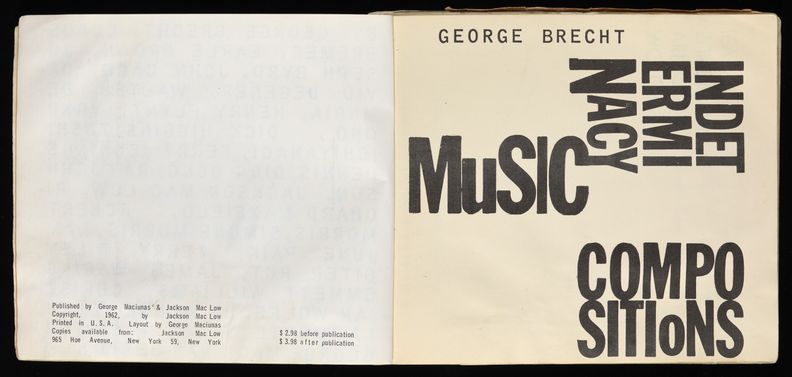
By then, Mac Low had joined the production team, typing up many of the contributions, correcting negatives, and handling communications with the printer. Maciunas, meanwhile, had left the country to take a design job with the U.S. military in Wiesbaden, West Germany, so Mac Low and Young hustled to find funds. They held two benefit concerts in early 1962 featuring many of the contributors to the volume; these events took place at the Living Theatre, whose Sixth Avenue premises had been recently redesigned by the architect and patron Paul Williams. (Williams was also the planner of the Gate Hill Cooperative outside of Stony Point, New York, where Cage, Tudor, M. C. Richards, and several others lived during the 1950s and 60s; Cage dedicated Williams Mix [1951–53] to him). Williams eventually paid the outstanding printing bill for An Anthology, but he asked that copyright on the final publication be held by both Young and Mac Low, to which condition Maciunas agreed. In the end, therefore, we say that Young edited it, Maciunas designed it, and Young and Mac Low copublished it. An Anthology was finally released in an edition of between seven hundred and nine hundred copies on the second weekend of May 1963.
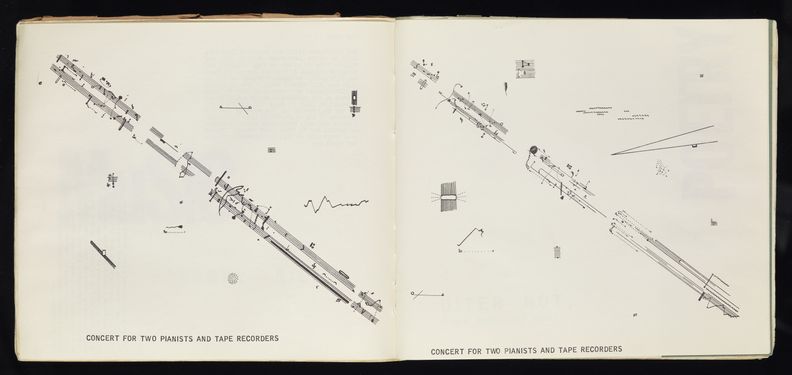
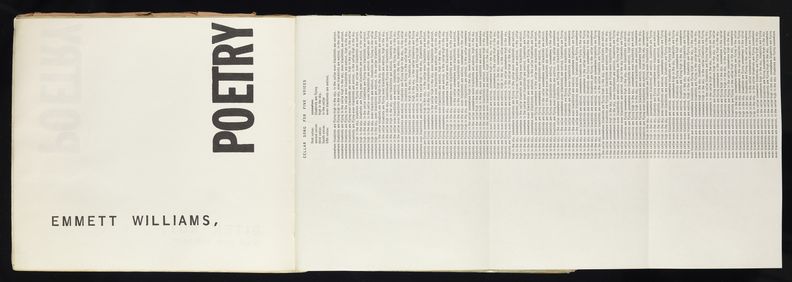
As its full title suggests, the book contains a haphazard miscellany. There is notated music for conventional recital performance—even if that music is indeterminate in nature—by Byrd, Jennings, Ichiyanagi, and Christian Wolff. Terry Riley contributed a lovely work of graphic notation titled Concert for Two Pianists and Tape Recorders (1960) (fig. 5.6), though he does not include instructions for interpretation. And there is some poetry from Mac Low, Claus Bremer, and Emmett Williams, whose Cellar Song for Five Voices (ca. 1960) (fig. 5.7) was clearly intended for performance and was in fact presented at one of the benefit concerts in early 1962. There are even some more-or-less conventional essays on topics of interest at the time, such as Nam June Paik’s rather elliptical text on fixed and open form and Flynt’s foundational essay “Concept Art,” in which he outlined a field of inquiry where structure could be cleaved from aesthetic “crutches” like music and isolated as its own site of play and invention. “‘Concept art’ is first of all an art of which the material is ‘concepts,’ as the material of for ex[ample] music is sound,” he wrote. “Since ‘concepts’ are closely bound up with language, concept art is a kind of art of which the material is language.”
Maxfield’s thoughtful essays on electronic music resonated with the other concerns of An Anthology’s contributors. In “Composers, Performance and Publication,” he noted how, by working directly with new electronic tools, composers had no further need of “obsolete symbols on score paper.” As Liz Kotz and others have observed, this departure from specialized musical notation and toward other notational strategies—namely text scores but also magnetic tape—opened up musical strategies to artists working outside the discipline.7 Elsewhere during this period, Maxfield explicitly linked the aesthetic problems posed by tape recording with sculpture, which presented similar combinations of fixed media and fluid perception.8 In “Music, Electronic and Performed,” he wrote, “Even when an art object is completely fixed the aesthetic experience it induces is never the same on two different occasions.”
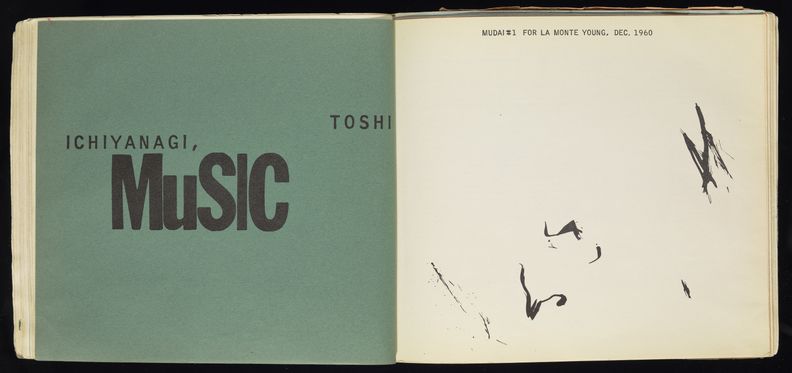
If these chapters largely remain in their own lanes, most of the other contributions support Branden Joseph’s contention that working across disciplines was the primary marker of being “advanced” after Cage.9 For example, in Yoko Ono’s contribution, To George, Poem No. 18, October 29, 1961 (1961), the line between drawing and poetry is obscured: the poem’s Japanese and English text has been almost completely covered up by a black ink wash. Likewise, Ichiyanagi’s Mudai #1 for La Monte Young, Dec. 1960 (1960) (fig. 5.8) offers a few calligraphic marks across its blank page.
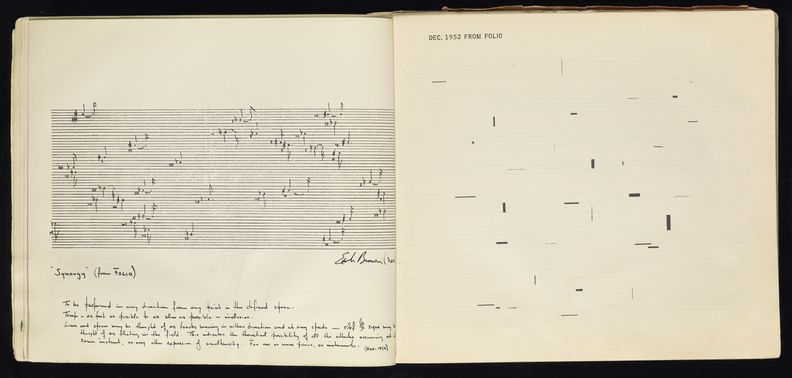
Among the more senior contributors, Earle Brown provided Young several spreads from Twenty-Five Pages (1953) and two from Folio and 4 Systems (1954), including the sublime graphic December 1952 (fig. 5.9), which, in its early departure from conventional music notation, opened up a route to the myriad uses of the score format that can be found elsewhere in An Anthology.
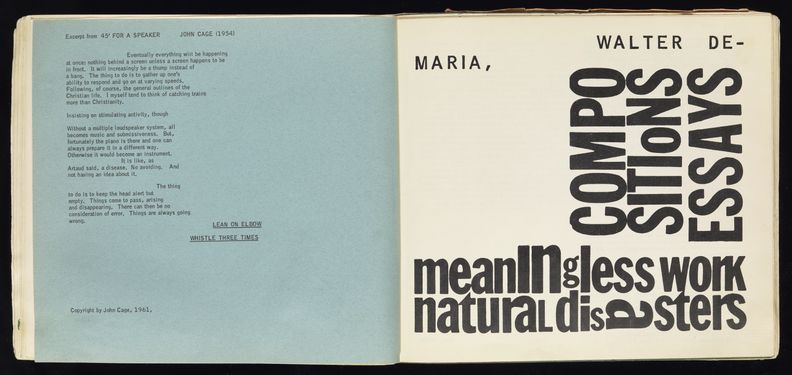
Even Cage’s 45′ for a Speaker (1954) (fig. 5.10) represents an early example of post-disciplinary performance that is rarely noted as such. Is it music, an expository lecture, or a monologue? The work relishes in this ambiguity about category.
A cluster of Cage’s students from the New School courses contributed text scores and events to the volume. In fact, the score for Brecht’s first large event, Motor Vehicle Sundown (Event) (1960), appears in An Anthology, along with two more text pieces by him for performers who respond sonically to standard playing cards distributed by a dealer. The little section of An Anthology titled “Paragraphs, Quotations and Lists” he includes after these text scores reiterates the Neo-Dada project of joining art and life. The two pieces by Higgins are similar to Brecht’s text scores, with a set of common items and a series of directions for how to manipulate them. In his own section (at nineteen pages, the longest in the publication), Mac Low included chance-derived poetry and prose, as well as scores for textual performances.
Three of Walter De Maria’s text scores distinguish themselves by producing objects rather than events—boxes or a column, for example (more about this in a moment). A fourth piece, Beach Crawl (1960), lays out a precise process for a group performance at the seashore that ends with participants shouting, “Well, that’s new, isn’t it?” This fixation on novelty extended to De Maria’s essay “Meaningless Work,” which reveals an interest—strongly shared at the time with Flynt—for new modalities of experience that could not be reduced to art, music, labor, or entertainment.
The collection has achieved historical significance for a few reasons. The first is its presentation of work that would later be construed as representative of musical minimalism, sculptural minimalism, postmodern dance, sound poetry, event scores, Fluxus, graphic notation, concept art, and even a certain strain of electronic music. The document is dense with history. It is also an uncertain textual object: What are you supposed to do with it? As Liz Kotz has documented, Maciunas spent much of 1962 trying to convince Young and Mac Low to produce the book with handmade, artisanal touches, like covers made of canvas or cardboard. The pair refused his innovative ideas. “You may want a book that will disappear as rapidly as an Allen [sic] Kaprow environment,” wrote Mac Low to Maciunas in early 1962. “We want one that will last awhile at least to be at least a semi-permanent record of our work.”10 Mac Low may have longed for permanence, but that didn’t require fixity; as Maciunas realized, a book could do more than record and preserve. Dieter Roth’s black page with holes (1961), unfortunately absent from the Getty Research Institute’s 1962 copy, exemplifies this tension. A detachable sheet of white card stock (black stock turned out to be expensive and hard to find) with ten holes of two sizes, it is intended to be placed over any page of text. The words peeping through the holes then become a kind of found poetry. Ultimately, the piece is a work of book art as well as a technology for reading any book and transforming it into new poetic texts.
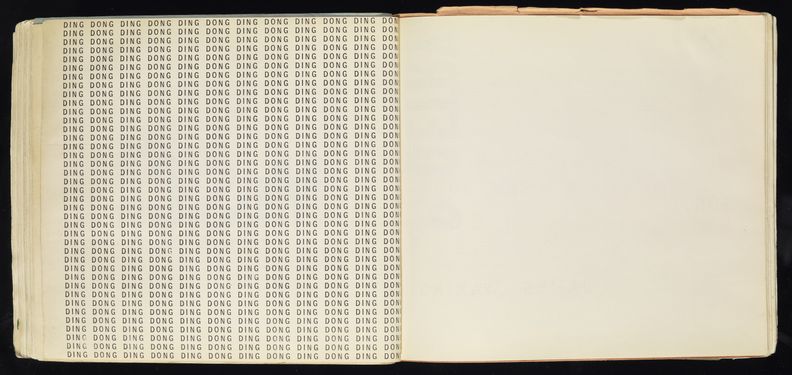
Maciunas’s role in the publication should not be overstated. His distinctive typographic style stamps the book with an easily recognized graphic identity, but it was Young who organized the contents. Maciunas did slip in a characteristic typographical intervention in the form of his (unattributed) piece Ding Dong, the title of which he inserted in the table of contents between the names Dennis Johnson and Ray Johnson.11
The text consists of a single two-beat phrase—DING DONG—repeated relentlessly across the left-hand page, margin to margin, and arranging itself into vertical columns, or stripes (fig. 5.11). Its status as proto-Fluxus is indicated not only by the droll humor and textual ambiguity (is it an instruction or a record of past action?) but also by the blank seriality of its iterative form. The ding and the dong, trading fours forever, might proliferate across a series of identical printings, or they might generate (or name) countless ringing events. In other words, the repetition of the text captures both the multiplicity of the commodity form and the singularity of performances that might escape it.
In fact, seriality is one of the most overdetermined points of tangle in the years around 1960. For the Maciunas-led offramp headed toward Fluxus, the creation of identical items in a series took the form of the multiple, or objects and boxes (Fluxboxes) filled with trinkets and distributed in small editions. As Natilee Harren has persuasively argued, the iterative logic of the score, which creates endless repetitions of the same relations in the form of events, found its sculptural corollary in Fluxus multiples. These latter are objects that you treat like scores: You handle them, you participate with them, you activate them in small private concerts.12
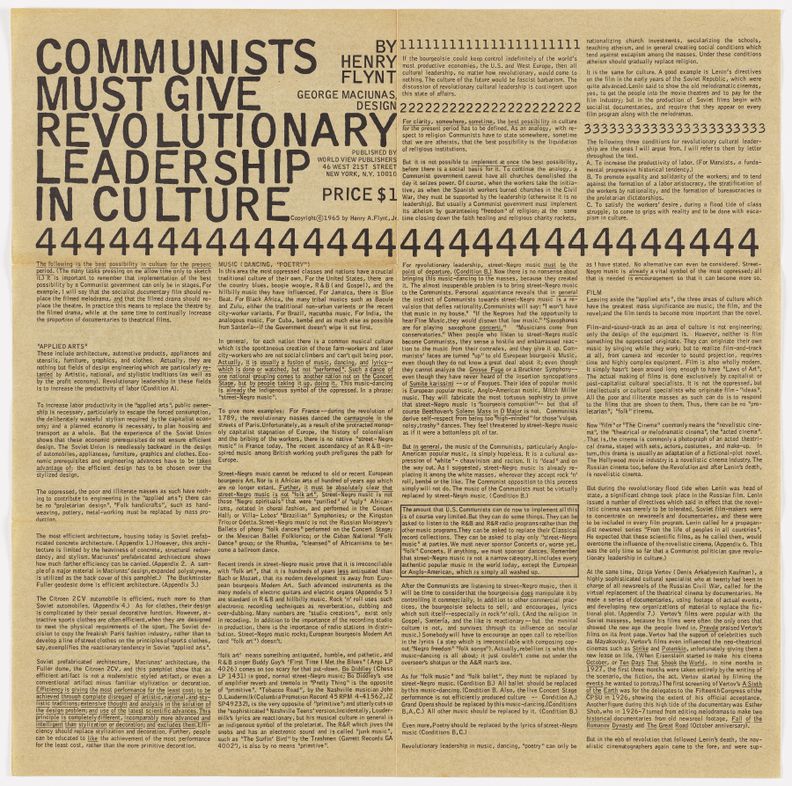
Although Fluxus multiples were handmade objects with little uniformity, they aspired to a condition of industrialized, mechanical duplication and administration. This aspiration was clear in light of Maciunas’s fascination with bureaucratic information management and its symbols, such as the filing card, the mailing label, and the taxonomic shelving system, as well as his evident belief in the powers of centralized planning, modern automation, and industrial prefabrication. For example, in his contribution to Flynt’s 1965 pamphlet Communists Must Give Revolutionary Leadership in Culture (fig. 5.12), Maciunas included plans for a “Soviet prefabricated building system” using calcium silicate insulation foam panels bonded to enamel.
Ultimately, as Harren argues, Maciunas’s slapdash forays into industrial production felt lowbrow compared with the cool sophistication of minimalist sculpture or high-gloss pop multiples.13 The modular logic of the series, however, spans these distinct aesthetic formations. If Maciunas took the series in one direction, Young took it in another, one more characteristic of what would later be called minimalism. “A minimalist work is not diminutive, and it is not underdetermined or open to ambient events. It saturates the field with uniformity or monotony,” writes Flynt. “The audience has to supply the psychological modulations.”14 In the short text called “Blank Form” (which is among the materials that Robert Morris removed from the final publication of An Anthology but that appear in the Getty Research Institute’s copy, which is a unique bound proof), Morris sketched a related project: “Art is primarily a situation in which one assumes an attitude of reacting to some of one’s awareness as art.”15
A fitting example, composed by Young in April 1960 but titled and premiered in 1961, is Arabic Numeral (Any Integer) to H. F., commonly known as X for Henry Flynt. The piece directs its performer to make any single, very loud sound—in the handwritten copy that can be found in the David Tudor Papers (box 14, folder 9), a piano cluster is indicated—and to repeat it for a certain predetermined number of iterations (which is the “Arabic numeral” in the title).16 Young requests an interval of between one and two seconds to separate the iterations, using a relatively short silence between sounds. As one commentator has pointed out, the piece demands uniformity but desires the variety that creeps in with fatigue and error.17 Suppose a pianist plans 6000 for Henry Flynt, beginning with a massive, two-armed cluster on the keyboard, played as loud as possible. By repetition number 400, she will have grown very tired. By number 3,000, she will be exhausted and barely able to carry on; her “as loud as possible” will have grown quieter. Once fatigue sets in, the pianist will begin dropping notes in the cluster. Should the next repetition match the previous imperfection, or should it attempt to return to the opening sound that was supposed to be repeated uniformly? These questions and conundrums can only be produced through the performance itself, in which the instructions laid out in the text score meet reality in the hands, ears, and body, fostering heightened awareness, assessment, and adjustment in real time. (One might call that improvisation.)
A similar arrangement of continuous pressure and small adjustment is proposed in the early version of Slant Board that Simone Forti contributed to An Anthology (wherein it appears as an untitled dance construction).18 Premiered in early 1961 at Ono’s loft, the construction was a large geometric plywood form of the type that would soon characterize the early minimalist sculptures of Forti’s husband, Robert Morris, who had built it for her following her construction plans. It was an eight-by-eight-foot platform, raised to a 45-degree angle, from which hung a few knotted ropes. Forti’s instructions direct three dancers to move across the platform, picking up and dropping ropes as necessary to adjust their balance and support. In a manner similar to that for X for Henry Flynt, Slant Board assigns a basic task to its performers, who then employ that high-pressure monotony (a 45-degree angle is not easy) to develop microscopic attention to the fine details of their bodies’ responses. This dynamic is extended into a collaborative scenario in Forti’s other dance construction for An Anthology, the earliest statement of her well-known group dance Huddle (1961).
Young himself contributed fourteen word pieces to the publication. Three of them, all from 1960, continue the proto-minimalist direction discussed above. Composition 1960 #7, the only one using musical notation, directs its performer to sound a dyad of B and F-sharp “for a long time.” Another, Composition 1960 #10 to Bob Morris, generalizes #7 into a meta-rule that dispenses with specialized notation; it reads, “Draw a straight line and follow it.” Finally, Composition 1960 #9 consists of an unlined index card with a single, heavy, straight line drawn across it. The title and directions on how to orient the card correctly are printed on the outside of an enclosing envelope that is itself pasted onto a page of An Anthology. This trio of little pieces exemplifies yet again the theme of inscriptive play across the publication: musical becomes typographic becomes graphic.
Young’s other word scores constitute a set of investigations into the limits and requirements of music as a formalized activity. Do you need an audience? An audible sound? A performer? A composer? Is the piano sufficient to qualify the event as music? What about one’s own distant memory of a sound? Can one frame natural phenomena as music? What about an imagined sound, one not present here? Can music exist in the subjunctive? This spirit of relentless questioning and expansion is threaded throughout An Anthology.
Notes
-
See Jeremy Grimshaw, Draw a Straight Line and Follow It: The Music and Mysticism of La Monte Young (New York: Oxford University Press, 2012). ↩︎
-
The description of Young’s New School colleagues draws on the following: Henry Flynt, “La Monte Young in New York, 1960–62,” in Sound and Light: La Monte Young and Marian Zazeela, ed. William Duckworth and Richard Fleming (Lewisburg, PA: Bucknell University Press, 1996), 44–97; Jackson Mac Low, “How Maciunas Met the New York Avant Garde,” in Fluxus: Today and Yesterday (Art and Design Profile 28), ed. Johan Pijnappel (London: Academy Editions, 1993); and Liz Kotz, “Poetry Machines,” in +/- 1961: Founding the Expanded Arts, ed. Julia Robinson and Christian Xatrec (Madrid: Museo Nacional Centro de Arte Reina Sofía, 2013), 50–67. ↩︎
-
Simone Forti to Anna Halprin, n.d. [early 1961], Anna Halprin Papers, box 1, folder 54, Museum of Performance + Design, San Francisco. ↩︎
-
See Virginia B. Spivey, “The Minimal Presence of Simone Forti,” Woman’s Art Journal 30, no. 1 (2009): 11–18. ↩︎
-
John Cage to David Tudor, n.d. [Summer 1961], David Tudor Papers, 980039, box 52, folder 3, Getty Research Institute, Los Angeles. ↩︎
-
Kotz, “Poetry Machines,” 65n8. Young’s correspondence indicates that he had also asked David Tudor and Hans Helms for materials. Young to David Tudor, n.d. [1961], David Tudor Papers, 980039, box 61, folder 2, Getty Research Institute, Los Angeles. ↩︎
-
Liz Kotz, Words to Be Looked At: Language in 1960s Art (Cambridge, MA: MIT Press, 2007). ↩︎
-
Richard Maxfield to Peter Yates, 3 October 1961, Peter Yates Papers, box 13, folder 6, Mandeville Special Collections, University of California, San Diego. ↩︎
-
Branden W. Joseph, Beyond the Dream Syndicate: Tony Conrad and the Arts after Cage (New York: Zone Books, 2008). See also Carrie Lambert, “More or Less Minimalism: Six Notes on Performance and Visual Art in the 1960s,” in A Minimal Future? Art as Object 1958–1968, ed. Ann Goldstein and Lisa Gabrielle Mark (Cambridge, MA: MIT Press, 2004), 103–9. ↩︎
-
Jackson Mac Low, quoted in Kotz, “Poetry Machines,” 51. ↩︎
-
Flynt, “La Monte Young in New York,” 64. ↩︎
-
Natilee Harren, Fluxus Forms: Scores, Multiples, and the Eternal Network (Chicago: University of Chicago Press, 2020), 138. ↩︎
-
As Kotz notes about the multiple, “It risks turning Minimalism into a toy, something that one would pick up and play with.” Liz Kotz, “Make an Object to Be Lost: Multiples and Minimalism,” in The Small Utopia: Ars Multiplicata (Milan: Prada Foundation, 2012), 181–89. ↩︎
-
Flynt, “La Monte Young in New York,” 67–68. ↩︎
-
La Monte Young, Jackson Mac Low, and George Maciunas, AN ANTHOLOGY of chance operations, concept art anti-art indeterminacy improvisation meaningless work natural disasters plans of action stories diagrams music poetry essays dance constructions mathematics compositions (New York: self-published, 1962), n.p. ↩︎
-
Toshi Ichiyanagi premiered the work on 14 May 1961, at Carnegie Recital Hall; David Tudor subsequently performed it at the Darmstadt Summer Course later that year. ↩︎
-
Cornelius Cardew, “On the Role of Instructions in the Performance of Indeterminate Music” (1965), in Treatise Handbook (New York: Edition Peters, 1971). ↩︎
-
For the final version of the score, see Simone Forti, Handbook in Motion (Halifax: Press of the Nova Scotia School of Design, 1974). ↩︎