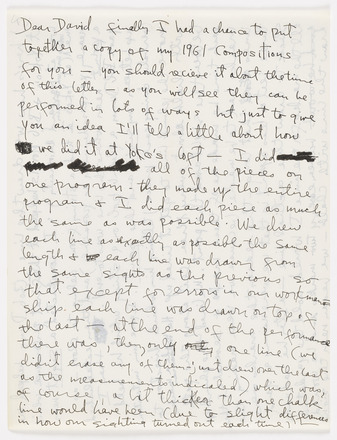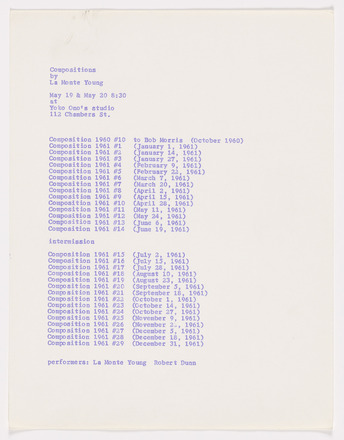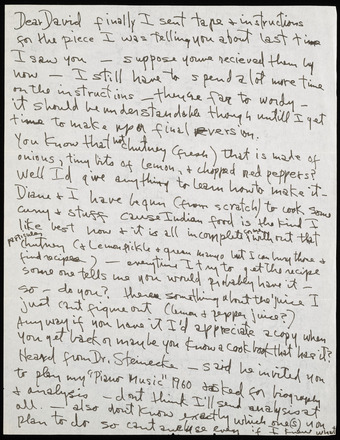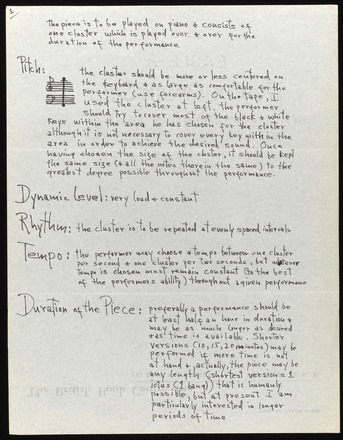
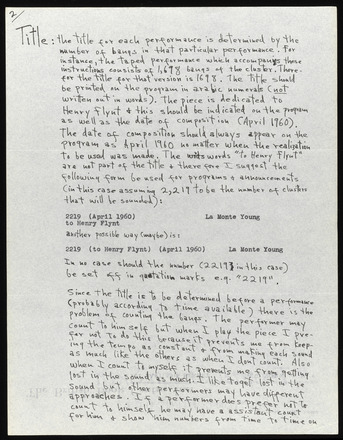
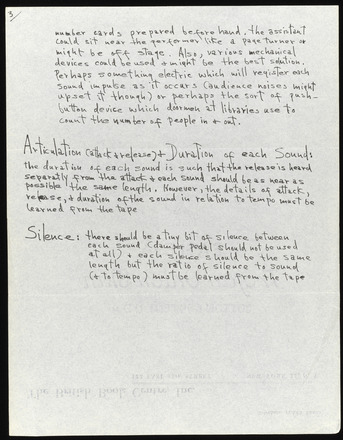
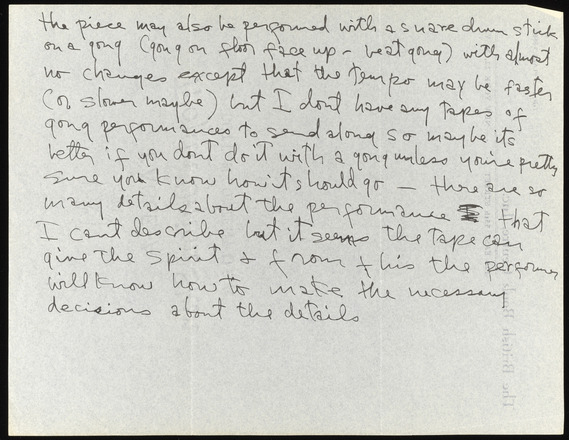
If one were to reconstruct a style history of the avant-garde of the 1950s and ’60s, one could mark this piece as an important intersection of the Neo-Dada avant-garde precipitated by John Cage, and the incipient minimalist movement that would emerge during the mid-1960s. X for Henry Flynt is a brutally monotonous series of identically spaced attacks. The original version prescribed a tone cluster on the piano to be performed exactly the same way each time. (Of course, in experiencing the piece, the imperfections between attacks inevitably attract one’s ear.) The duration is not required but encouraged to be long. (La Monte Young writes in the score: “I am particularly interested in longer periods of time.”) The “X” in the title is to be replaced by the number of attacks in that specific performance. In 1961, David Tudor famously performed 566 for Henry Flynt at Darmstadt by striking a gong with a drumstick 566 times, provoking an audience member to call an ambulance, perhaps out of irritation or concern.
© La Monte Young / MELA Foundation, Inc.