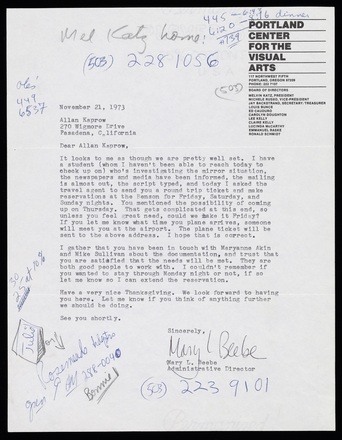
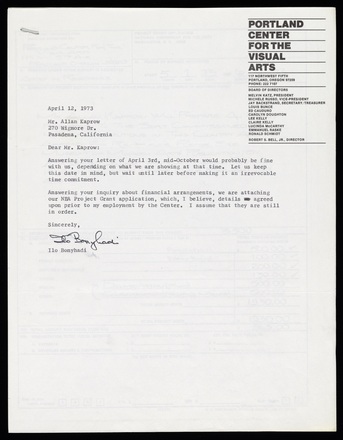
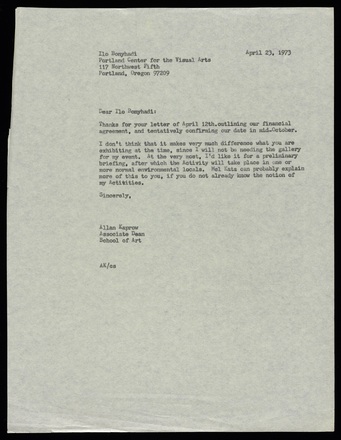
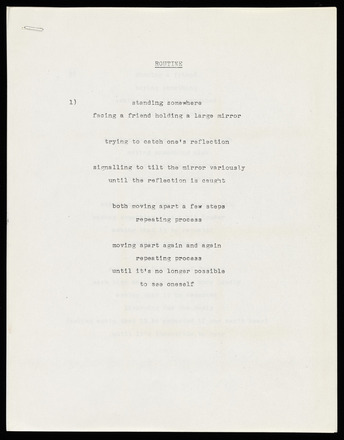
Letter from Allan Kaprow to Mary L. Beebe at the
Portland Center for the Visual Arts
Maker
Allan Kaprow (American, 1927–2006)
Date
5 November 1973
Type
correspondence
Location
Getty Research Institute, Allan Kaprow Papers, 980063,
box 24, folder 9
The Portland Center for the Visual Arts had assumed that
Kaprow would use film or video to document the performance
of the activity. Here Kaprow suggests that they will make
two different kinds of photographic texts—one a
documentary “record,” the other “the actual film, photos,
or tapes,” by which he means a scorelike instructional
film, video, or booklet. This letter also indicates how
systematic Kaprow’s activity form had become by that year.
For example, he confidently predicts that 25 percent of
those who attend his briefing will return the next day to
participate in the realization. This systematic quality of
activities is further reflected in Kaprow’s use of
standardized, uniformly available materials in his
programs, such as “pocket mirrors (3” × 4” @ 12c ea.).”
Kaprow, Allan. Letter from Allan Kaprow to Mary L.
Beebe at the Portland Center for the Visual Arts, 5
November 1973. Getty Research Institute, Allan Kaprow
Papers, 980063, box 24, folder 9. In
The Scores Project: Experimental Notation in Music,
Art, Poetry, and Dance, 1950–1975, ed. Michael Gallope, Natilee Harren, and John
Hicks. Los Angeles: Getty Research Institute, 2025.
https://www.getty.edu/publications/scores/object-index/600/.
The Scores Project
Experimental Notation in Music, Art, Poetry, and Dance, 1950–1975