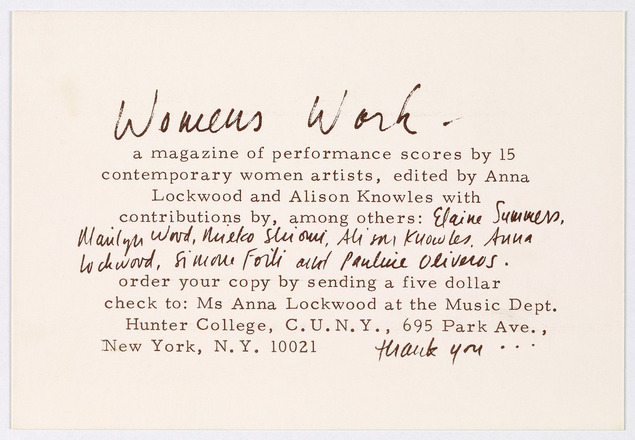
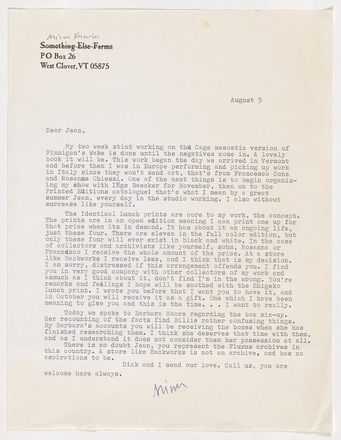
Alison Knowles’s career as an artist began before the onset of the women’s liberation movement of the 1960s. In retrospect, she and others have identified a feminist impulse in her early work that involved making and serving food. But her sense of herself as a woman artist, one who might seek out collaborations and solidarities with other women, emerged after teaching at CalArts in the early 1970s, where Judy Chicago and Miriam Schapiro developed the Feminist Art Program. As she recalled later in an interview with former student Aviva Rahmani, Knowles’s experience at CalArts “forced me to take a harder look at myself and what my own history had been” (Aviva Rahmani, “Alison Knowles: An Interview,” in M/E/A/N/I/N/G: An Anthology of Artists’ Writings, Theory, and Criticism, ed. Susan Bee and Mira Schor [Durham, NC: Duke University Press, 2000], 364). Still, Knowles remained committed to collaborating with and mentoring artists of all genders, and this led to her occasional feeling of estrangement from the Feminist Art Program, which insisted on women-only cohorts and curricula. In this letter to collector Jean Brown, written sometime after Knowles returned to New York from California, one can see Knowles’s excitement about creating both a women’s household with Bici Forbes (Nye Ffarrabas), and a women’s avant-garde publication with Anna (now Annea) Lockwood. At the same time, however, Knowles stakes a position in opposition to “the partisanship within the women’s movement.” The Womens Work magazine she pitches here came to fruition in 1975; a second issue was published in 1978.
© Alison Knowles.