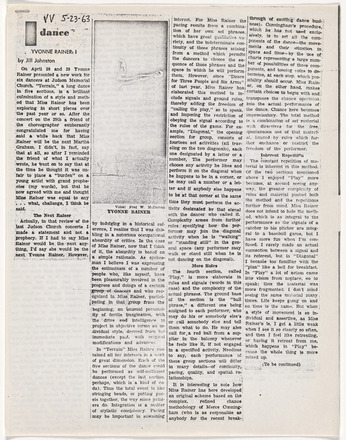
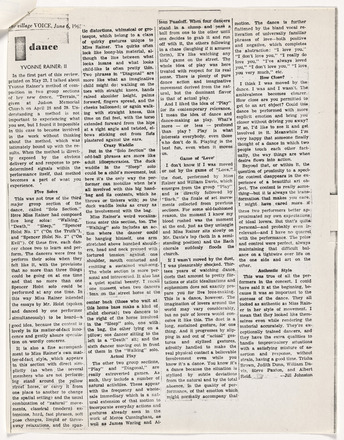
The cultural critic Jill Johnston’s extensive two-part review of Yvonne Rainer’s multi-part dance Terrain, performed at Judson Memorial Church on 28 and 29 April 1963, provides a devoted close-read of a complex work. In part one, Johnston writes, “the total event is like stringing beads, or putting panels together, the way some painters do.” She focuses on the work’s basis in an algorithmic, game-like play of following rules and signals. Rainer’s strategy, which produces slightly differing results with each performance, is informed by John Cage and Merce Cunningham’s engagements with indeterminacy and also resonates with the operations of Fluxus event scores. In part two of the review, Johnston focuses on the outcomes of Rainer’s interest in play, relating her work to that of Cunningham, James Waring, and Aileen Passloff. Rainer’s dances Play and Diagonal appear “like watching any kids’ game on the street,” Johnston writes. “The whole idea of play was here treated with respect for its real sense.” Rainer also delivered a shocking duet on the theme of lovemaking that hewed unusually close to the real act, inspiring Johnston to pose deep questions about the proximity of art and life, and the role of the viewer between them. Crucial to the success of Rainer’s work, she concludes, are the sensitive talents of the dancers working alongside her: Trisha Brown, Judith Dunn, William Davis, Steve Paxton, and Albert Reid. Rather than completely sublimating their individual way of moving to a choreographic standard, “They looked like themselves even while rendering the material accurately.”
of
More ...
461
| Title | “Yvonne Rainer: I” and “Yvonne Rainer: II,” The Village Voice |
| Maker | Jill Johnston (American, 1929–2010) |
| Date | 23 May 1963 and 6 June 1963 |
| Type | press clipping |
| Location | Getty Research Institute, Yvonne Rainer Papers, 2006.M.24, box 22, folder 4 |
Cite
Johnston, Jill. “Yvonne Rainer: I” and “Yvonne Rainer:
II,” The Village Voice, 23 May 1963 and 6
June 1963. Getty Research Institute, Yvonne Rainer
Papers, 2006.M.24, box 22, folder 4. In
The Scores Project: Experimental Notation in Music,
Art, Poetry, and Dance, 1950–1975, ed. Michael Gallope, Natilee Harren, and John
Hicks. Los Angeles: Getty Research Institute, 2025.
https://