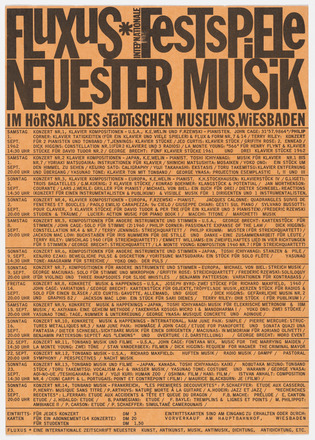
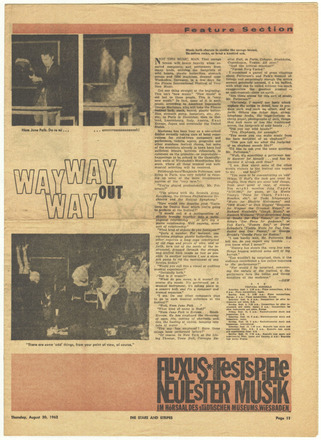
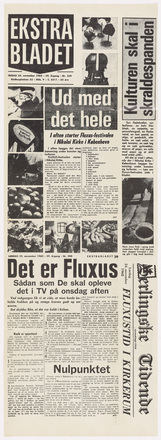
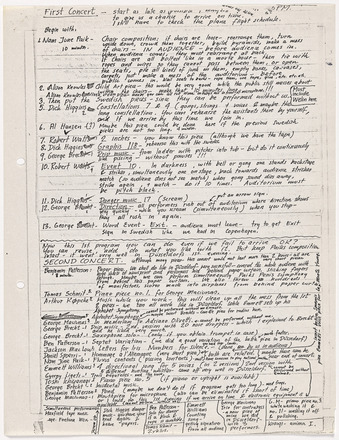
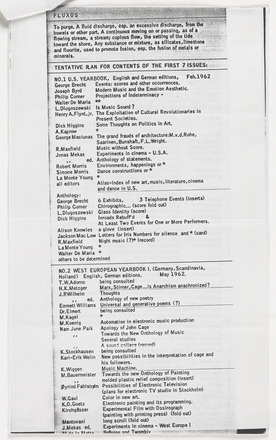
This 1962 film newsreel, broadcast on German public television, provides the earliest and most vivid documentation of Fluxus performance practices. It showcases and narrates selections from the 8 September concert of the Fluxus Internationale Festspiele Neuester Musik, held in the auditorium of the Museum Wiesbaden from 1 to 23 September. The 8 September concert included works by George Brecht, Joseph Byrd, George Maciunas, Benjamin Patterson, Dick Higgins, Jackson Mac Low, Emmett Williams, Robert Watts, La Monte Young, and Philip Corner. The performers included Maciunas, Patterson, Higgins, Williams, Alison Knowles, and Nam June Paik.
Advancing upon the increasingly theatrical works that David Tudor had introduced to Darmstadt’s Neue Musik (new music) scene, Maciunas posited the Fluxus concert program as neuester musik (newest/latest music) in a further challenge to German audiences that received divided response. The newsreel opens with a view of concert flyers defaced with the phrase “DIE IRREN SIND LOS” (the crazies are loose) and goes on to characterize the concerts’ reception as split between sympathetic comparisons to the work of Eugène Ionesco, Samuel Beckett, and Dada, and hostile analogies to headache-inducing circus antics. Indeed, the film captures a remarkable range of reactions from audience members, who express variations of pleasure, captivation, boredom, confusion, disgust, and surprise.
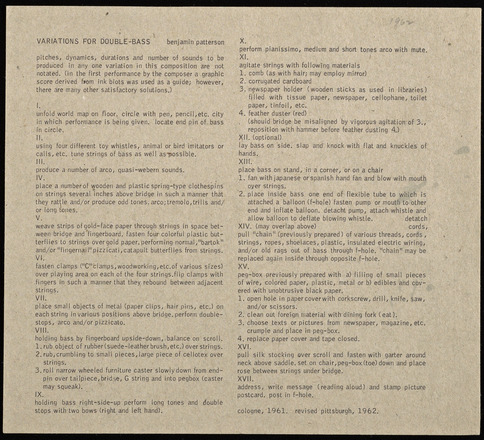
The first piece we see performed is Byrd’s Piece for Richard Maxfield (1960), in which the performers simply clap as they stand onstage. “Do we have to remain serious?” the narrator asks, imagining audience members’ thoughts. Then follows Maciunas’s In Memoriam to Adriano Olivetti Version 2 (1962) and Patterson’s Variations for Double-Bass (1961–62). Next, Williams’s Four-Directional Song of Doubt for Five Voices (1957) consists of five performers saying, in differing sequences, the words “you just never quite know.” We then see extraordinary footage of Paik performing La Monte Young’s Composition 1960 #10 to Bob Morris, which instructs, “Draw a straight line and follow it”; Paik’s realization was so singular it became known as a signature Paik piece, titled Zen for Head. The narrator highlights it as the least musical work on the program. The concert’s finale is Philip Corner’s Piano Activities (1962), in which the performers attack a piano with implements including a brick, a hammer, a tea kettle, a shoe, a feather duster, and wooden two-by-fours. This interpretation of Corner’s piece reportedly offended some Germans who valued the piano as a sacred item. Meanwhile, Maciunas claimed that the already damaged secondhand instrument would not have made it out of the theater in one piece. As the performers lug the irreparable piano offstage through the hall’s emergency exit (Notausgang), the narrator concludes: “Oh blessed Mozart, have no fear, your music may still use the main entrance.”
© Hessischer Rundfunk - www.hr.de.