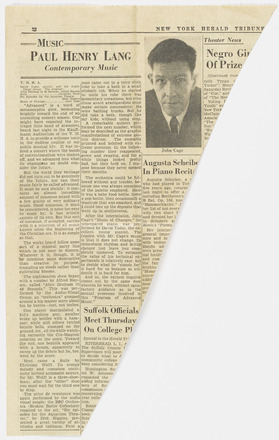
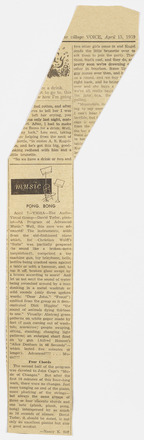
The famous critic Harold Schonberg is relatively kind to the Audio-Visual Group. He credits the artists with intelligence, while noting their bohemian appearance. The style of this review employs parataxis, almost imitating the discontinuous qualities of the performances. Unlike Paul Henry Lang’s review, Schonberg “gets” the intermedial play of having a non-musician artist like Dick Higgins take a bath onstage and perform a live “drip painting” in the manner of Jackson Pollock. He seems to have a sense of how to “enjoy” the show. Ironically, John Cage comes off as the conservative here, given David Tudor’s performance of Music of Changes (1951), an eight-year-old work for piano solo largely based in conventional notation.
335
| Title | “‘Advanced’ Music Beeps and Plinks: Experimenters Use Bottle, Ratchets, Toy Machine Gun in Concert at ‘Y,’” review of David Tudor and the Audio-Visual Group, New York Times |
| Maker | Harold C. Schonberg |
| Date | 8 April 1959 |
| Type | press clipping |
| Location | Getty Research Institute, David Tudor Papers, 980039, box 62, folder 15 |
Cite
Schonberg, Harold C. “‘Advanced’ Music Beeps and
Plinks: Experimenters Use Bottle, Ratchets, Toy
Machine Gun in Concert at ‘Y,’” review of David Tudor
and the Audio-Visual Group, New York Times, 8
April 1959. Getty Research Institute, David Tudor
Papers, 980039, box 62, folder 15. In
The Scores Project: Experimental Notation in Music,
Art, Poetry, and Dance, 1950–1975, ed. Michael Gallope, Natilee Harren, and John
Hicks. Los Angeles: Getty Research Institute, 2025.
https://