Between 1958 and 1959, around the same time George Brecht devised his first event scores (see chapter 6), Allan Kaprow developed the “happening.” Kaprow had started out as a painter and then, in the tradition of Cubism and Dada, began to affix everyday materials to his paintings. Inspired by a wide range of sources, from Jackson Pollock’s mural-size paintings to lowbrow funhouses, Kaprow’s work rapidly increased in scale from collages to three-dimensional assemblages to, finally, room-size installations he called “environments.”1 Kaprow constructed his environments out of a signature array of everyday objects (for instance, plastic drop cloths, holiday lights, tinfoil, mirrors). In his later happenings, he incorporated human participants and gave them various actions, tasks, and games to perform.
While Kaprow staged several early happenings in art galleries, he soon decided that the physical, psychological, and social coordinates of the gallery impeded the sort of participation he desired from viewers. He thus began to work in a way we would now call site-specific, meaning that he created happenings for specific non-art locations and structures. Another major shift in the poetics of the happening occurred around 1965, when Kaprow decided to “eliminate the audience” (as he put it) by working exclusively with small groups of committed participants to realize a given happening over two or more days.2 Kaprow fostered such intimacy in order to differentiate the happening from both traditional theater and youth culture (light shows, rock concerts, promotional stunts) and their purportedly more passive forms of spectatorship. In part, he was responding to the fact that, during the later 1960s, the word “happening” was becoming synonymous with spectacular events, whereas before 1965 it meant simply “occurrence.” For this reason, Kaprow largely abandoned the use of the word “happening” by the 1970s and turned instead to what he called “activities” for the rest of his career.3
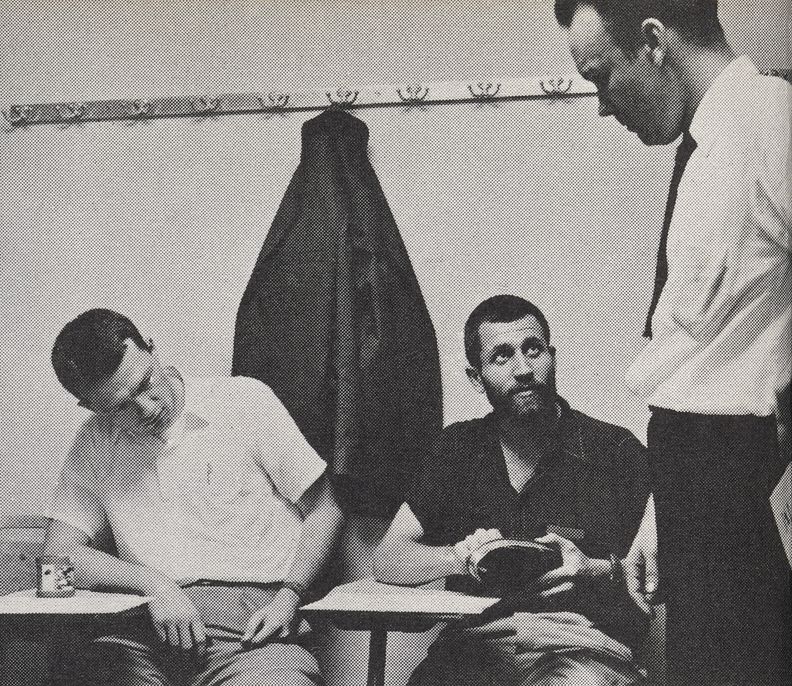
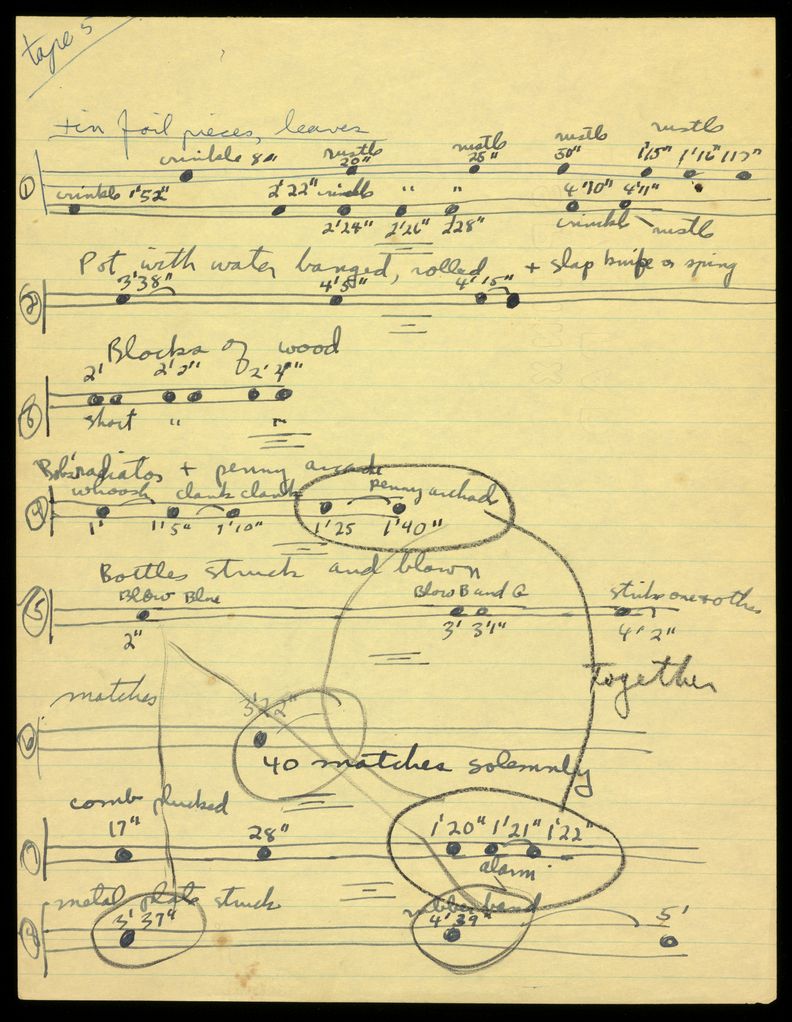
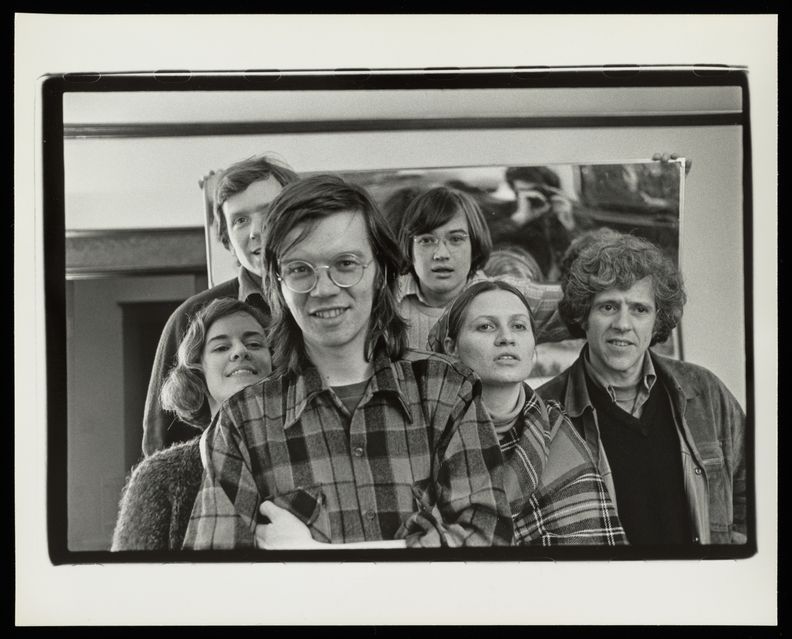
Kaprow developed a notation practice to support his work with happenings and activities. Like Brecht, he was profoundly influenced by John Cage’s experimental composition course at the New School for Social Research (fig. 11.1). By the time Kaprow started the course in late 1957, he had already experimented with sound in his assemblages and environments, notably via noise-making toys, which he hid in the corners of the Hansa Gallery’s ceiling molding.4 Frustrated by the mechanical repetition of his sonic environment, Kaprow enrolled in Cage’s class with the intention of learning how to make audiotape collages.5 Although Kaprow learned musique concrète techniques from Cage (fig. 11.2), he found Cage’s deeper philosophical lessons about indeterminacy even more productive. Cage taught that the experimental score and its performance are at once interdependent and incommensurate: where the score is abstract, the performance is concrete; where the score is fixed, every performance is different. Cage also demonstrated these ideas in a fun and participatory way in a classroom that Kaprow likened to “a playground.”6 Each week, Cage asked students to compose a short score in response to a prompt that often involved chance procedures and nontraditional instruments like radios, which he had used in some of his own compositions. The students would perform their scores for Cage during class and discuss the results, reflecting on what they had experienced.7
Kaprow’s activities can be seen to revisit the unrehearsed performances and philosophical discussions that flourished in Cage’s classroom. Of his activities, Routine is a prime example. Commissioned by Oregon’s Portland Center for the Visual Arts (PCVA) in April 1973, Routine encompasses several interlocking elements. In the fall of that year, Kaprow composed the score, which he referred to as the “program.”8 During a three-day residency at the PCVA in December, he realized the program with twenty or so different pairs of participants. The realizations took place on a Saturday afternoon and were bookended by what he called a “briefing” on Friday evening and a “review” on Saturday evening. In the remaining available time on Friday and Sunday, Kaprow also produced a version of Routine in the form of a short instructional film. Finally, two years later, Kaprow published Routine as an “activity booklet” that included the program, photographs, and an accompanying essay.
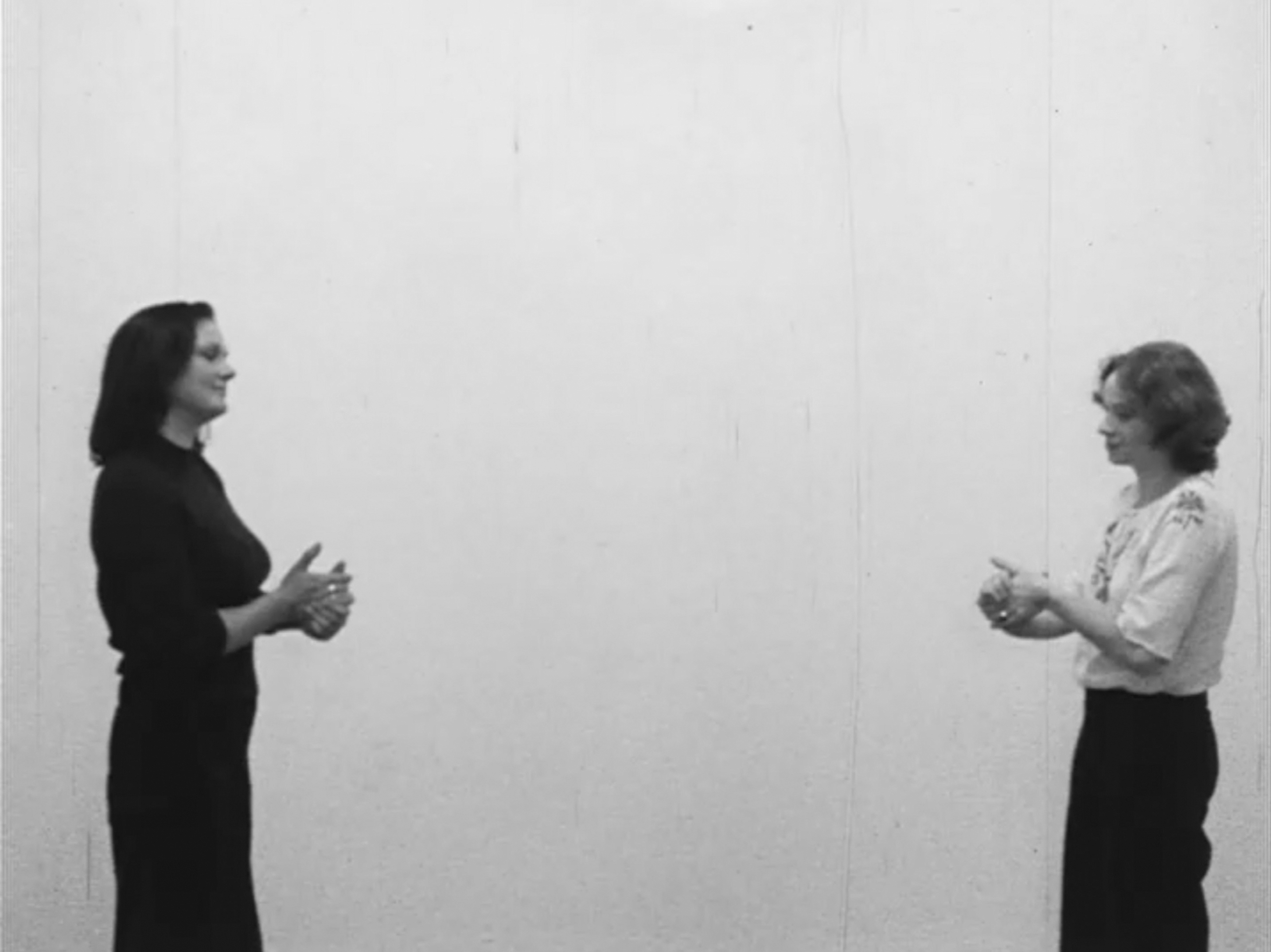
Over the course of Routine’s five parts, Kaprow uses ordinary objects to isolate and scramble visual and aural communication channels. In parts 1, 3, and 5, the two participants look at each other in mirrors; in parts 2, 4, and 5, they speak over the phone. In each part, participants alternate and repeat routine gestures and phrases to the point of illegibility, inaudibility, or exhaustion and interact with each other in both intimate and socially awkward ways. Over the course of each part, communication becomes more and more difficult as the various tasks become further abstracted, inducing moments of self-conscious reflection.
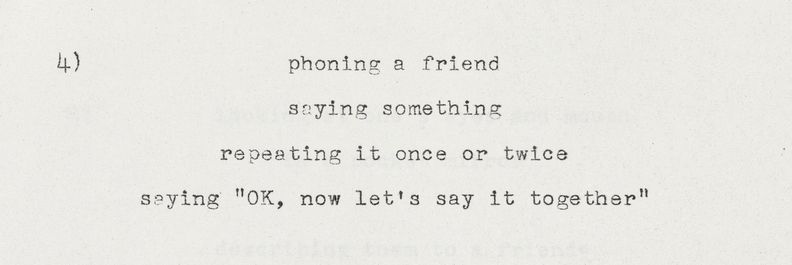
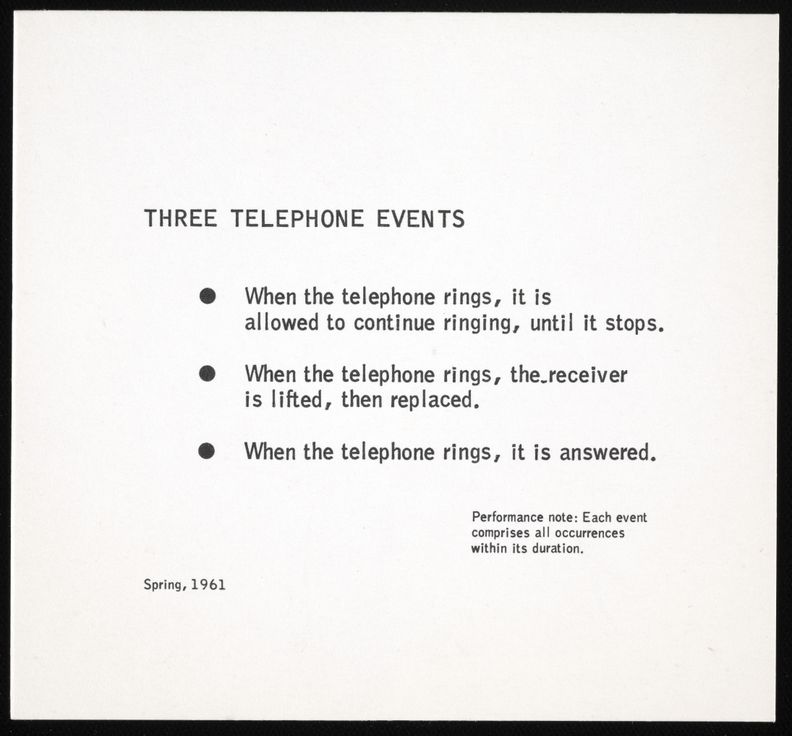
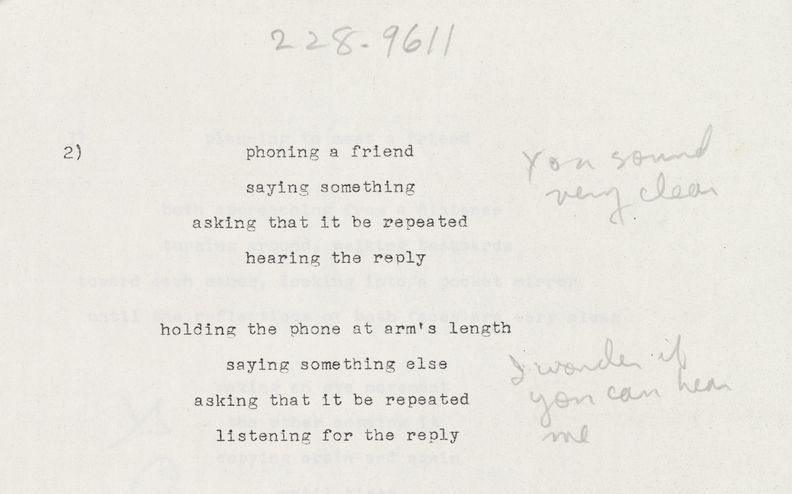
The program is composed of ordinary language that has been repurposed in highly formal ways. The blocks of text are centered, symmetrical, and generously framed by blank space. Most importantly, Kaprow writes in the continuous present tense rather than the imperative. This is unusual for instructions and, to some extent, lends the program a self-contained, poetic quality. At the same time, however, many of the notations are indeterminate and thus require considerable interpretive work to be realized, as, for example, in the beginning of part 4 (fig. 11.3). Here, the instruction reads “saying something”—but saying what, exactly? This is for the performer to decide. Kaprow’s intense focus on the form of the phone call, seemingly at the expense of its content or message, invites comparison to Brecht’s earlier Three Telephone Events (1961), an event score that Kaprow particularly liked (fig. 11.4).
Kaprow eventually concluded that his experimental scores should not circulate independently of a structured pedagogical context, a conceit distinguishing his practice from that of Brecht and other Fluxus artists.9 It may also reflect his long career as a university professor.10 Kaprow argued, “An unfamiliar genre like this one does not speak for itself. Explaining, reading, thinking, doing, feeling, reviewing, and thinking again are commingled.”11 To this end, he introduced Routine with a “briefing” in the form of a short lecture that broke down the formal structure of the activity and sketched out various ways to interpret it. Here, Kaprow translated philosophical questions into vernacular terms and made the activity sound both intellectually worthwhile and fun. It was with a certain seriousness of purpose, then, that the participants in Routine spread out across Portland to realize the program in their own ways (fig. 11.5). After the realizations had occurred, Kaprow reconvened the participants at the PCVA for a “review”—a seminar-style discussion during which participants analyzed their experiences. He would ask: Did your experience of Routine conform to your expectations? How did your experience differ from your partner’s? Questions such as these enabled Kaprow to gather crucial feedback and to measure, however informally, the program’s ability to inspire diverse realizations while maintaining a unified purposiveness.
Kaprow’s commitment to framing his activities pedagogically posed certain challenges, particularly with regard to publication. The typed program alone did not, in Kaprow’s view, offer enough guidance, so he developed two novel publication formats: the activity booklet and what we might call the “activity film.” The activity booklets invariably open with a short essay that condenses the functions of Kaprow’s “briefing” and “review.” In the essay, Kaprow clarifies the key concepts that animate the program and summarizes the range of realizations that have already occurred. But even this was not enough to reel in the distant reader. In order to provoke a physical response, Kaprow enlists the mimetic magic of photographic media. As he explains at the start of the Routine activity booklet:
The photos here do not document ROUTINE. They fictionalize it. They were made and assembled to illustrate a framework of moves upon which an action or set of actions could be based. They function somewhere between the artifice of a Hollywood movie and an instruction manual.12
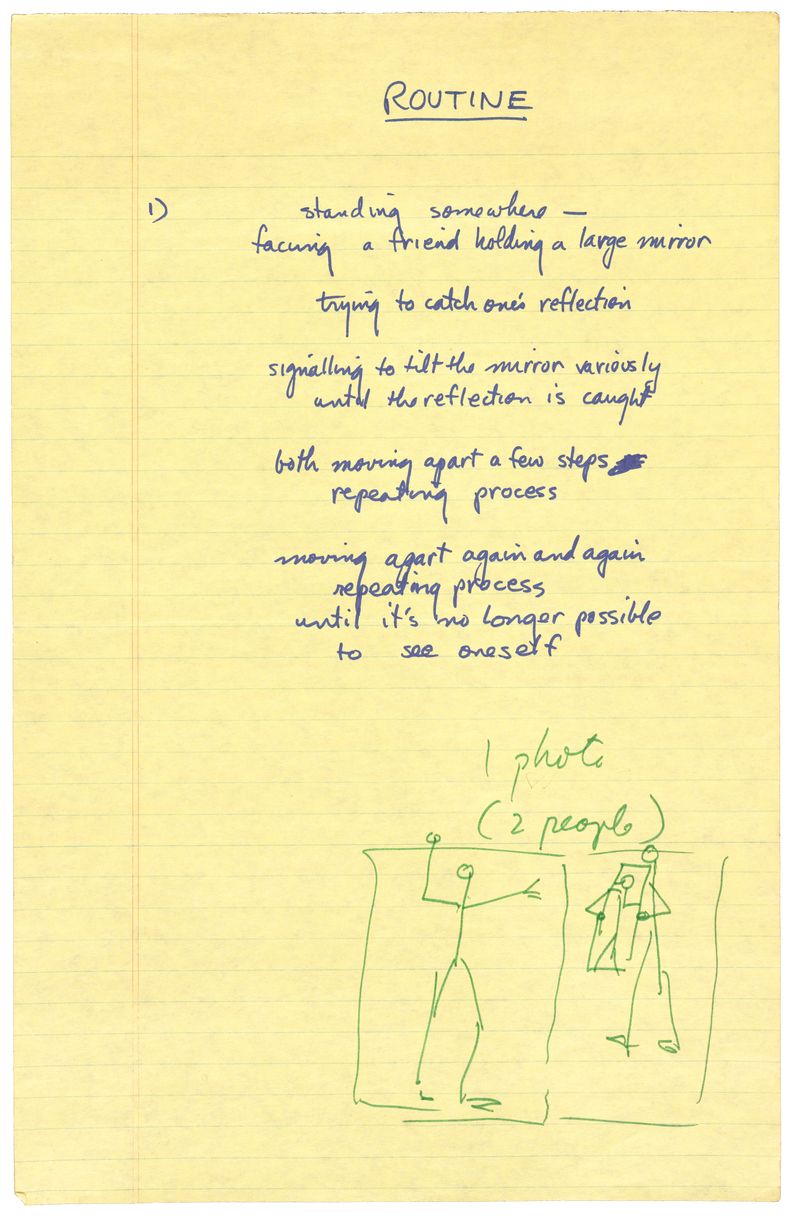
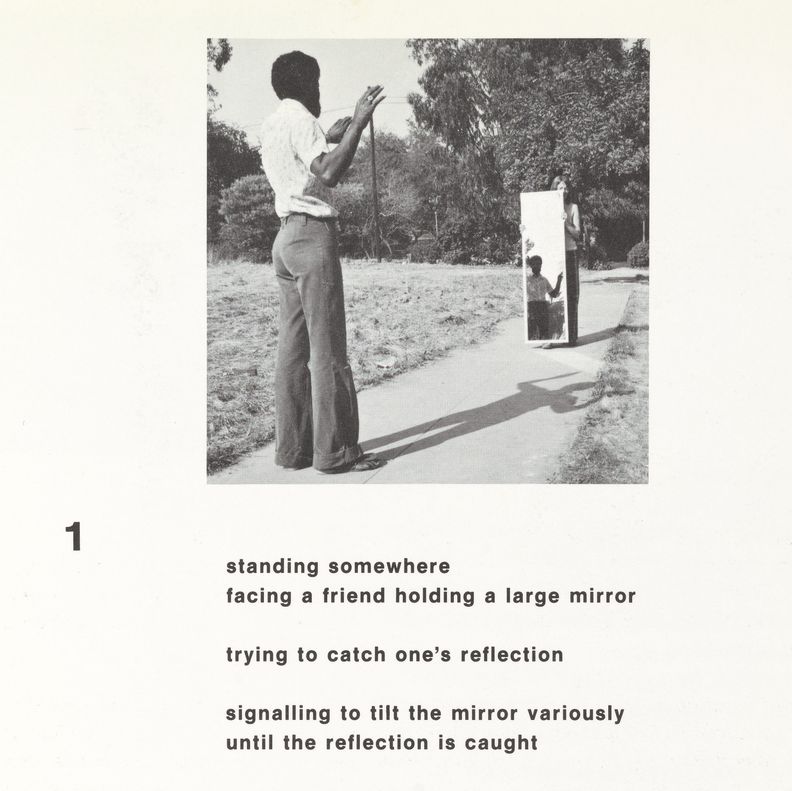
Where most artists in Kaprow’s milieu used photography to document performances, Kaprow used the medium to inspire new ones. To this end, he developed a diagrammatic approach that began by sketching out the basic photographic compositions in advance. More than a mere guide, these sketches yielded photographs that retain a strong graphic quality: individual faces are deliberately obscured in favor of clear postures and spatial relationships. For example, on the first page of the activity booklet, the man’s shadow is a stick figure come to life or, rather, a living person made into a stick figure (figs. 11.6, 11.7). Sometimes Kaprow took the photographs for his activity booklets, but more often he directed an art student to do it; in this case it was Alvin Comiter, a student at the California Institute of the Arts. Nevertheless, Kaprow dictated the style as well as the mise-en-scène, in the manner of a film director guiding a cinematographer.
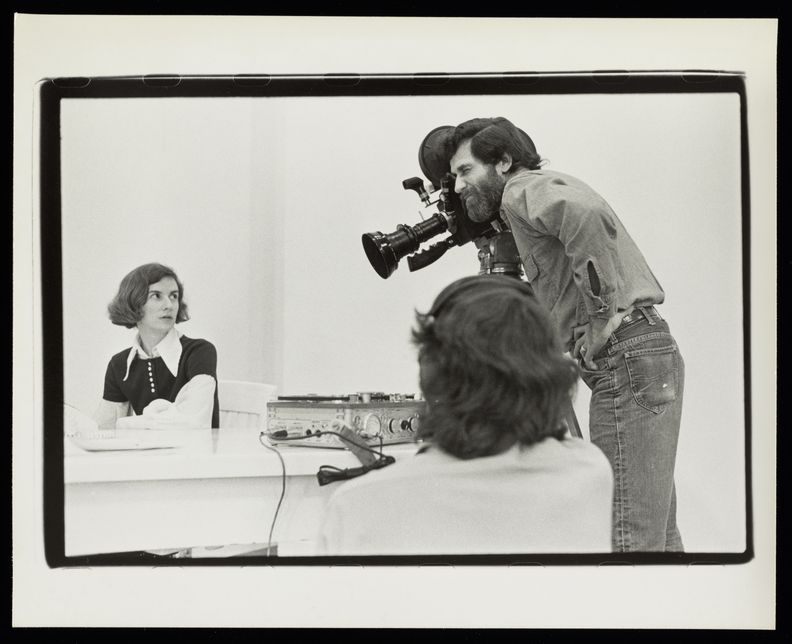
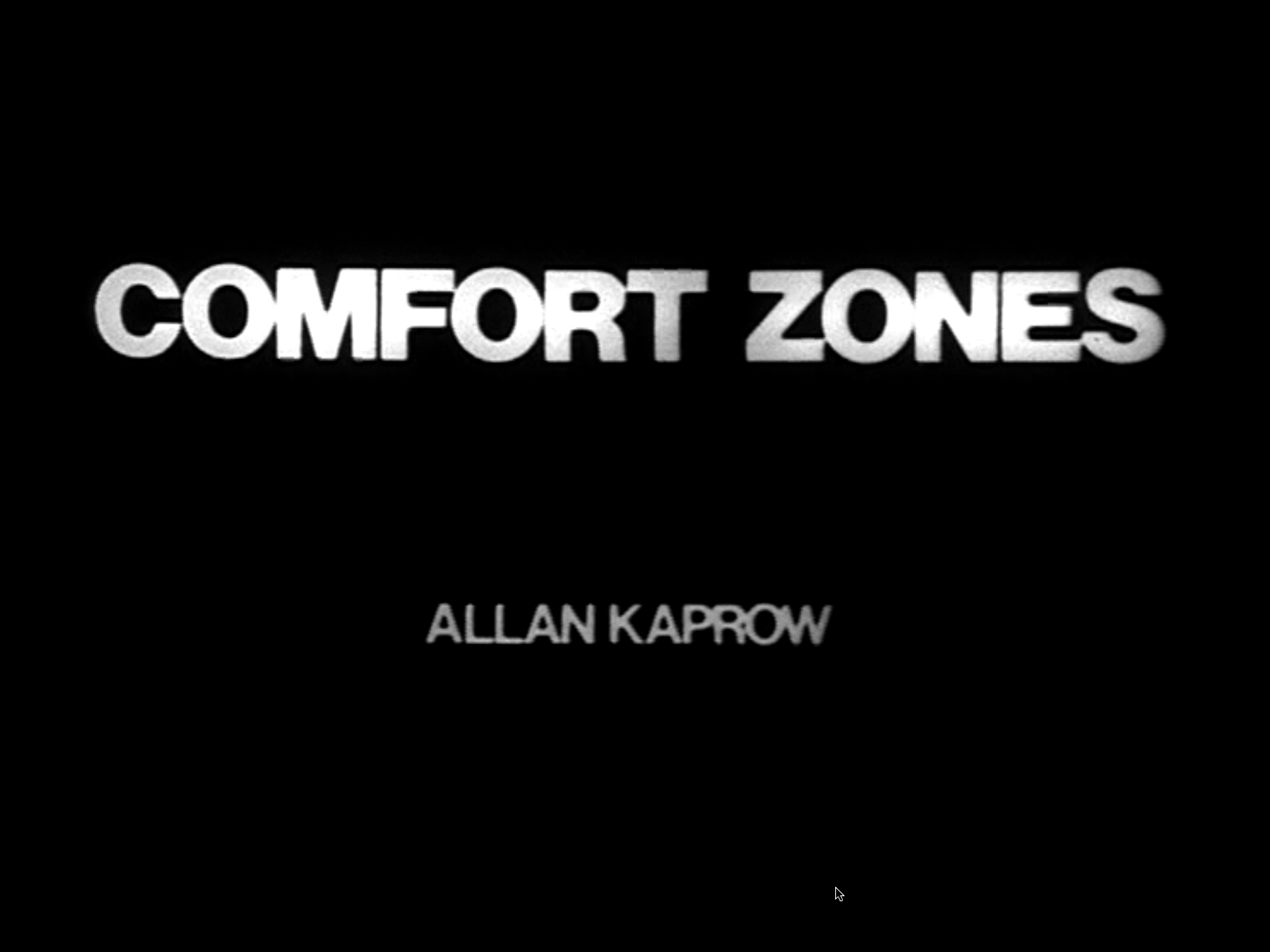
The PCVA gave Kaprow a modest budget for documentation. But instead of filming the Saturday realizations as one might expect, the artist kept those private. He had determined that the presence of a camera altered the experience of performance in profound ways that had to be carefully accounted for.13 He used the funds to produce an instructional film, complete with copious voiceovers, intertitles, and semi-rehearsed performances (fig. 11.8). Like the sort of industrial film it mimics rhetorically, the activity film Routine was made cheaply and quickly, and to carry out his vision Kaprow engaged the technical expertise of young people, including the aspiring documentary filmmaker Michael Sullivan (fig. 11.9).14
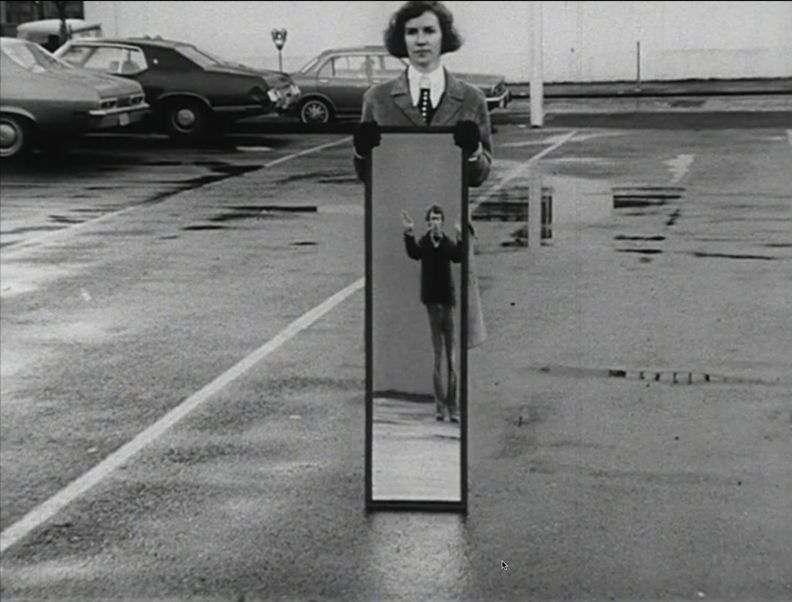
The activity film for Routine follows the pattern of the genre of the activity booklet in many ways. The compositions and gestures, for instance, tend to look somewhat abstract, thanks in part to the readymade geometries of the locations themselves, like the white lines of a parking lot (fig. 11.10). Further, the shot-reverse-shot editing is easy to follow, in part because it is a familiar element of classic Hollywood film grammar. In this context, Kaprow’s numerous activities for couples that entail an exaggerated series of miscommunications and awkward entanglements curiously evoke the plot of a romantic comedy, albeit a drastically simplified one.
Kaprow’s films and videos of the 1970s were experiments (figs. 11.11, 11.12, 11.13, and 11.14). He was clear about their intended function: to serve as animated versions of indeterminate scores rather than as documentations of performances. Indeed, he stated this intention directly through his opening voiceovers. But Kaprow was not entirely sure that any film could function as an indeterminate score, since participants might be tempted to simply mimic what they saw on screen, thus foreclosing the creative aspect of realization in the Cagean tradition. Thus, in characteristic fashion, Kaprow devised a further experiment in 1976. He directed a group of friends, along with his then wife, Vaughan Rachel, to try out one of his instructional videotapes as an experimental score for an activity. After the group performed the activity, Kaprow convened a review session at which he asked them about their experiences using the instructional videotape. Kaprow recorded this review session on audiotape, and as it unspools we hear his friends criticize his videotape score, describing it as idealized, didactic, or otherwise misleading. While many artists might find this reaction deflating, Kaprow sounds energized. For him, the score form was at least in part a tool for generating meaningful debate and self-critique. The process of realization would ideally generate further new forms, which is precisely what we hear later on the audiotaped review when one of his friends proposes that Kaprow make an almost absurdly recursive instructional videotape explaining how to use his instructional videotapes. Such glimmers of self-reflection were perennially Kaprow’s aim as he brought both participants and pedagogical techniques into the center of his artworks.
Notes
-
Allan Kaprow, “The Legacy of Jackson Pollock” (1958), in Essays on the Blurring of Art and Life, ed. Jeff Kelley (Berkeley: University of California Press, 2003), 1–9; and Allan Kaprow, Assemblages, Environments, and Happenings (New York: Harry N. Abrams, 1966), 157–65. ↩︎
-
Allan Kaprow, “Nontheatrical Performance” (1976), in Essays on the Blurring of Art and Life, 173. ↩︎
-
Kaprow explains: “My choice of the word ‘Happening’ was intended to neutralize art and to suggest the possibility of a consciousness and mode of action unencumbered by associations with either any art or other profession. Once I saw that it acquired stereotypical meanings which only got in the way of that consciousness, I adopted Michael Kirby’s word ‘Activity’ as an alternative.” Allan Kaprow, “Easy Activity,” in Art Studies for an Editor: 25 Essays in Memory of Milton S. Fox (New York: Harry N. Abrams, 1975), 177. Michael Kirby was a drama professor at New York University and editor of Happenings: An Illustrated Anthology (New York: E. P. Dutton, 1965). ↩︎
-
Allan Kaprow, interview by Joan Marter and Joseph Jacobs, in Off Limits: Rutgers University and the Avant-Garde, 1957–63, ed. Joan Marter (New Brunswick, NJ: Rutgers University Press, 1999), 132. ↩︎
-
Kaprow recalled, “I went to John [Cage] to find out how I could use tapes, because I figured tapes could contain a lot more sound on them, that I could do much more with them because I heard a lot of his work, and everybody was doing pre-electronic music in those days, calling it musique concrète, which was in the mid-fifties.” Allan Kaprow, oral history interview by Moira Roth, 5 and 18 February 1981, Archives of American Art, Smithsonian Institution, Washington, D.C., 22. ↩︎
-
Allan Kaprow, in conversation with Gordon Mumma, James Tenney, Christian Wolff, Alvin Curran, and Maryanne Amacher, in “Cage’s Influence: A Panel Discussion,” in Writings through John Cage’s Music, Poetry, and Art, ed. David W. Bernstein and Christopher Hatch (Chicago: University of Chicago Press, 2001), 171. ↩︎
-
Cage recalled about his New School course: “One thing I insisted upon in the class, I said, ‘Don’t bring any work to the class that you can’t do. If you can’t do it here, don’t bring it here.’” John Cage, oral history interview, 2 May 1974, Archives of American Art, Smithsonian Institution, Washington, D.C., https://www.aaa.si.edu/collections/interviews/oral-history-interview-john-cage-12442. For the broad outlines of Cage’s class, see Joseph Jacobs, “Crashing New York à la John Cage,” in Marter, Off Limits, 65–99; and Bruce Altshuler, “The Cage Class,” in FluxAttitudes, ed. Cornelia Lauf and Susan Hapgood (Buffalo, NY: Hallwalls Contemporary Arts Center, 1991), 17–23. ↩︎
-
Kaprow called his scores “programs” after 1968 in order to foster associations with computing and modern communications systems, rather than with fine art. See Allan Kaprow, interview by Richard Schechner, The Drama Review 12, no. 3 (1968): 153; and Allan Kaprow, “Education of the Un-Artist, Part I” (1971), in Essays on the Blurring of Art and Life, 106. ↩︎
-
Kaprow collaborated with many Fluxus artists over the years, but he did not identify as a Fluxus artist himself. According to his account, this was because he could not get along with George Maciunas. Allan Kaprow, “Maestro Maciunas” (1996), in Essays on the Blurring of Art and Life, 243–46. ↩︎
-
Kaprow earned a master’s degree in art history from Columbia University in 1952 and held academic posts at the following institutions: Rutgers University, 1952–61; Stony Brook University, 1961–68; the California Institute of the Arts, 1969–74; and University of California at San Diego, 1974–92. ↩︎
-
Kaprow, “Nontheatrical Performance,” 167. ↩︎
-
Allan Kaprow, Routine activity booklet, 1975, Allan Kaprow Papers, 980063, box 24, folder 9, Getty Research Institute, Los Angeles. ↩︎
-
On Kaprow’s complex uses of photography in happenings, see Judith F. Rodenbeck, “Foil,” in Radical Prototypes: Allan Kaprow and the Invention of Happenings (Cambridge, MA: MIT Press, 2011), 223–40. On this topic in relation to Routine, see Judith F. Rodenbeck, “Various Small Ethnofictions of Coastal California,” in The Uses of Photography: Art, Politics, and the Reinvention of a Medium, ed. Jill Dawsey (San Diego: Museum of Contemporary Art San Diego, 2016), 103–6. ↩︎
-
Brian Marquard, “Michael Sullivan; at 67, producer for ‘Frontline,’” Boston Globe, 28 June 2013, https://www.bostonglobe.com/metro/2013/06/27/michael-sullivan-marblehead-frontline-producer-projects-included-the-mormons-and-kind-hearted-woman/gsv1MiSnWgjxyJYJ0vkE8H/story.html. ↩︎