Alison Knowles is the only woman among the founding members of Fluxus. With a background in painting and printmaking, Knowles graduated from Pratt Institute in Brooklyn in 1956, where she studied with the abstract expressionist painter Adolph Gottlieb and the German émigré illustrator and painter Richard Lindner.1 Her study of the visual arts left an imprint on her later work. Lindner, for example, directed his students to draw urban street scenes from life, an assignment that might be seen to reverberate in Knowles’s sustained interest in social observation.2 After graduation, Knowles studied briefly at Syracuse University with the famed Black Mountain College instructor Josef Albers.3 Although she was an uneasy fit for Albers’s occasionally strict approach to pedagogy, Knowles’s mature work builds upon the pragmatic aspect of his experimentalism. In an echo of Albers’s material studies, many of her works explore the manifold possibilities of ordinary and accessible materials, and Knowles’s goal of overcoming habitual perception through rigorous acts of attention is broadly consistent with Albers’s philosophy of visual education.4
Though Knowles started out as a painter, she pushed the medium beyond its customary bounds by exploring the practice of silkscreen printing on canvas.5 In 1960, she met Dick Higgins, who would become her lifelong partner.6 Trained in literature and music, Higgins had taken John Cage’s influential experimental composition course at the New School for Social Research in the summer of 1958, alongside George Brecht and Allan Kaprow (fig. 9.1). Knowles came to know Cage’s work through Higgins and, in turn, became interested in chance procedures, which she adapted for use in her paintings, for instance by tossing coins and consulting the I Ching, the ancient Chinese book of divination, when deciding where to place colors.7
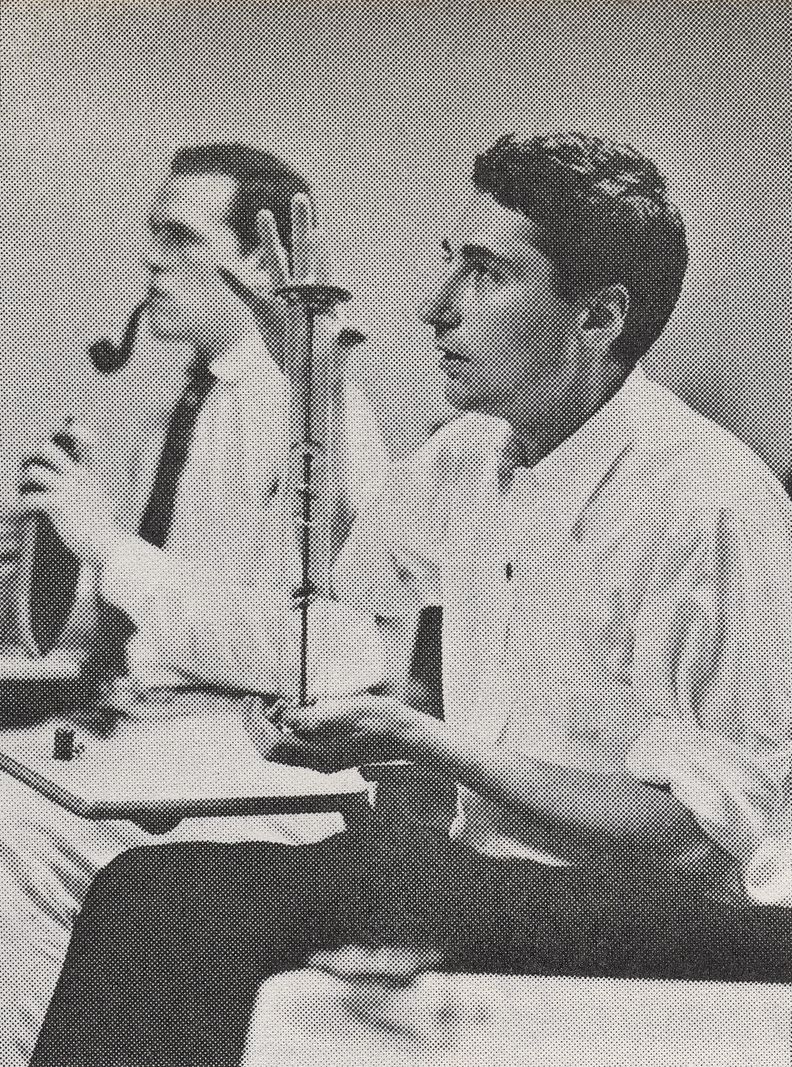
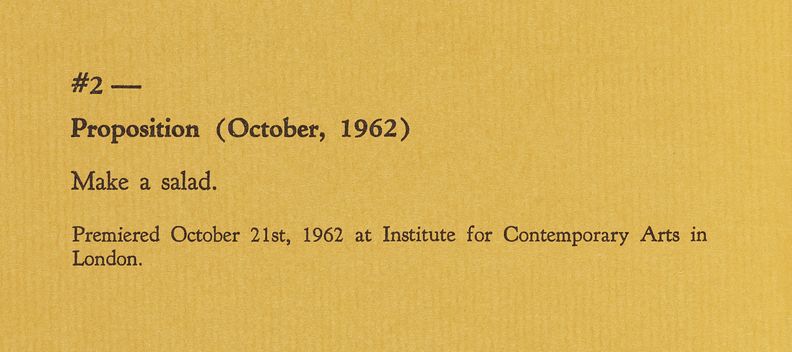
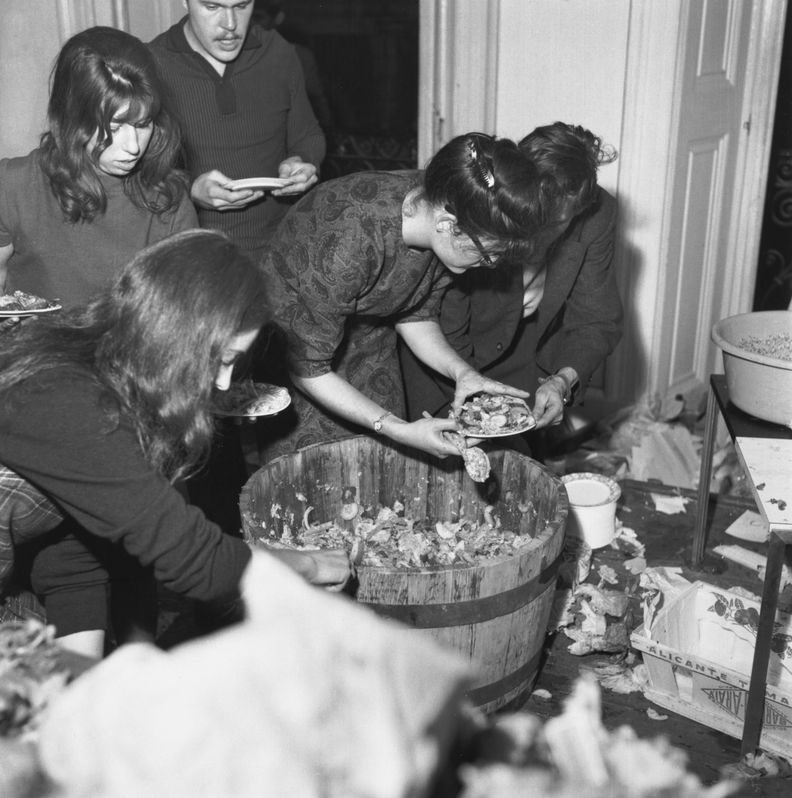
The inaugural Fluxus concert tour to Europe in 1962 marked a key turning point in her career. She had joined the tour as a committed performer of her friends’ event scores, but the pressure cooker of the nightly concerts inspired her to become a composer in her own right. As she recalled in 1985: “We knew there were a few hundred people showing up each night, so we got it together, often just before the performance. It was under this duress and excitement that I started to write my own. I started with ‘Make a Salad.’”8 First published under the title #2—Proposition (October, 1962), the score for Make a Salad led to a premiere performance in which she did exactly that, chopping lettuce, cucumbers, and carrots and mixing these ingredients with blue cheese in a large pickle barrel (figs. 9.2, 9.3).9 In subsequent decades, experimental scores became a fundamental component of her practice: Knowles wrote new scores while repeatedly reworking and reinterpreting a few of her iconic early scores (principally Make a Salad and The Identical Lunch).
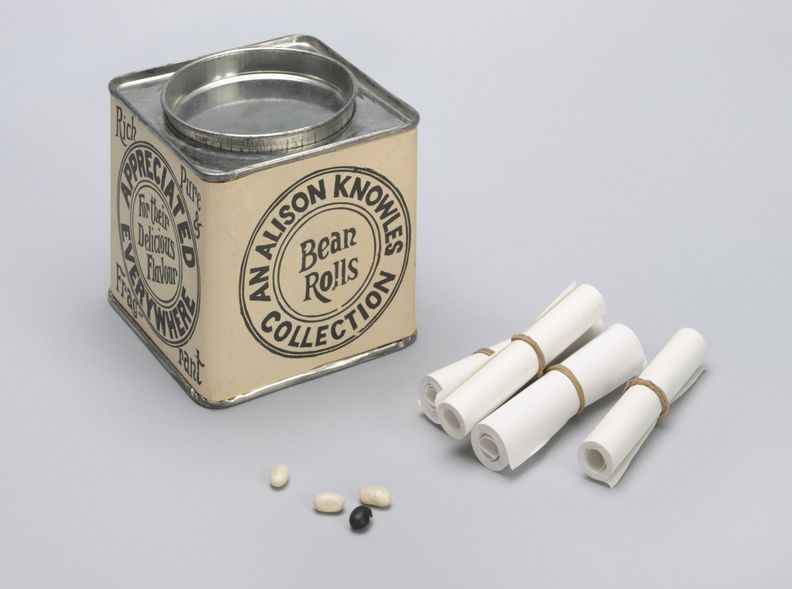
One novel axis of Knowles’s work can be found in her distinctive use of materials and social rituals. While other Fluxus artists incorporated food into their event scores, Knowles explored particular foods at length while foregrounding the attendant rituals of preparing and serving them. For example, in an echo of the midcentury fashion for anthropological universals, she produced a series of works that playfully cataloged the many uses and meanings of a single ingredient: the bean. Her celebrated Fluxus multiple The Bean Rolls (1963) featured dried beans rattling around in a repurposed tea tin alongside more than a dozen rolls of paper, with quotes taken from her library research on the significance of beans across a number of world cultures (fig. 9.4).10 The focus on beans grew out of her experience cooking inexpensive and nutritious meals, often for large groups of people, but she also took inspiration from Cage’s encyclopedic knowledge of mushrooms.11
In Make a Salad (1962) and subsequent event scores, Knowles focused on cooking and eating as social processes. Others in her milieu, namely Cage and David Tudor, were similarly interested in cooking, particularly with Asian recipes and ingredients, but never considered this activity part of their formal creative practices.12 In crafting her scores, Knowles tinkered with the form of the recipe—with its list of accessible tools and ingredients and its direct and instrumental use of language—and explored the possibility that the event score and the recipe might be virtually coextensive forms.13 In Make a Salad and its companion piece, Make a Soup (1964), however, the recipe is reduced to an indeterminate skeleton, because Knowles does not list any particular ingredients or actions. Whereas the typical recipe takes for granted a definite outcome and assumed criteria for good and bad results, Knowles’s scores intentionally generate variation and even perplexity. She included the score for The Identical Lunch (late 1960s–early 70s) in her Journal of the Identical Lunch (1971), a compendium of materials related to varied dimensions of the work as it was performed and realized. As with other books she produced, Knowles regarded it not as mere documentation but as an independent work.14
Knowles’s Identical Lunch is one of the more difficult artworks in The Scores Project to describe, since it reorders the elements of score, realization, and documentation in novel ways. The nearly mythic story of its genesis is an important part of the work, so I will recount its broad outlines here. In 1965, Knowles and Higgins moved from their industrial SoHo loft to a large brownstone in Chelsea at 238 West 22nd Street.15 They lived on the first floor with their twin daughters while Higgins operated Something Else Press on the second floor and Knowles shared a studio with the Fluxus composer Philip Corner on the top floor.16 Sometime in 1967, when her daughters were toddlers, Knowles developed the habit of getting out of the house for lunch. She would walk a few blocks to a bustling neighborhood diner called Riss Restaurant and repeatedly order the same meal: “a tunafish sandwich on wheat toast with lettuce and butter, no mayo and a large glass of buttermilk.”17 Knowles notes that this lunch, while ordinary, was the diner’s best offering. Ordering the same thing as a matter of routine also saved her time and energy, freeing her mind to think of other things. Knowles herself called it “a convenience and time-saver.”18
Corner, who was her frequent lunch companion in those days, prompted a transformation of the ontology of the lunch from an unconscious habit to a highly self-conscious performance. One day in 1968, he pointed out that her order resembled an event score. In a test of Corner’s thesis, Knowles began to document her daily lunch performances in what she called her “Journal of the Identical Lunch.” She subsequently published excerpts from this journal in an experimental literary magazine, The Outsider, in which she also set down the first formal version of the score, which reads: “a tunafish sandwich on wheat toast with lettuce and butter, no mayo and a large glass of buttermilk was and is eaten many days of each week at the same place at about the same time.”19 Over the next few years, Knowles disseminated the score among a network of friends. In turn, she asked them to realize The Identical Lunch and share documentation of these realizations, which she compiled in 1971 as Journal of the Identical Lunch. This publication, which was in a sense collaborative, inspired further realizations, such as Philip Corner’s 1973 book, George Maciunas’s symphony version, and other versions by Knowles herself.
The complex ontology of Knowles’s score for The Identical Lunch is crystallized in the form of its single sentence, particularly in its use of multiple tenses and temporalities. She employs both the past and present tense when she writes that “a tunafish sandwich . . . was and is eaten.” In her Journal of the Identical Lunch, Knowles adds the future tense, asserting that, “New Lunches will include many other people and their own performances.”20 Knowles thereby makes explicit the often implicit temporality of the score, which exists in the present and intends future action but also conjures a speculative history of past performance. As discussed in chapter 11, Allan Kaprow’s “activity booklets” similarly condense multiple temporalities of the score through his use of documentary photographs that are posed and framed to be prescriptive and future-oriented.
Consonant with Knowles’s use of the past tense in the score, she devotes most of her Journal to a rich variety of documentation of various performances: We flip through Riss receipts, hand-drawn diagrams, documentary photographs, and correspondence on index cards. Emerging from this material diversity is a polyphony of individual voices, with each performer-documentarian describing a unique scene or experience of the lunch. Such variation underscores a fundamental Cagean conceit of the work: that the identical in name is hardly identical in reality, and even less so when taking account of an individual’s experience of it.
Several performer-documentarians in Knowles’s Journal exhibit an unsettlingly detailed mode of attention, applying the technique of formalist close looking to the point of absurdity and even grotesquery. Knowles herself charts minute changes in the water content of the tuna she is served, detecting a consistent weekly cycle, though refraining from drawing any conclusions (such as those one might expect from, say, a Department of Health inspector). The precise meaning of the cycle, hence the purpose of her diligent effort, remains suspended and open to further interpretation.
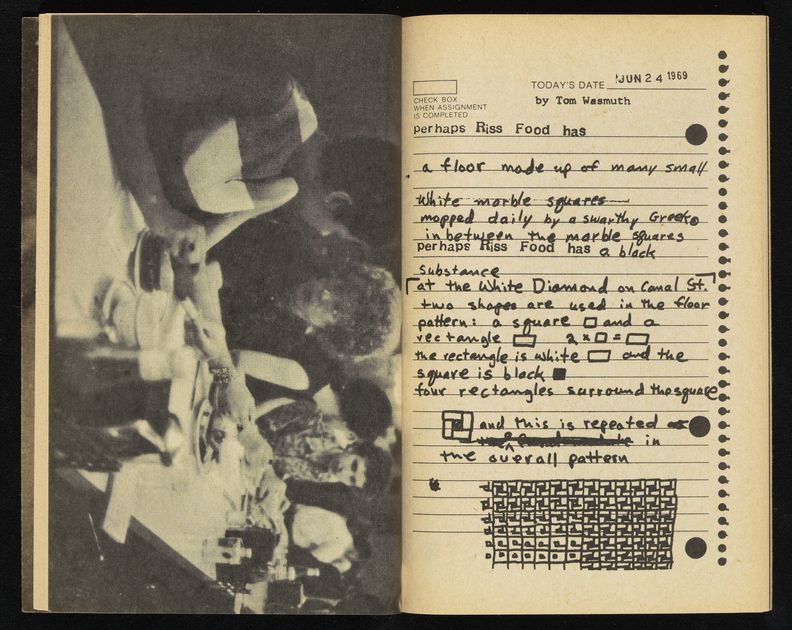
In the artist Tom Wasmuth’s documentation, a formalist exercise in close looking veers beyond the lunch itself to the diner’s custodian, whom he marks with an ethnic stereotype, and then to the diner’s floor. Wasmuth’s hand-drawn diagram of a tiled floor at another establishment (the “White Diamond”) almost resembles an art historian’s sketch of an ancient Roman marble floor in its precision and apparent seriousness of purpose (fig. 9.5). Meanwhile, the writer and musician Lynn Lonidier experiments with a perversely close analysis of an employee’s appearance, noting “the wrinkled flesh puckering from the waitress’s arms.”21 Knowles herself records precise dates and uses somewhat obscure code names for regular customers and workers, for example “N” for herself, “F” for someone she calls “The Dog-woman,” and “E” for “Flo, afternoon waitress.”22 And Higgins, with a touch of noir, refers to himself the consumer as a “suspect” observed in the third person: “at 12:52½ suspect completed the consumption of the sandwich.”23
The Journal’s sometimes humorously detailed observations can convey a feeling of ambivalence about the ritual itself. Lonidier describes her aversion to eating the lunch by using the term “nausea,” and she is not the only performer-documentarian in Knowles’s Journal to do so. In the postwar period, a can of tuna was an ambivalent object for economic and political reasons: It was a paradigmatic product of consumer society, and as such a totem of industrial capitalism’s fundamental contradictions. It was affordable, relatively nutritious, and easy to prepare, thus capable of liberating working mothers—a demographic that included Knowles herself—from some degree of household drudgery. On the other hand, the mass-produced cans of processed meat could seem unnatural, formless, smelly, unappetizing, and more fit for cats than people. The glass of buttermilk Knowles orders is a similarly ambivalent object when viewed in its historical context. In their Journal, Knowles records having increasing difficulty obtaining it at Riss, presumably due to low demand. The obsolescence of buttermilk as a popular beverage at the time may explain Knowles’s decision to add “or a cup of soup” as a possible alternative in all but the first iteration of the score.
With this sociohistorical context in mind, Knowles’s transformation of the habitual lunch through conscious attention and reflection takes on added complexity. In the many interviews Knowles has given since the 1970s, she has sometimes described The Identical Lunch as a call to find meaning in the most ordinary things through a meditative practice of what we might now call mindfulness.24 In these instances, she suggests that any favorite lunch will do, because it is the quality of disciplined attention that matters most. She has also occasionally allowed that there may be a politically progressive dimension to her use of food, since preparing and serving staples like salads, beans, and tuna has been the province of women and low-paid workers and thus systemically undervalued if not simply ignored. One could argue that framing such labor as art can help to make it visible. Alongside these committed gestures in The Identical Lunch, we can still detect an ambivalent energy in Knowles’s 1970s-era realizations. In this way, the ordinariness of the lunch maintains at least a measure of negativity and thus preserves, in a playful manner, a reflection on alienation under modern capitalism.
Teasing out one feminist dimension of The Identical Lunch, the art historian Nicole L. Woods sees Knowles’s work in the diner as a means of negotiating “her labour as an artist and her labour as a mother.”25 Indeed, as a mother of toddlers in the 1960s, Knowles took her place as a domestic worker alongside other workers on their lunch breaks. In 2000, Knowles herself noted, with regard to Make a Salad, that she “was the only woman in the original Fluxus group, so the piece had a dynamic feminist twist as well.”26 In a foregrounding of care work, Knowles developed a distinct strain of realizations of The Identical Lunch in which she began to prepare and serve the meal herself, such that the original setting of the Riss diner recedes into the background. For the 1969 New Year’s Eve Flux-Feast at the Fluxhouse Cooperative in SoHo, Knowles created a makeshift diner of her own in the manner of a “happening.”27 Inside a translucent enclosure made of shower curtains, Knowles prepared and served the identical lunch to individual participants.28 Here, the quasi-ethnographic dimension of The Identical Lunch persisted: Knowles took Polaroids of the participants eating lunch, some of which she transferred to silkscreen and printed on canvas.
In tandem with Knowles’s rising status in the history of art, The Identical Lunch has achieved iconic status, not unlike Cage’s 4′33″ (1952). In part, this is because universities and art museums have leveraged the work’s participatory and functional dimensions to engage with students and patrons. In 2011, participants could sign up to eat an Identical Lunch in the Museum of Modern Art’s café, with the artist herself in attendance.29 Later, in 2013, at the Smart Museum at the University of Chicago, a version of the original Identical Lunch (buttermilk included) was added to the museum café’s menu. Regarding visits to colleges and universities, Knowles noted: “I would definitely propose that my audience have The Identical Lunch with me when I was through with my talk. And sometimes they could do that—they’d make us 50 identical lunches. Of course I couldn’t always get a kitchen to make it, and I didn’t enjoy eating it in front of my audience and not having them have any.”30 In the gig economy of contemporary art, the meanings of The Identical Lunch have shifted from an observation-based working-class lunch to an iconic, highly recognizable performance. These newer meanings multiply and ramify further in the ongoing reception and interpretation of Knowles’s Identical Lunch, which range from new modes of cooking-as-world-making, to reflections on the twenty-first-century equivalent of tuna and the commodity character of food.
Notes
-
Alison Knowles, “Curriculum Vitae,” in Indigo Island: Art Works by Alison Knowles (Saarbrücken, Germany: Stadtgalerie Saarbrücken, 1994), 117. ↩︎
-
Hannah B. Higgins, “Love’s Labor’s Lost and Found: A Meditation on Fluxus, Family, and Something Else,” Art Journal 69, nos. 1–2 (May 2010): 13. Knowles herself said, “For me the real world is the right place to start from, whether you are making art, a performance, music, or dinner.” Alison Knowles, interview by Linda M. Montano, in Linda M. Montano, Performance Artists Talking in the Eighties: Sex, Food, Money/Fame, Ritual/Death (Berkeley: University of California Press, 2000), 173. ↩︎
-
Higgins, “Love’s Labor’s Lost and Found,” 12. Higgins does not say when Knowles studied with Albers, but it was likely during the summer of 1957, when Albers served as Visiting Instructor in Pictorial Design at Syracuse University’s School of Art. See the Josef and Anni Albers Foundation Chronology, https://www.albersfoundation.org/alberses/chronology/. ↩︎
-
Eva Díaz, The Experimenters: Chance and Design at Black Mountain College (Chicago: University of Chicago Press, 2015); and Jeffrey Saletnik, Josef Albers, Late Modernism, and Pedagogic Form (Chicago: University of Chicago Press, 2022). ↩︎
-
Díaz, Experimenters, 13. Dick Higgins identifies Knowles as “a silk-screen cameraman by trade” in his “Publisher’s Foreword” to The Four Suits: Benjamin Patterson, Philip Corner, Alison Knowles, and Tomas Schmit (New York: Something Else Press, 1965), xii. He continues, “and so it was natural that she should be about the first to do the kind of multiple overlay silk screen printing that was later associated with Rauschenberg, Warhol, etc” (xii). ↩︎
-
Knowles and Higgins’s daughter Hannah B. Higgins establishes that her parents met in 1960 in “Eleven Snapshots of Dick Higgins,” in Intermedia, Fluxus and the Something Else Press: Selected Writings by Dick Higgins, ed. Steve Clay and Ken Friedman (Catskill, NY: Siglio, 2018), 335. She also writes, “They married (1960), divorced (1970), became neighbors (1975), and remarried (1985) in an open manner, and lived a complex life ever after.” Higgins, “Love’s Labor’s Lost and Found,” 14. ↩︎
-
Nicole L. Woods writes that “Knowles’s paintings in the late 1950s . . . used the I-Ching for color placement,” although she does not specify exactly how. Nicole L. Woods, “Object/Poems: Alison Knowles’s Feminist Archite(x)ture,” XTRA 15, no. 1 (2012): 16. Little is known about Knowles’s early paintings, probably because the artist burned most of them once she became involved with Fluxus, according to Higgins, “Love’s Labor’s Lost and Found,” 13. ↩︎
-
Alison Knowles, quoted in Estera Milman, “Road Shows, Street Events, and Fluxus People: A Conversation with Alison Knowles” (1985), Visible Language 26, nos. 1–2 (1992): 98. ↩︎
-
Nicole L. Woods notes that, while Make a Salad was first published and listed as #2 in Knowles’s first book of scores, the ordering was Dick Higgins’s mistake. Nicole L. Woods, “Taste Economies: Alison Knowles, Gordon Matta-Clark and the Intersection of Food, Time and Performance,” Performance Research: A Journal of the Performing Arts 19, no. 3 (2014): 157. On the ingredients, see Mari Dumett, “Alison Knowles: Ritual and Routine,” in Corporate Imaginations: Fluxus Strategies for Living (Berkeley: University of California Press), 282. ↩︎
-
Knowles, in Montano, Performance Artists Talking in the Eighties, 174. ↩︎
-
Knowles cited the New York Mycological Society, cofounded by Cage in 1962, as an important influence. Knowles, “Curriculum Vitae,” 117. ↩︎
-
See David Tudor, Recipes for Rum Coconut, Milk au Diable, Lime Pickle, and Buttermilk, ca. 1960s, David Tudor Papers, 980039, box 39, folders 1–2, Getty Research Institute, Los Angeles. ↩︎
-
On cooking as meditation, see Montano, Performance Artists Talking in the Eighties, 175. On the score as recipe, see Milman, “Road Shows,” 104; and Dumett, “Alison Knowles: Ritual and Routine,” 281. Knowles makes explicit the latent connection we might observe in the Getty Research Institute’s David Tudor archive between his secondary realizations and his hand-copied recipes (see chapter 2). ↩︎
-
On Knowles’s creative approach to the form of the book, see Julia Robinson, “The Sculpture of Indeterminacy: Alison Knowles’s Beans and Variations,” Art Journal 63, no. 4 (2004): 96–115. ↩︎
-
Knowles publishes her exact address in Alison Knowles, By Alison Knowles, A Great Bear Pamphlet (New York: Something Else Press, 1965), 15. ↩︎
-
Alison Knowles and Hannah B. Higgins, “Notes toward Indigo Island: A Conversation between Alison Knowles and Hannah Higgins,” in Knowles, 100; and Dumett, “Alison Knowles: Ritual and Routine,” 279. ↩︎
-
Alison Knowles, “The Identical Lunch,” The Outsider 2, nos. 4–5 (1968/69): 182. ↩︎
-
Knowles, “Identical Lunch,” 182. ↩︎
-
Knowles, “Identical Lunch,” 182. ↩︎
-
Alison Knowles, Journal of the Identical Lunch (San Francisco: Nova Broadcast Press, 1971), inside front cover. ↩︎
-
Knowles, Journal of the Identical Lunch (1971), 2. ↩︎
-
Knowles, Journal of the Identical Lunch (1971), 10. ↩︎
-
Higgins, quoted in Knowles, Journal of the Identical Lunch (1971), 5. ↩︎
-
See, for example, Allie Wist, “When a Tuna Fish Sandwich Becomes a Work of Art: An Interview with ‘The Identical Lunch’ artist Alison Knowles about Tuna Sandwiches, Performance Art, and How Our Daily Rituals Can Be Vehicles for Inspiration,” Saveur, 14 March 2018, https://www.saveur.com/interview-identical-lunch-alison-knowles. ↩︎
-
Woods, “Taste Economies,” 159. ↩︎
-
Knowles, quoted in Montano, Performance Artists Talking in the Eighties, 173. ↩︎
-
George Maciunas, “Invitation to Participate in New Years Eve’s Flux-Feast” (1969), reprinted in Emmett Williams and Ann Noel, Mr. Fluxus: A Collective Portrait of George Maciunas (New York: Random House, 1998), 163; and Dumett, “Alison Knowles: Ritual and Routine,” 302. ↩︎
-
Knowles recalled in 2008: “I got a shower curtain and I isolated a little space in the corner of the room and then I invited particular people to come and I served them a lunch. I had a toaster in there, and I’d mixed up the tuna fish and I had the lettuce. They’d sit down and eat the lunch there and I’d take a Polaroid of them eating and then they could talk to me about whatever.” Alison Knowles, in discussion with Jessica Lynne Santone, 22 October 2008, in Jessica Lynne Santone, “Circulating the Event: The Social Life of Performance Documentation, 1965–1975” (PhD diss., McGill University, 2010), 102. ↩︎
-
“The Museum of Modern Art’s Performance Exhibition Series Continues in January 2011 with Eclectic Group of Performances,” press release, 20 December 2010, https://assets.moma.org/documents/moma_press-release_387221.pdf. ↩︎
-
Wist, “When a Tuna Fish Sandwich Becomes a Work of Art,” n.p. ↩︎