Sylvano Bussotti’s Five Piano Pieces for David Tudor (1959) may be better known for its visual appearance than for its sound in performance. The striking notation for No. 4 (fig. 3.1) was reproduced in print reviews of David Tudor’s performance, and two decades later it appeared at the front of the introduction to Gilles Deleuze and Félix Guattari’s encyclopedic Mille Plateaux (1980). Bussotti’s score is wild, inventive, and highly memorable; stretched across five staves, all the usual rules and parameters appear to have been scrambled. Ink pools inexplicably in various holes created by a tangle of curved lines. With so much called into question, by what rules and expectations might this composition be adequately performed?
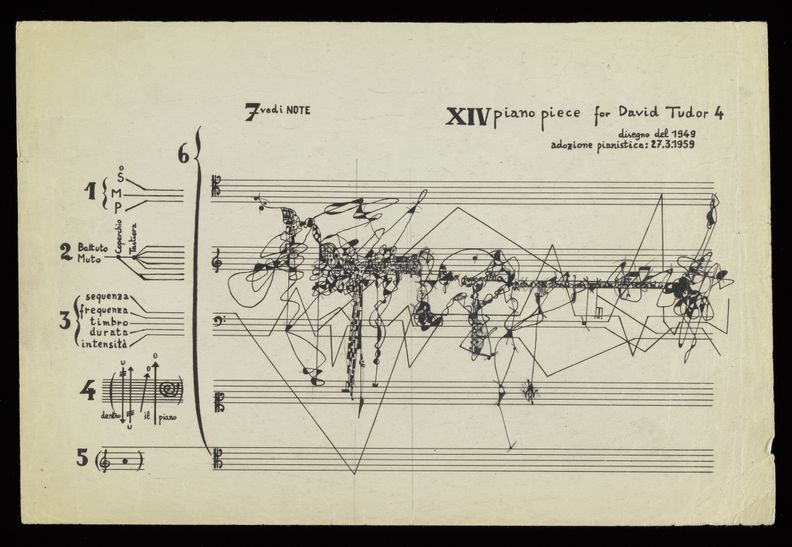
A percocious young composer when he wrote this score in 1959, Bussotti, like many European enthusiasts of contemporary music, was revolutionized by witnessing Tudor and John Cage promote their use of indeterminate scores at the Darmstadt Summer Course in 1958. Eschewing the high-modernist formalism associated with the more systematic procedures of the twelve-tone method, Bussotti set his imagination free and allowed the inky density of his score to explode in expressionistic directions in a way that upended the usual rules of interpretation. In the process, he deployed his talents as a visual artist in the media of drawing and painting and reimagined the score as an inventive form of visual art. He recast note heads, grace notes, accidentals, fermatas, and a handful of unconventional musical signs into imaginatively designed assemblages. The tangled, curvilinear forms at the center of the score for No. 4 (see fig. 3.1) was a repurposed drawing of Bussotti’s from 1949 that he then superimposed onto an array of staves. The scores for his subsequent compositions, notably his chamber opera La Passion selon sade (1965), aggregated musical symbols into faces, images, inventive calligraphy, and labyrinthine diagrams. His graphic scores render the conventional transparency of musical notation opaque and spur the performer to experiment to find an acceptable method of execution.
Bussotti philosophized in striking terms about these notational innovations. After traveling to Paris in 1956 to study composition, he met an important colleague of the philosopher Theodor Adorno, the young composer and critic Heinz-Klaus Metzger, who introduced him to the basics of Adorno’s dialectical method of negative critique, which emphasized the importance of fracturing historical techniques and forms. Under Metzger’s musical and intellectual influence, Bussotti began to describe his own compositional approach as a dialectical humanism, one that sought to preserve expression, excess, emotion, and sentimentality against the high-modernist fashions for formalism.1 A second influence was Antonin Artaud, whose “Theater of Cruelty” was popular and well-known among avant-gardists of the 1950s and ’60s, particularly Pierre Boulez, Tudor, and Cage.2 As scholars have noted, Bussotti’s expressionistic humanism also paralleled his unique relationship to his own homosexuality. Unlike other queer composers of the midcentury avant-garde who were more or less reserved about their sexuality—most famously Cage and Boulez—Bussotti was flamboyant and relatively open about his desires in ways that challenged social norms of the late 1950s.3
In line with his expressionistic and visual approach to indeterminate scores, and at a marked remove from many of Morton Feldman’s and Cage’s experimental scores of the 1950s, Bussotti’s Five Piano Pieces went so far as to try to surpass formalisms. The five pieces are solo piano extracts from Pièces de chair II (1958–60), a larger cycle of twenty-seven songs for piano, baritone, female voice, and other instruments.4 The guidelines for decoding Five Piano Pieces span the traditionally determinate (Nos. 2 and 5) to the unusual and partially indeterminate (No. 1), to highly indeterminate scores that required a “realization,” or a customized performance score (Nos. 3 and 4). In this way, Five Piano Pieces ventures from determined procedures into the territory of intuition, inconsistency, and communicative immediacy through score-drawings that entice performers to compose their own work.5
As if to compensate for this indeterminacy, Bussotti dedicated these pieces to Tudor, their uniquely entrusted performer, whose reputation had been internationally established by 1959. In a letter Bussotti wrote to Tudor and included with a copy of the scores he had written for the pianist, the composer addresses Tudor as someone already taken to be an “instrumental means” in his own right.6 In Bussotti’s view, Tudor was not a mere interpreter or pianist of the score. Rather, he was a unique technical mediator who could ensure ontological coherence for the work’s performance. Ronald Bogue has aptly described Bussotti’s positioning of Tudor as a post-human assemblage—a “Tudor-piano machine”—a singular being that brings together body, mind, technique, and technology (what Bussotti called a “Minotaurus of the pianistical mythology”).7 For Bussotti, this meant not only that the score could be delivered to Tudor with the utmost trust but also that the work likely had to be performed by Tudor in order to be considered complete. This collaboration might be productively framed as a form of queer intimacy between composer and performer. It was also a reassertion of closure or certainty in the face of an experimental notation that is otherwise open and indeterminate. In terms coined by the philosopher Nelson Goodman, when the allographic iterative score becomes wildly open-ended, it may help to have an autographic, certified performance.8
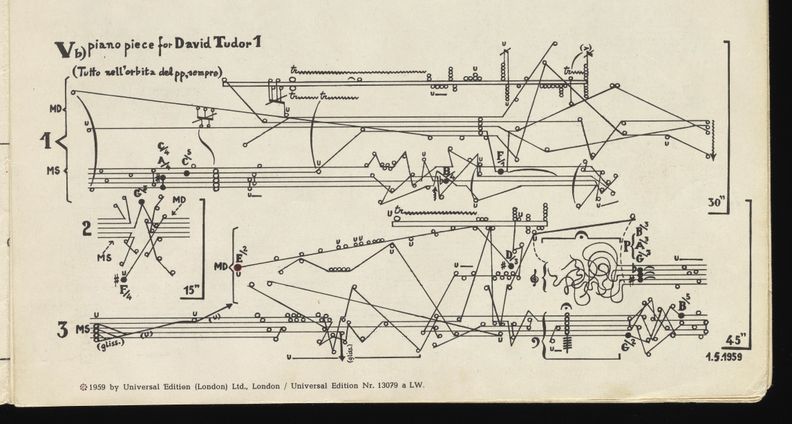
Among the indeterminate scores (Nos. 1, 3, and 4), No. 1 was notable for the imaginative decision to use a strange, tablature-like notation (fig. 3.2). In it, Bussotti repurposes the staff into a linear map indicating where the performer should place their fingers to touch or scrape the keys without depressing them. “MD” (mano destra) means right hand, and “MS” (mano sinistra) means left; the five lines of each staff refer to the five fingers of each hand, though, unlike traditional staff lines, these lines move up and down to indicate the motion of the fingers across the keyboard. Along the staff lines, the letters u and o indicate, respectively, attacks to be made with either the fingernail or finger pad. Most of the performance involves gliding the fingers along the surface of the keys. In accordance with Tudor’s practice at the time, his realization of this piece was a sight-reading tool to be used during performance; he essentially spaces out Bussotti’s notation so that it can be played cleanly without much preparation or any memorization. For his performance, Tudor wore fingerless gloves, an instruction Karlheinz Stockhausen would later incorporate into his glissando-heavy Klavierstück X (1961). On at least one occasion, Tudor’s gloves were sensationalized by the press for the supposed protection they gave the pianist’s hands, but in fact they allowed him to achieve a frictionless glide across the keys. There is also a unique indeterminacy to No. 1 that calls into question the traditional measure of pianistic skill; according to Bussotti’s typed instructions, if certain notes are accidentally struck, the composer will accept that as a compliant performance of the work.
No. 3 involves far more indeterminacy (fig. 3.3). In fact, Tudor later recalled that his realization of No. 3 helped emancipate him from the use of musical notation altogether.9 From Tudor’s perspective, the pianist and composer Ferruccio Busoni’s writings on the limits of musical notation were a memorable point of reference.10 Its score is to be loosely read from left to right, with the vertical axis indicating an unspecified range of pitches on the piano, from low to high. There are some familiar symbols: a scattering of note heads, a few glissando-like arrows, about two dozen slurs that draw together coherent gestures, and a concluding fermata. But many elements are quite indeterminate: staff lines bleed and knock into one another or break down into interior fractures and shattered geometries, infecting the symbolic medium with unclear and befuddling messages.
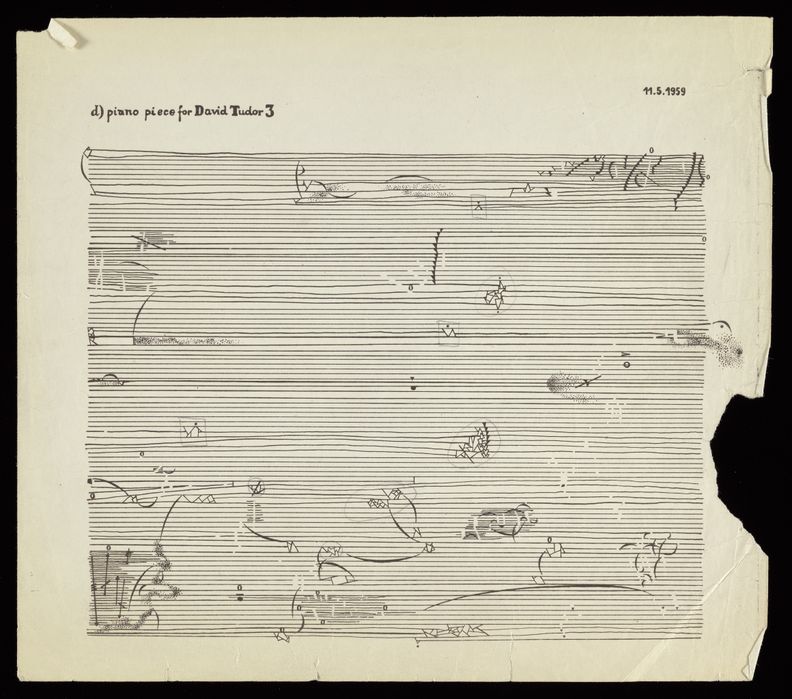
What is striking about No. 3 is that Tudor, who in the past was, without exception, carefully devoted to actualizing a version of what the composer specified, here quite freely made compositional decisions without much in the way of guidance from Bussotti’s score. One can see in Tudor’s own copy of the score that he had circled some key events in pencil (see fig. 3.3). As he loosely moves through the score from left to right, his gestures follow Bussotti’s typed instructions to play slurred events as a whole, but he also allows himself the freedom to rewind the horizontal axis and play events in sequence rather than all at once. That is, when choosing what to play, a bit of jumping around on Tudor’s part is expected, if not inevitable. Tudor’s inventive realization of No. 3 is a dramatic composition with some exquisite extended techniques (fig. 3.4), including the use of a glass slide on the piano strings in order to create glissandi, and the use of hands to hit the strings percussively. And yet, as inventive as it was, the practical goal of Tudor’s realization was no different than it had been for scores by Feldman and Cage: to create a repeatable, straightforward score that could be sight-read. It also had an important social function in that its repeatability could serve as a backbone of credibility for audiences and critics.

At the time, Cage was exploring indeterminate notations in his Variations I (1958) that seemed to abandon all vestiges of traditional Western musical symbols (notes, rests, etc.) in favor of plastic transparencies that allowed performers to freely overlay patterns of lines and dots with only minimal instructions on how to interpret them. By challenging the authority of determinate notation, Tudor understood Busoni and Cage to be thinking along the same lines: “There is a paragraph in Busoni which speaks of notation as an evil separating musicians from music, and I think everyone should know that this is true. . . . Notation is an invention of the devil, and when I became free of it, through pieces like Cage’s Fontana Mix and Music Walk, and later Bussotti’s Piano Piece for David Tudor No. 3, it really did a lot for me.”11 In his realization for No. 3, Tudor’s relationship with Bussotti’s notation was almost intuitive; in assembling it, he more freely drew from extended techniques that he had begun to practice in recent years.
Of the three indeterminate scores in Five Piano Pieces, the most complex and challenging is No. 4 (see fig. 3.1). Contrary to some of the existing commentary on this composition, Bussotti did not leave the realization entirely up to Tudor’s discretion. Superimposed on the staves is the curvilinear drawing Bussotti had made in 1949: a mixture of dots, regions, and squiggly lines. This is the central notation of what one plays. The staves’ five clefs indicate loose ranges of the attacks, while the second layer of five staff fragments on the far left (numbered 1 through 5) provide supplementary material about the kinds of sounds to be played. Staves 1, 2, and 4 specify various kinds of attacks (Staff 1: muted, muffled, or pizzicato; Staff 2: muted beating on the keys or the keyboard cover; and Staff 4: five kinds of glissandi in the piano—two with fingernails, two with the pads of the fingers, and one oscillating glissando). Staff 5 indicates the pitch of that staff’s one attack: in an alto clef, it is A 440 (the A above middle C). Staff 3 is the most precise in its demands, asking the performer to calculate values for the parameters of each attack (sequence in time, frequency, timbre, duration, and intensity) based in measured distances between the drawing’s dark spots and the angular staff lines. Cage pioneered this calculation technique in Variations I and the Solo for Piano (1958; see chapter 2), and Bussotti had learned of it during his visit to Darmstadt in 1958 (a debt he acknowledges in his instructions). Finally, a large 6 labels a bracket that encloses the individual five clefs as a totality. Lest one think all these specifications would be an impossible headache to play accurately, Bussotti’s typed instructions explain that when actually performing the piece, “the pianist is authorized to automatically perform ‘what the drawing inspires,’” without worrying about specific correspondences.12
Tudor eschewed Bussotti’s instruction to “automatically perform” by following the drawing intuitively. Instead, he dutifully realized Bussotti’s instructions for Staff 3 through a list of calculations in a way that parallels the kinds of tables he made for scores by Cage and used this list to create a realization for No. 4. The penciled annotations on Tudor’s copy of the score (see fig. 3.1) show two vertical lines drawn at the vertices of the “sequenza” line from Staff 3, as well as a series of check marks written over black dots, evidence of Tudor checking off” various attacks as he recorded their distance from each of the lines in Staff 3. After producing a seven-sheet-long set of values for attacks corresponding to these black dots, Tudor then recorded them on seven sheets of his customary short staff paper, producing a playable realization (fig. 3.5).
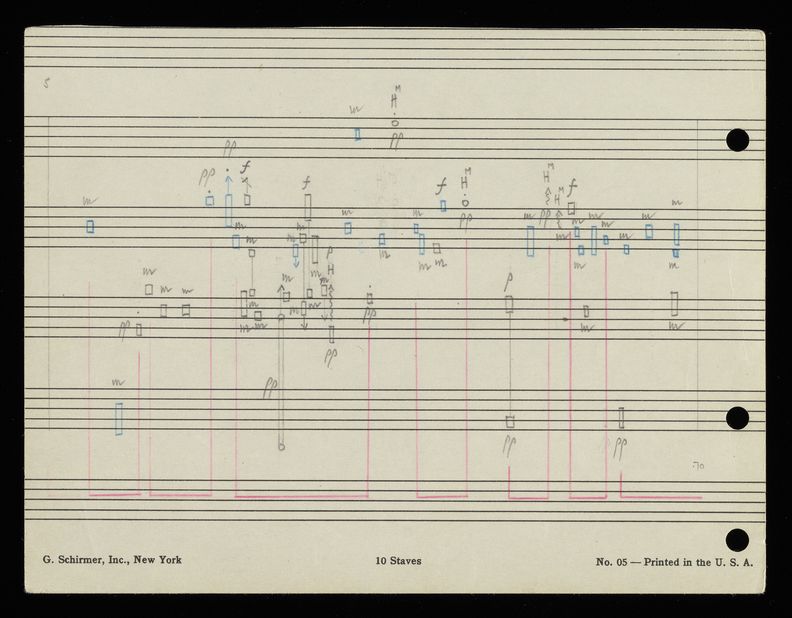
Completing this realization at one of the busiest times of his career, Tudor seemed not to have had time to finish learning it for performance.13 In the live recording, likely made in 1960 at the Living Theatre in New York, Tudor is relatively loose in the timings and seems to have performed only the first four of the seven sheets he realized for No. 4. According to Stockhausen, Bussotti had approved the possibility of a partial performance of No. 4 the year prior in Darmstadt.14
The Bussotti–Tudor collaboration could be said to serve as an ironic counterexample to Umberto Eco’s open work—a concept that Eco coined in 1962 to mark the opening up of traditionally determinate forms of notation.15 For it is not as though the traditional division of labor between composer, score, and performer has entirely broken down into a wide field of multiplicities and open-ended structures. Rather, it is more precise to say the ontological boundaries of Bussotti’s “work” are displaced onto nonnormative spheres. The score has been transformed from normative symbolic indications into an object of visual perplexity and wonder on its own, supplemented by Bussotti’s textual scaffolding. The resultant sonic performance is personally entrusted to a single performer whose job it is to stage and mysteriously decode the esoteric quasi-language of the score.
It is both a curious detail of cultural history and a philosophically rich fact that audiences reacted with puzzlement, bemusement, and distress upon witnessing Tudor’s performances. One must remember that many audience members in 1959 strongly expected performers of classical music to play from notation that told the performer exactly what notes to play. What the philosopher Stanley Cavell worried in 1967 was a risk of “fraudulence” in modernist composition was a real concern.16 During the premiere of Five Piano Pieces at Darmstadt in 1959, Stockhausen refused audience requests for repeat performances, which were purportedly made in order to challenge the legitimacy of Tudor’s interpretation.17 In this manner, the audiences found ways to improvise legislations of the nonnormative boundaries of the composition.
Other responses were more playful and associative. The music critic Ed Wallace, writing for the New York World-Telegram and The Sun, published a review of Tudor’s 1960 performance of Five Piano Pieces at the Living Theatre in New York. The bemused review recasts the concert as the vernacular equivalent of a wrestling match. Wallace likens the violence of Tudor’s extended techniques to that of a fighter exacting revenge on the domestic piano (which the critic associates with his own childhood guilt over not practicing). Wallace, somewhat enthusiastically, reproduces the score for No. 4 in the pages of the World-Telegram, with the emendations “What arrives on paper looks like a mixture of blackstrap [molasses] and soot, applied with a defective spray gun” and “Way out cats will recognize this as the piano piece written for David Tudor by Sylvano Bussotti. Beginners should remember to wear gloves.”18 These spirited middlebrow responses complicate any straightforward displacement of this multiplicity onto the authority of Bussotti’s and Tudor’s personalities alone. Like the event scores that became a popular format after 1960 and would eschew the traditional coordinates of musical performance altogether, the messiness and ontological disunity of the result acquires significance in the moment of its social impact. Five Piano Pieces elicited often contentious and unpredictable reactions that gave it meaning, while the score functioned as the central provocateur.
We might also consider a contrasting performance by the pianist Steffen Schleiermacher.19 Schleiermacher begins by pounding on the outside of the piano before moving on to the keyboard for a set of repeated tone clusters. He then strums on the wound bass strings, then returns to the keyboard to play additional clusters, this time in a more focused register. Following Bussotti’s indication via the bracket labeled “6” that the piece is to be interpreted holistically and the performer should not worry about a precise realization of individual inscriptions, the individual attacks from Schleiermacher’s hands do not correspond one-to-one to blocks of black ink. Instead, they unfold in a rougher, mimetic correspondence, as if the interior complexity of the score were a direct transduction—but not a symbolic encoding—of what was truly in the composition. Or, conversely, since the symbolic medium of notation has broken down in Bussotti’s hands, one might interpret it as an impossible goal of what might be achieved if an interpreter knew exactly what Bussotti intended to express. Alternatively, perhaps it is neither, and instead is something more akin to a negative provocation, a death of musical literacy displayed in visual terms.
Notes
-
Bussotti wrote in a prefatory note to his work Due voci (1958) that his approach to music represented a “dialectical rebellion of the humanistic attitude in the man who writes music, against the stiff aridity of systems.” Quoted in Erik Ullman, “The Music of Sylvano Bussotti,” Perspectives of New Music 34, no. 2 (1996): 186–201. ↩︎
-
See Antonin Artaud, The Theater and Its Double (New York: Grove Press, 1958). Bussotti in fact set Artaud’s texts to music several times over the course of his career. See Piero Carreras, “La Passion Selon Sade, Opera d’Arte Totale,” Scenari, 16 June 2016, https://www.mimesis-scenari.it/2016/06/16/la-passion-selon-sade-opera-darte-totale/. ↩︎
-
See Paul Attinello, “Bussotti, Sylvano,” in The Queer Encyclopedia of Music, Dance, and Musical Theater, ed. Claude J. Summers (Jersey City, NJ: Cleis Press, 2004), 37–38; and David Osmond-Smith and Paul Attinello, “Gay Darmstadt: Flamboyance and Rigour at the Summer Courses for New Music,” in Other Darmstadts, ed. Paul Attinello, Christopher Fox, and Martin Iddon (Abingdon, U.K.: Routledge, 2007), 105–14. ↩︎
-
For a larger discussion of this cycle, see Paul Attinello, “Hieroglyph, Gesture, Sign, Meaning: Bussotti’s Pièces de chair II,” in Perspectives in Systematic Musicology, ed. Roger A. Kendall and Roger W. H. Savage (Los Angeles: Department of Ethnomusicology, UCLA, 2005), 219–27. ↩︎
-
Included in The Scores Project is Tudor’s typewritten copy of Bussotti’s original instructions in Italian for the score. ↩︎
-
Sylvano Bussotti to David Tudor, 22 May 1959, David Tudor Papers, 980039, box 174, folder 3 (original in Series III), Getty Research Institute, Los Angeles (hereafter cited as David Tudor Papers). ↩︎
-
Ronald Bogue, “Scoring the Rhizome: Bussotti’s Musical Diagram,” Deleuze Studies 8, no. 4 (2014): 479. For Bussotti’s quotation, see David Tudor Papers, box 174, folder 3 (original in Series III). ↩︎
-
For a discussion of the terms autographic and allographic, see Nelson Goodman, Languages of Art: An Approach to a Theory of Symbols (Indianapolis: Bobbs-Merrill, 1968). This dialectic whereby artists reassert control over their work is one that perennially recurs in Cage’s career. See Benjamin Piekut, “Murder by Cello: Charlotte Moorman Meets John Cage,” in Experimentalism Otherwise: The New York Avant-Garde and Its Limits (Berkeley: University of California Press, 2011), 140–76; and Ryan Dohoney, “John Cage, Julius Eastman, and the Homosexual Ego,” in Tomorrow Is the Question: New Directions in Experimental Music Studies, ed. Benjamin Piekut (Ann Arbor: University of Michigan Press, 2014). ↩︎
-
David Tudor, in David Tudor and Victor Schonfeld, “From Piano to Electronics,” Music and Musicians 20 (August 1972): 24–6. ↩︎
-
See Ferruccio Busoni, Sketch of a New Aesthetic of Music, trans. Theodore Baker (1907; repr., New York: G. Schirmer, 1911). See also Erin Knyt, “Between Composition and Transcription: Ferruccio Busoni and Musical Notation,” Twentieth-Century Music 11, no. 1 (2014): 37–61. ↩︎
-
Tudor, “From Piano to Electronics,” 24. ↩︎
-
Sylvano Bussotti, Performance notes for Pièces de chair II, 1958–59, pp. 11–12, David Tudor Papers, 980039, box 174, folder 3. ↩︎
-
In correspondence with his partner M. C. Richards, it is evident that Tudor, on occasion, had insufficient time to prepare compositions he was expected to play. With no reliable employment, he had to try to earn a steady income through performance alone, which was often a challenge for him during the 1950s. For Tudor’s letters to M. C. Richards, see Mary Caroline Richards Papers, 960036, box 26, box 114, Getty Research Institute, Los Angeles. For Richards’s letters to Tudor, see David Tudor Papers, box 59, folder 5–10, Getty Research Institute, Los Angeles. ↩︎
-
In Stockhausen’s account, Tudor had asked Bussotti if a partial performance of No. 4 would be adequate, and Bussotti agreed. See Martin Iddon, New Music at Darmstadt: Nono, Stockhausen, Cage, and Boulez (New York: Cambridge University Press, 2013), 243. ↩︎
-
Umberto Eco, The Open Work, trans. Anna Cancogni (Cambridge, MA: Harvard University Press, 1989). ↩︎
-
Stanley Cavell, “Music Discomposed” (1967), in Must We Mean What We Say (Cambridge: Cambridge University Press, 2002), 180–212. ↩︎
-
The reviewer’s testimony is available in Ernst Thomas, “Klänge für das Auge? Gefährliche Doktrinen auf den Darmstädter Ferienkursen,” Frankfurter Allgemeine Zeitung (1 September 1959). For the anecdote related to the audience stirring at the Darmstadt premiere of Bussotti’s Five Piano Pieces, see Amy Beal, New Music, New Allies: American Experimental Music in West Germany from the Zero Hour to Reunification (Berkeley: University of California Press, 2006), 110. For a second discussion of the reception of the Darmstadt performance, see Iddon, New Music at Darmstadt, 248–49. ↩︎
-
Ed Wallace, “Above Ground Test Deactivates Piano,” New York World-Telegram and The Sun, 5 April 1960. ↩︎
-
Steffen Schleiermacher, pianist, “Four Piano Pieces for David Tudor (1959)” by Sylvano Bussotti, track 1 on Fluxus Piano, Musikproduktion Dabringhaus und Grimm, 2015, compact disc. ↩︎