John Cage’s Concert for Piano and Orchestra (1958) is a unique work in his oeuvre because of its association not only with the composer himself but also with David Tudor’s extensive role in realizing and performing the part of the Concert intended for the solo pianist, which Cage titled the Solo for Piano. What, might we ask, is so unusual and unprecedented about the Concert’s Solo for Piano, and how do we understand its great appeal for Tudor?
To begin, the Solo for Piano represented, at the time, Cage’s most elaborate and complex use of indeterminacy in performance. As he said in his lecture “Indeterminacy,” the second of three talks delivered under the title “Composition as Process” in Darmstadt, Germany, in September 1958:
A performance of a composition which is indeterminate of its performance is necessarily unique. It cannot be repeated. When performed a second time, the outcome is other than it was. Nothing is accomplished by such a performance, since that performance cannot be grasped as an object in time.1
To make compositions that reflected these ideals, Cage developed complex and visually striking notations that distanced performers from the intention-driven principles that had heretofore guided Western music. As James Pritchett has argued, the crucial principles of indeterminacy were (1) experimental—involving actions with unforeseen outcomes such that a performance “cannot be repeated” or “grasped as an object”; (2) purposeless—as in a “purposeless process” that gives rise to “no matter what eventuality,” in which “nothing is accomplished”; and (3) unknowing—“by employing some operation exterior to [the performer’s] mind.”2 All were central to Cage’s work after 1950, which was recognized for its experimental procedures that resulted in unique and unpredictable events, for its commitment to the “purposeless” quality of a music divorced from the aims of individual expression, and for its Zen-infused philosophy that grounded Cage’s compositional technique in the impersonal forces of nature.3
If Cage’s philosophy is well-known, it is less often remarked that Tudor played a crucial role in the development of Cage’s turn to indeterminacy. Like Tudor and Morton Feldman (see chapter 1), the first meeting of Tudor and Cage was auspicious. On 17 December 1950, in New York, Tudor gave the U.S. premiere performance of Pierre Boulez’s Second Sonata (1948), a technically demanding piece that extended the dissonant atonality associated with composers such as Arnold Schoenberg and Anton Webern into an aggressive, large-scale composition. As a result of this premiere, Tudor began to develop a reputation as an exceptionally talented performer of difficult modern music, a reputation that would prove significant to the notoriety of the postwar musical avant-garde. Cage, who turned pages for Tudor at the premiere, was himself electrified by the performance. The following year, Cage, feeling inspired, embarked on a monumental solo piano work for Tudor titled Music of Changes.4 Recalling this early collaboration, Cage noted:
In all my works since 1952, I have tried to achieve what would seem interesting and vibrant to David Tudor. Whatever succeeds in the works I have done has been determined in relationship to him. . . . Tudor was present in everything I was doing. . . . At that time [1951], he was the Music of Changes.5
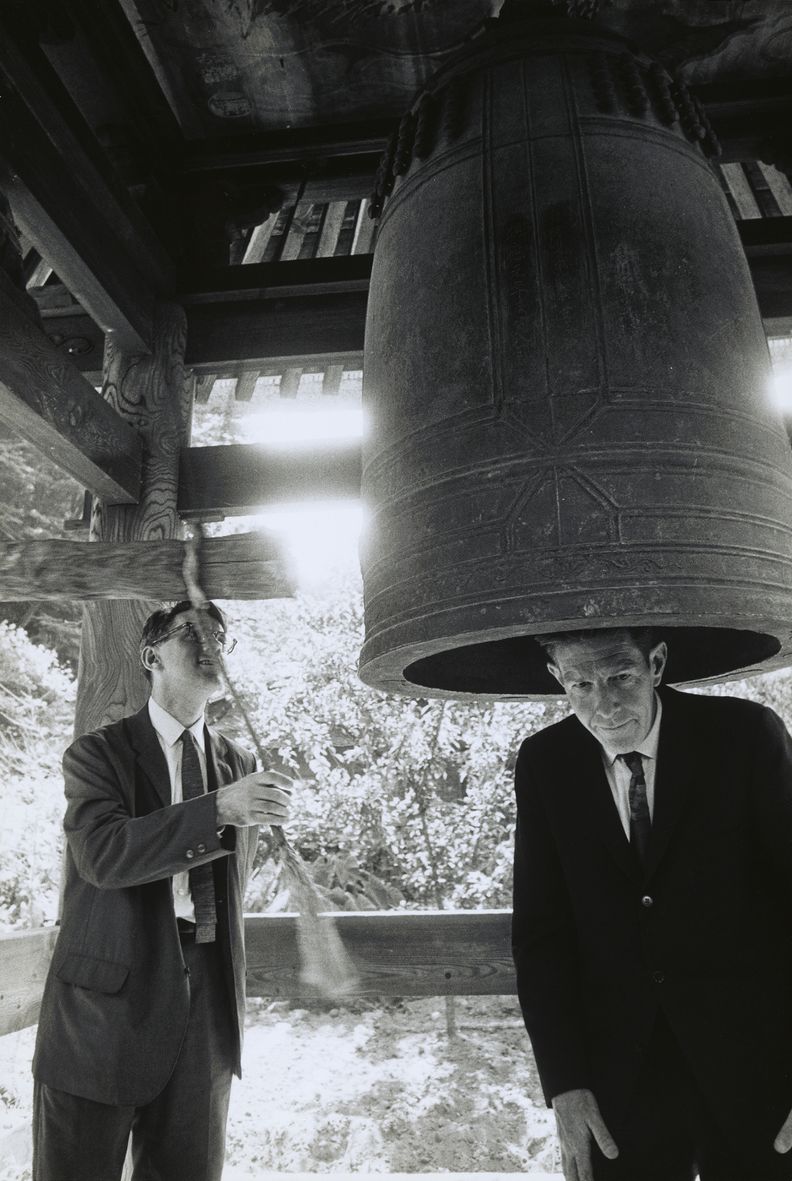
Tudor learned each section of Music of Changes as soon as Cage completed it, thus confirming that the notation was playable. The correspondence between the two offers a vivid chronicle of their collaboration, which fostered a long-lasting friendship (fig. 2.1). A letter from Tudor to Cage in late July 1951 questions and seeks to verify numerous technical details with respect to pedaling:
A few things I would like to check: . . . what are the exact functions you had in mind for the pedals . . . ; what about the inclusion in the pedals of the graces D + A p. 5 4s. [4th system]; are the 4 16ths top p. 6 correct (I hope so!); to which group does the 2nd ½ pedal belong p.7 3s. 1m., ffff or ppp-pppp . . . . I have revised the pedaling considerably, we’ll see how you like it.6
Cage’s reply, dated 5 August 1951 (fig. 2.2), shows not only the depth of his personal attachment (“Your letter has given me much pleasure, how much exactly I cannot say as I’ve lost count of the number of times I’ve reread it”) but also his technical vigilance in addressing every detailed question Tudor had posed. From Tudor’s intimate yet assertive queries, one gets a sense that he was not merely a performer who was capable of serving as a dutiful interpreter but also keen on making significant musical choices of his own. In his preface to Music of Changes, Cage concluded that such a bond of trust had become necessary in order for Tudor to decipher the complex score he had devised: “It will be found in many places that the notation is irrational; in such instances the performer is to employ his own discretion.”7
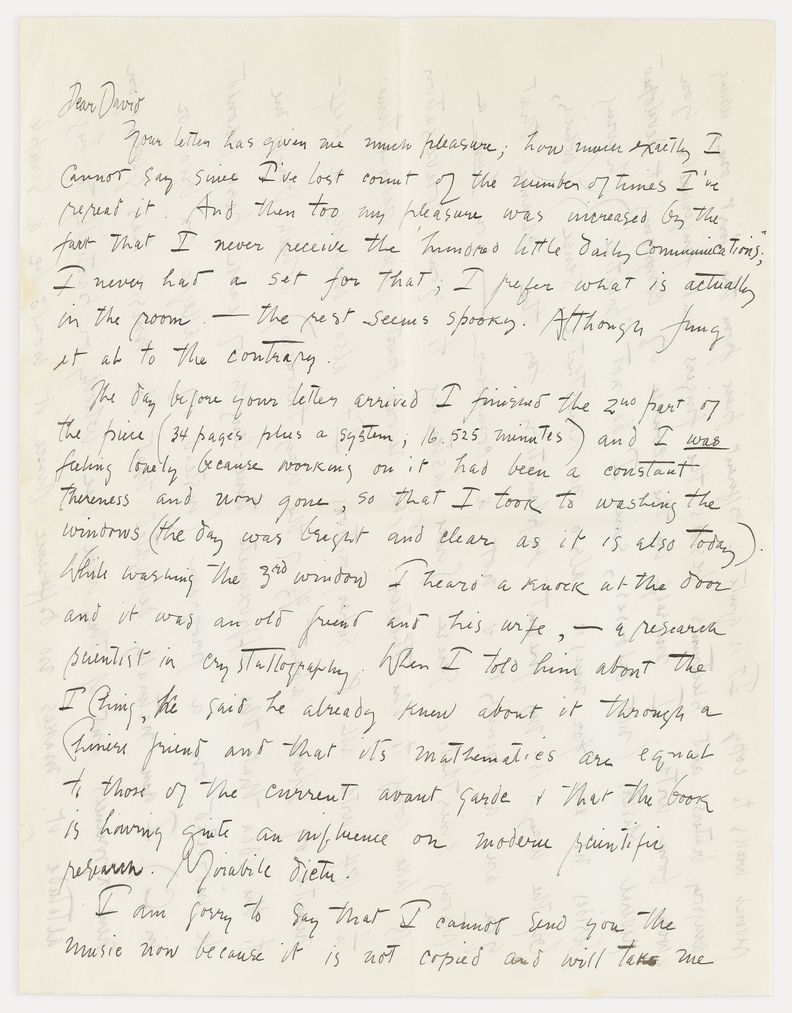
At the end of his August reply, Cage writes that a performance of Music of Changes should be guided by a principle of radical discontinuity: “The guiding principle for performance should be to act so that each action is itself (that means infinitely different and incomparable, single, never before or later to occur, so that each moment makes history).”8 Cage’s statement is emblematic of his famous turn during this same year—1951—to chance operations. In preparing Music of Changes for Tudor, Cage created a chart of various sounds (single notes, two pitches, chords, larger constellations of pitches, and silences), a set of possible durations, and a chart of different dynamic values. A coin toss determined numbers that corresponded to hexagrams in the I Ching, the ancient Chinese divination text that was translated into English as Book of Changes. Such hexagrams in turn pointed to different combinations of sounds, durations, and dynamics that Cage would then sequence together in the score.
While the compositional process was chance-based, Music of Changes is a fully notated score that remains relatively fixed from one performance to the next.9 As his chance-derived compositions developed in the 1950s, Cage expanded upon his aesthetic of non-intentionality by inventing a wealth of more or less indeterminate musical notations. For the Solo for Piano, he devised visually complex “graphs” (as he called them) that gave Tudor room to interpret imaginative hand-drawn diagrams, navigate ambiguous and often convoluted instructions, choose which graphs to play and when, and, in some instances, determine what to play by using secondary calculations or realizations. Some of the graphs for Solo for Piano were entirely new; others Cage reworked from scores from the 1950s, including the Music for Piano series (1952–56), Winter Music (1957), and Variations I (1958), all of which were written for Tudor. A sheet from the score shows two of Cage’s graphs for the Solo for Piano, each identified by a letter of the alphabet (D and Z) (fig. 2.3).
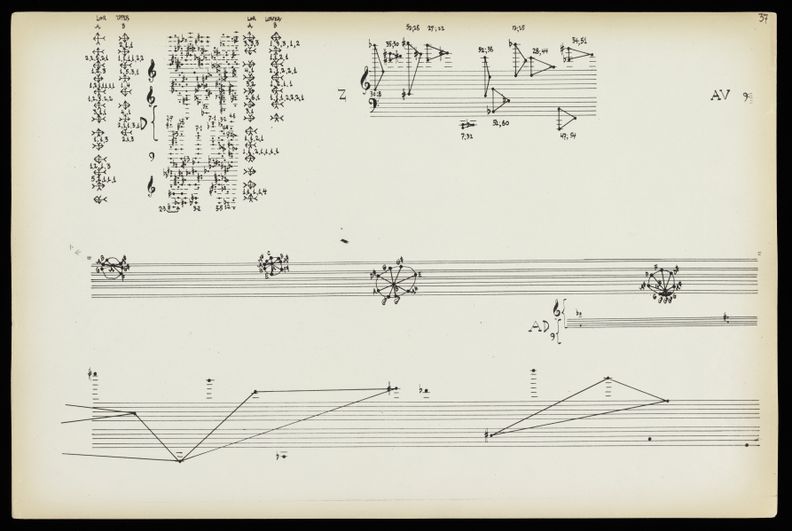
In all, the Solo for Piano contains eighty-four graphs distributed across sixty-three pages, with some graphs stretching over two or three pages. Cage deliberately chose this multiplicity and maximal information to diffuse his own compositional agency and to produce a highly abstract and esoteric composition devoid of traditionally expressive audible patterns and repetitions. The resultant stack of pages is also a complex physical object, like a thick deck of playing cards, only here the cards measure 11 by 17 inches. For this reason, the sheets are nearly impossible to view as a totality. Physically handling the score—shuffling it, recombining it, marveling at its many intricacies—these actions mirror, from a visual and tactile perspective, the indeterminacy of the work.
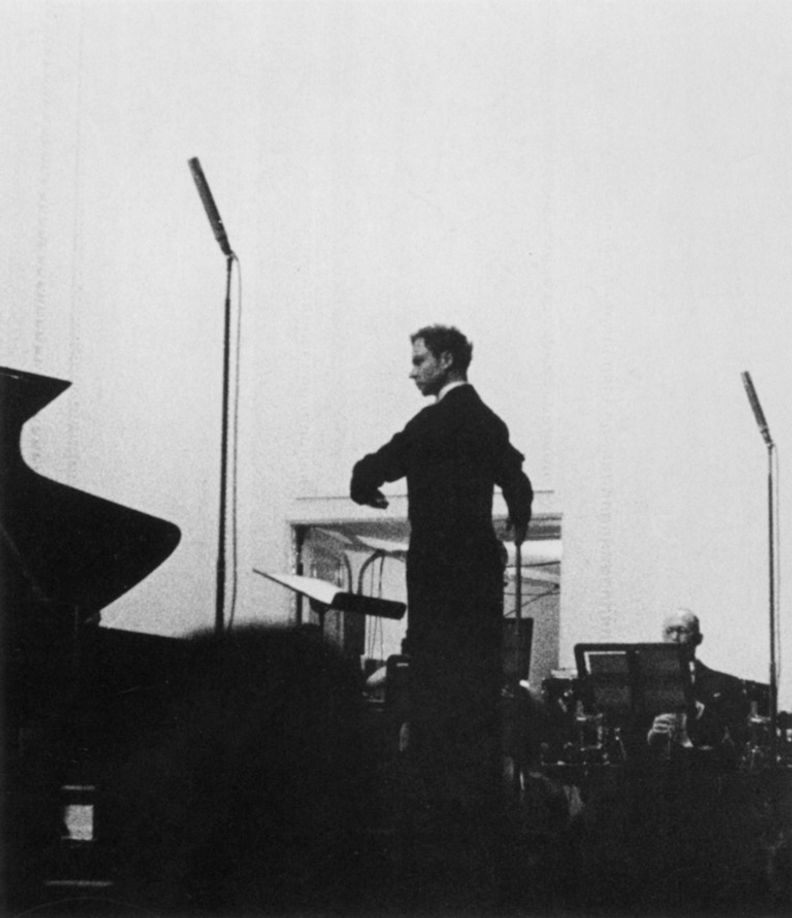
This indeterminacy is reflected outside the solo part as well. A traditional score reads from left to right and can be bound in a fixed order like a book, but Cage’s Concert has no full orchestral score, only separate parts—the sixty-three pages of the Solo for Piano, thirteen instrumental parts, and a separate part for the conductor. Each instrumental part is twelve pages in length and features isolated note heads that indicate individual attacks, many of which are subject to extended techniques (for example, playing with open spit valves, disconnecting tuning slides, slapping keys, and singing or gurgling through an instrument). Cage left the timing open and allowed his performers to play any, all, or none of the notations in the score. Meanwhile, the conductor’s part calls for, among other instructions, circling one’s arms in order to keep clock time for an agreed-upon performance length. This role was first undertaken by the dancer and choreographer Merce Cunningham, who served as conductor for the premiere on 15 May 1958, at New York’s Town Hall (fig. 2.4).
In a manner that mirrors his realizations for Feldman’s graph-paper scores of the early 1950s (see chapter 1), Tudor devised detailed realizations of the graphs in the Solo for Piano for the premiere, and he invented a visual notation that mixed traditional musical notation with his own customized system (see Score section). In preparing his realizations, Tudor began by making sketches of individual graphs in pencil, then copying them as polished performance scores onto small card stock manuscript paper. Finally, he assembled sequences of the graphs that would conform to agreed-upon lengths of time for a given performance. The result was a relatively conventional performance score with a determined length.
In the Playback section for this chapter are a variety of items that correspond to Tudor’s realization of Cage’s Solo for Piano. Among them is a curated selection of five of Cage’s graphs—J, K, T, AY, and CE—which were chosen because they exemplified both Tudor’s pianistic virtuosity and Cage’s compositional and notational intricacy. In each of these items, Cage’s original graph is included along with its instructions, paired with Tudor’s corresponding realization for the 1958 premiere. (Tudor’s realization is notable for its almost theatrical foregrounding of his pianism.) By way of a simple animation, the esoteric notations are made accessible to users who may have only a limited familiarity with traditional Western musical notation. In addition to these five curated graphs, we have included in the Playback section a flipbook that features the entire performance of Tudor’s first realization. In real time as Tudor is performing, the flipbook simultaneously opens the corresponding graphs from Solo for Piano and from Tudor’s corresponding realization.
Following the first performances of the Concert, Tudor produced a second and far sparser realization of the Solo for Piano in 1959. His process for creating this second realization was probably the most labor intensive of any for Cage’s scores. Tudor culled all the single attacks from his first realization and, using a second run of chance procedures, spread them out into a vast, deserted, nearly silent, and impersonal landscape of ninety minutes. He fastidiously transcribed these various attacks into a performance score in proportional notation, a notation without traditional meter or rhythm in which a designated length of a staff in space corresponds to a particular duration (in this case, each page was equal to one minute) (fig. 2.5). The result is much less virtuosic than the first realizations. Cage and Tudor used this second realization for their landmark recording Indeterminacy (1959), which featured stories read by Cage at varying speed alongside Tudor’s performance of the solo.
These are two entirely different realizations of the same work—two among many other possible realizations. It is the kind of open-endedness that could easily cause philosophers to puzzle over the fundamental questions of a work’s ontology. In his landmark book Languages of Art (1968), the philosopher Nelson Goodman cites the most indeterminate of Cage’s graphs in the Solo for Piano to question the limits of a performer’s compliance to the symbolic capacities of the musical score.10 Goodman’s prescriptions for notation are exacting. His analysis of graph BB states that Cage’s instructions for measuring the distances of the five perpendiculars lack a precise unit and are thus too ambiguous to be properly notational. But philosophers were not the only ones to debate the work’s porous and ambiguous ontology. In newspaper reviews of the Concert, one can find middlebrow critics grappling with the oddity of such a piece. Reviewers, not always interested in the esotericism of chance procedures, often focused on the sensory impact of Cage’s works from the 1950s, associating it with violence, wrestling matches, psychosis, comedy, childlike outbursts, or even the advent of a nihilistic age.
Far from being considered controversial reviews, however, such receptions of Cage’s works (including others featured in The Scores Project) could be read as a reflection of the powerful influence of Antonin Artaud’s “Theater of Cruelty” on both Tudor and Cage during the 1950s—an avant-garde aesthetic exemplified by the non-normative, violent, and destructive carnality of life, and remembered widely for its impact on performance art at midcentury. Artaud’s influence on their collaboration was significant. It came first through Tudor via his preparation for the American premiere of Boulez’s Second Sonata (a work that was itself inspired by Artaud), and was further developed by Cage in the dissonant landscape of Music of Changes, and through the multisensory disorder of the famous 1952 “happening” at Black Mountain College that came to be known as Theater Piece No. 1. With this in mind, we invite readers to contemplate these reviews not as evidence of the Concert’s history of controversial reception but as part of an extended ontology of a multifaceted work that is as often legislated and decided by critics, audiences, and various compliant or disobedient collaborators as it would be by a philosopher. In other words, the fact that people disagreed about the music’s significance is, in our view, essential to the identity of the indeterminate work. What makes it striking and successful is that the Concert continued to serve as a magnet for audiences, artists, dancers, and others alike.
Beyond the newspaper reviews, we have included a variety of other materials pertinent to Cage’s Concert. This includes Tudor’s sketches for his realizations of each of the curated graphs as well as various sequences of the graphs for his versions of the first realization for performances of different lengths, many of which were designed to mesh structural clock time with dances by Merce Cunningham. (In particular, the Concert was performed between 1958 and 1960 to accompany Cunningham’s vaudevillian work Antic Meet.) For these performances, Tudor, like Cage, re-sequenced his existing realizations of individual graphs to meet the agreed-upon time length for Cunningham’s dances. We have also included a selection of pertinent correspondence between Tudor, Cage, and M. C. Richards, who was Tudor’s partner during the period and a translator of Artaud’s writings into English. Indeed, this reminds us that given the varied audiences of Cage’s iconic works from midcentury, the Concert should be read not simply toward a pious view of what constitutes a correct performance of Cage’s work but in the full richness of its provocative multiplicity, and in a way that crosses the boundaries of different media.
Notes
-
John Cage, “Indeterminacy” (1958), in Silence: Lectures and Writings by John Cage (Middletown, CT: Wesleyan University Press, 1961), 39. ↩︎
-
Cage, “Indeterminacy,” 38–39. For Pritchett’s account, see James Pritchett, The Music of John Cage (Cambridge: Cambridge University Press), 76–78. ↩︎
-
For a critical view of Cage’s claims to have channeled the forces of nature, see Benjamin Piekut, “Chance and Certainty: John Cage’s Politics of Nature,” Cultural Critique, no. 84 (2013): 134–63. ↩︎
-
See, for example, Cage’s letter to Boulez on the day following the premiere of Second Sonata, in The Selected Letters of John Cage, ed. Laura Kuhn (Middletown, CT: Wesleyan University Press, 2016), 139–41. ↩︎
-
Daniel Charles, For the Birds: John Cage in Conversation with Daniel Charles (Boston: Marion Boyars Publishers, 1981), 178. ↩︎
-
David Tudor to John Cage, late July 1951, in Martin Iddon, ed., John Cage and David Tudor: Correspondence on Interpretation and Performance (Cambridge: Cambridge University Press, 2013), 18. ↩︎
-
John Cage, preface to Music of Changes (New York: Henmar Press, 1961). ↩︎
-
John Cage to David Tudor, 1952, David Tudor Papers, 980039, box 7, folder 7, Getty Research Institute, Los Angeles. ↩︎
-
See Pritchett, Music of John Cage, 108. ↩︎
-
Nelson Goodman, Languages of Art: An Approach to a Theory of Symbols (Indianapolis: Bobbs-Merrill, 1968), 187–90. ↩︎