|
Purpose
The Union List of Artist Names ® (ULAN), the Art & Architecture Thesaurus ® (AAT), the Getty Thesaurus of Geographic Names ® (TGN). the Cultural Objects Name Authority ® (CONA), and the Getty Iconography Authority ™ (IA) are structured resources that can be used to improve access to information about art, architecture, and other material culture. The Vocabularies are not simply 'value vocabularies,' but knowledge bases. Through rich metadata and links, the Getty Vocabularies provide powerful conduits for knowledge creation, complex research, and discovery for digital art history and related disciplines.
- Cataloging: For some users, the Getty Vocabularies are utilized as data value standards at the point of documentation or cataloging, to promote consistency in assignment of a term or to provide options among multiple terms referencing the same concept. The Vocabularies provide preferred names/terms and synonyms for people, places, and things. They also provide structure and classification schemes that can aid in documentation.
- Linking: For other users, the Getty Vocabularies are used in linking, in order to reference the unique identifier of the Vocabulary record, or to otherwise reconcile their data.
- Retrieval: For other users, the Getty Vocabularies aid in retrieval and discovery, utilizing synonymous terms, broader/narrower contexts, and other rich contextual data in search assistants, in database retrieval systems, and more broadly in a linked environment. The Vocabularies are rich knowledge bases that contain dozens of fields of rich contextual data about each concept, and semantic networks that highlight links and paths between concepts.
- Research tools: For other users, the Getty Vocabularies are used as look-up resources, valuable because of the rich information and contextual knowledge that they contain.
In order to meet the needs of these various user communities, the Getty Vocabularies are made available in several ways.
- Data files: Releases include Linked Open Data (LOD) (JSON, RDF, N3/Turtle, N-Triples for GVP and Linked.Art), XML, Relational Tables, Web Services APIs. These files are used by developers or incorporated in various tools by vendors or others. We plan to release a version in the MARC format, as is used for ULAN and TGN in the Virtual International Authority File (VIAF®). Some of these releases contain simplified versions of the data, while others contain the full, rich data sets, providing versions to meet the requirements of various developer communities. The AAT, TGN, and ULAN are available as LOD, relational tables, and XML. AAT, TGN, ULAN, CONA, and IA are available through APIs. The data file releases are refreshed periodically throughout the year. The Getty Vocabularies are published under the Open Data Commons Attribution License (ODC-By) 1.0.
- Online Search: The five Getty Vocabularies' online search pages are consistently the top sites visited at the Getty Research Institute Web site each month. Using these search tools, catalogers copy-and-paste Vocabulary terms and IDs as part of their daily workflow. Researchers use the search to locate rich information about the Vocabulary concepts. In the results displays, for each concept the data fields are presented in a logical full-record display for end users, as well as in hierarchical views. The online search data is refreshed monthly.
Various releases or utilizations of the Getty Vocabulary data may contain more or less of the full, available data for each Vocabulary record, depending upon the purpose of the release. An implementation that intends to ask complex queries using the Vocabulary data would require the full available data. In another example, if a developer only needs to link to the unique identifier for the concept, perhaps a streamlined data set would be more appropriate; e.g., the ULAN data (and soon TGN data also) that is included in the VIAF is a subset of the full data available, which is streamlined and parsed to fit the particular requirements of MARC.
Target audience: The five Getty vocabularies are intended to provide terminology and other information about the objects, artists, concepts, and places important to various disciplines that specialize in art, architecture, and other material culture. The primary users of the Getty vocabularies include researchers in art and art history, museums, art libraries, archives, visual resource collection catalogers, conservation specialists, archaeological projects, bibliographic projects concerned with art, and the developers and information specialists who are dealing with the needs of these users. In addition, a significant number of users of the Getty vocabularies are students or members of the general public.
Comprehensiveness and updates: ULAN contains information about people and corporate bodies related to the creation and maintenance of art and architecture. It includes names, rich relationships, notes, sources, and biographical information for artists, architects, firms, studios, repositories, and patrons, both named and anonymous. See Scope and Structure below.
As of this writing, ULAN contains 525,300 person or corporate body records (1,483,845 names).
ULAN is a compiled resource; it is not comprehensive. ULAN grows through
contributions. See the online list of Contributors. Some recent and historical contributors include projects and departments at the Getty Research Institute (including the Provenance Index, Special Collections, Photo Archive, the Library, the Florentine Codex initiative, and other scholarly research); the Getty Conservation Institute; the J. Paul Getty Museum; Academia Sinica of Taiwan; Centro de Documentación de Bienes Patrimoniales, Chile; Netherlands Institute for Art History (RKD); the Osterreichische Galerie Belvedere in Vienna; the Built Works Registry; the Staatliche Museen zu Berlin Preussischer Kulturbesitz; the Built Works Registry; Witt Computer Index and the Courtauld Institute; Avery Index to Architectural Periodicals, Columbia University; Museum of Modern Art, New York; Grove Art; Indiana University slide library; Victoria and Albert Museum; Bibliography of the History of Art / Bibliographie d'Histoire de l'Art; Foundation for Documents of Architecture, Washington, DC; the Rijksmuseum in Amsterdam; Istituto Centrale per il Catalogo e la Documentazione, Rome; the Canadian Heritage Information Network (CHIN); Canadian Centre for Architecture / Centre Canadien d'Architecture; Frick Art Reference Library; the Smithsonian Institution National Museum of African Art; National Art Library in London; Census of Antique Art and Architecture Known to the Renaissance; the Mystic Seaport Museum; the Harry Ransom Humanities Research Center at the University of Texas at Austin; and the Bunting Visual Resources Library at the University of New Mexico.
Minimum record: A minimum record contains a numeric ID,
a name, a role, nationality, and life dates. However, the data model includes rich metadata and links to allow complex research and discovery. Information in ULAN was compiled by the Getty Vocabulary Program in collaboration with many institutions. Institutions, projects, and individual scholars or experts who are interested in contributing to ULAN may contact us at vocab@getty.edu. Implementers should keep in mind that the vocabularies grow and change over time. Updated data are released periodically throughout the year.
Contribute to the Getty Vocabularies: Read about contributions.
Mission and History of ULAN
Mission: The mission of the Getty Vocabulary Program (GVP) is to produce rich, structured, authoritative vocabularies, in compliance with international standards, that provide a powerful conduit for inter-related, linked, and meaningful research, discovery, and understanding of the visual arts and their various histories, in collaboration with the international community, and utilizing training and outreach to inform the field. One of our primary goals is to broaden and enrich the scope and coverage of the Getty Vocabularies to become ever more multilingual, multicultural, inclusive, and representative of the subjects and priorities of the GRI, the Getty, and global art history.
History: ULAN was informed by the work of the CIHA TAU (Thesaurus Artis Universalis) committees, who met in Europe in 1980s and devised models for authorities for people and places needed to document and research information about art and art history. Work on ULAN began in 1984, when the Getty decided to merge
and coordinate controlled vocabulary resources for use by the J.
Paul Getty Trust's many automated documentation projects. The AAT
was already being managed by the Getty at this time, and the Getty
attempted to respond to requests from Getty projects for additional
controlled vocabularies for artists' names (ULAN) and geographic
names (TGN). In 1987 the Getty created a department dedicated to
compiling and distributing terminology. The ULAN grows and changes
via contributions from the user community and editorial work of
the Getty Vocabulary Program.
Although originally intended only for use by Getty projects, the
broader art information community outside the Getty expressed a
need to use ULAN for cataloging and retrieval. The Getty thus distributed
ULAN for broader use according to the tenets previously established
for the construction and maintenance of the AAT: Its scope includes
names needed to catalog and retrieve information about the visual
arts and architecture; it is based on terminology that is current,
warranted for use by authoritative literary sources, and validated
by use in the scholarly art and architectural history community;
and it is compiled and edited in response to the needs of the user
community. Originally constructed as a simple alphabetized "union
list" of clustered artist names and biographies, in order to
make it consistent with the AAT and TGN, in the late 1990s ULAN
was brought into compliance with national and international standards
for thesaurus construction. Its scope was broadened to include corporate
bodies such as architectural firms and repositories of art, which
may have hierarchical levels. Also included are appellations for unknown creators (e.g., unknown Aztec) and named but unidentified people and corporate bodies. The hierarchical structure is used to organize these various types of entities into facets.
The ULAN was founded under the management of Eleanor Fink (head
of what was then called the Vocabulary Coordination Group, and later
Director of the Art History Information Program, later called the
Getty Information Institute). The ULAN has been constructed over
the years by numerous members of the user community and an army
of dedicated editors, under the supervision of several managers.
The ULAN was published in 1994 in hardcopy (Union List of Artist
Names. Project manager, James M. Bower; senior editor, Murtha
Baca. New York: G.K. Hall, 1994) and machine-readable files. Given
the growing size and frequency of changes and additions to the ULAN,
by 1997 it had become evident that hard-copy publication was impractical.
It is now published in automated formats only, in both a searchable
online Web interface and in data files available for licensing.
The data for ULAN is compiled and edited in an editorial system
that was custom-built by Getty technical staff to meet the unique
requirements of compiling data from many contributors, merging,
moving, and publishing in various formats. Final editorial control
of the ULAN is maintained by the Getty Vocabulary Program, using
well-established editorial rules.
Currently, Patricia Harpring is Managing Editor of the Getty Vocabulary Program, within the Getty Research Institute's Research and Knowledge Creation section, led by Nancy Um. Editors are Jonathan Ward, Robin Johnson, and Antonio Beecroft. Mark Pyzyk is Data Analyst and Facilitator. The technical team is located in the Getty Digital division; team members include Lily Pregill, Gregg Garcia, and David Newbury.
Scope and Structure
Scope: ULAN focuses on creators of the visual arts. It includes names, relationships, and biographical information for makers and other people and corporate bodies required for the documentation, collection, and discovery of rich information about art, architecture, and other material culture where the works are of the type collected by art museums and other repositories for visual cultural heritage, or that are architecture. Within scope are artists, architects, other makers, firms, and studios, both named and anonymous. Also included may be patrons (who often have input in the creative process) and repositories of art. Makers may be named (e.g., Katsushika Hokusai) or anonymous (e.g., Master of the Aachen Altar). ULAN includes makers of cultural visual works which are ceremonial or utilitarian in nature, even if not classified as art according to traditional Western perceptions. Appellations for creating cultures are included (e.g., unknown Aztec). Also included are repositories of art. Amateur artists may be included in ULAN if their work is of the type typically collected by art museums and information for all CORE ULAN fields is available, including a recognized published source that names or discusses the artist and their work (for example, a journal article or an entry in a museum catalog). Occasionally, names of certain donors, sitters, and other non-makers associated with the work may be included, although generally such names are out of scope.
What is excluded from ULAN? Filmmakers, musicians, actors, dancers, or other performing artists are out of scope for ULAN. The names of fictional and literary characters who may be the subject of the visual work are excluded from ULAN; they could be recorded instead in the Iconography Authority (IA), provided they are within scope for the IA. Records for people and corporate bodies that are named in documentation or archival materials about visual works, but whose identity and biographical information are unknown or unknowable are typically out of scope for ULAN. Attribution statements, including those naming studios or workshops, are outside the scope of ULAN. For example, when a painting is attributed to to an artist or to some unknown hand in the workshop of a known artist (e.g., as might be expressed in an object record as attributed to Hokusai or follower of Rembrandt), these attribution statements are outside the scope of ULAN (attribution qualifiers are in AAT). In such cases, the attribution statement combines a qualifier that should be recorded in the object record, not included in ULAN, and possibly a link to a known artist (if applicable). Generic personal names, such as the word Brueghel, are excluded from ULAN because they do not represent a single definable entity. Overall, records that lack the minimal information for a ULAN record are excluded (i.e., name, nationality, role, and life dates or an estimation of when the person existed); see guidelines for contributions for more information regarding minimum contribution requirements.
Although occasionally the names of donors, sitters, and others who are only peripherally associated with the creation of the work may be included in ULAN, these people are not the focus of ULAN and are generally excluded. Filmmakers, musicians, actors, dancers, or other performing artists are excluded from ULAN are included only in the rare occasion when the people or their works are necessary to catalog particular visual works. Names of catalogers, conservators, field archaeologists, art historians, and authors who write about cultural works are typically excluded from ULAN. In general, if a repository includes names such as noted above in the catalog record, we advise that the names be maintained in a local authority rather than contributed to ULAN, because such names are likely needed locally but are not useful to the larger ULAN user community. Also excluded from ULAN are certain local names for people and corporate bodies who themselves are within scope for ULAN, but where these particular names are used only locally; for example, excluded are local abbreviations for names and name spellings found in only one archival document.
Please see further discussion in the guidelines for contributions and editorial guidelines regarding which names may be contributed to ULAN and which should instead be maintained in a local authority; you may consult the list of fields likely to be found in a work record and that may contain personal names, but which are out of scope for inclusion in ULAN.
Structure: The ULAN is a structured vocabulary containing names and other information about people and corporate bodies related to art, architecture, and other cultural visual works. Names in ULAN
may include given names, pseudonyms, variant spellings, names in
multiple languages, and names that have changed over time (e.g.,
married names). Among these names, one is flagged as the default preferred
name for the record.
Although narrower-context records in certain facets are displayed as a list, ULAN is structured as a thesaurus,
compliant with ISO and NISO standards for thesaurus construction;
it contains hierarchical, equivalence, and associative relationships.
The focus of each ULAN record is the concept of a person or corporate body. In the ULAN database, each
record for informaiton about a person or corporate body (also called a subject in this manual) is identified
by a unique numeric ID. The temporal coverage
of the ULAN ranges from Antiquity to the present and the scope is
global. Required fields are the following:
record type
name
name source
display biography
nationality
role
birth date and death date
More about scope and structure: Even though the structure
is relatively flat, the ULAN is constructed as a hierarchical database;
its trees branch from a root called Top of the ULAN hierarchies
(Subject_ID: 500000001); it currently has five published facets:
Persons, Artists;
Corporate Bodies;
Non-Artists;
Unidentified Named People; and Unknown People by Culture.
Entities in the facets other than Corporate Bodies facet typically have no
children. Entities in the Corporate Bodies facet may branch into trees.
There may be multiple broader contexts, making the ULAN structure
polyhierarchical. In addition to the hierarchical relationships,
the ULAN also has equivalent and associative relationships.
FACETS OF ULAN
PERSONS, ARTISTS
Records under this level represent information about individuals involved in the creation or production of works of art or architecture. Included are individuals whose biographies are well known (e.g., Rembrandt van Rijn (Dutch painter and printmaker, 1606-1669)) as well as anonymous creators with identified oeuvres but whose names are unknown and whose biography is surmised (e.g., Master of Alkmaar (North Netherlandish painter, active ca. 1490-ca. 1510)). Important patrons and a limited class of other people whose names are required to catalog visual works are located in the Non-Artists facet. People whose primary life roles were other than "artist" or "architect," but who created or designed art or architecture in an amateur capacity, are included under "Persons, Artists."
CORPORATE BODIES:
Records under this level represent information about corporate bodies, defined as two or more people working together to create or produce art or architecture. Corporate bodies must be organized, identifiable groups of individuals working together in a particular place and within a defined period of time, including legally incorporated entities, such as a modern architectural firm (e.g., Adler and Sullivan) as well as entities that are not incorporated, such as a 16th-century sculptors' studio or family of artists may be recorded as a corporate body (e.g., della Robbia family). A workshop may be included if the workshop itself is a distinct personality collectively responsible for the creation of art (for example, the 13th-century group of French illuminators, Soissons Atelier). Museums and most other repositories are also considered corporate bodies within the scope of ULAN. Built works are not included, even if they have the same name as the corporate body housed within them (e.g., National Gallery of Art). The built work named "National Gallery of Art" should be recorded in CONA, not ULAN.
NON-ARTISTS
Records under "Non-Artists" comprise personal names and biographies required for cataloging art, architecture, or other cultural works, but where the people discussed are not artists. Most records in this facet represent patrons, who often had input in the creative process. Occasionally donors, sitters, and others whose names are required for indexing visual works but who are themselves not artists may be included, although typically such people are out of scope for ULAN.
UNKNOWN PEOPLE BY CULTURE
Unknown people people by culture comprise appellations referring to generic culture or nationality designations that are typically used in cataloging to record unidentified makers with unestablished oeuvres, such as unknown Aztec or simply Aztec. (The terms in this facet may also be used for unknown people other than artists, such as donors or subjects depicted.) The appellation for creation in this context refers to the culture in which the work was created, not necessarily to the nationality or culture of the individual artist (who is by definition unknown). The generic "unknown" designation does not refer to one identified, if anonymous, individual; but instead the same heading refers to any of hundreds of anonymous, unidentified artistic personalities.
Although ULAN includes designations for these unknown people, in this case each ULAN record does not represent a single individual. "Anonymous" creators, who according to CCO and CDWA represent one person and have established oeuvres and estimated life dates, are recorded with pseudonyms or other appellations (e.g., Boucicaut Master) in the ULAN Persons, Artists facet. Note that some repositories call "unknown" artists "anonymous"; thus a variant name for unknown artists in ULAN include the word "anonymous," even though "anonymous" is defined differently in ULAN and related standards (CCO, CDWA).
UNIDENTIFIED NAMED PEOPLE
Records in this facet generally represesnt people or corporate bodies where the identity is knowable, but has not yet been thoroughly researched; these records are required by a given contribtuion to allow linking to known Artists or others in the meantime. Also in this facet is legacy data from a few Getty projects, where the information about the unnamed person is unknowable; these people are named in original documents or other sources, but the reference is ambiguous and thus no biography or firm identification of the person may be made. These records will be deleted from the published ULAN as soon as possible. For the records for people in this facet, no scholarly appellation has been attributed and no assessment of their oeuvre has been made (if either of these criteria is met, the record would be for an anonymous master who should be included in ULAN “Persons, Artists” facet). The names in the “Unidentified Named People” facet are often flagged as for "local use": due to the ambiguous nature of their identity, they should be omitted when ULAN is used for indexing or incorporated in a broad retrieval application.
End-users should link to or otherwise use entites in this facet with caution, given that even if the identity may in future be established and perhaps merged with an existing ULAN record, the ID could change (merged records will assume the subject_id of the established ULAN record, however, the subject_id of the record that is recessive in the merge is tracked in revision history for users). If a query results in two results seemingly for the same entity, but one entity is under Unidentified Named People, prefer the entity under another facet.
Information in the Record (Fields)
Click on field names to go to the full Editorial Guidelines on a given field. Fields marked "required-default" are filled with default values when contributors do not supply the data. The following is a partial list of fields. For the full set of fields, see Editorial Guidelines and Data Dictionary.
- Language: Most fields in ULAN records are written in
English. However, the structure of the ULAN supports multilinguality
of names and scope notes, which are repeating and may be written and flagged in
multiple languages. The record-preferred names are written in the Roman alphabet, but any data in Unicode may be included as language variants or other variant names.
- Diacritics: The ULAN names and other fields contain dozens
of different diacritics, which in legacy data were expressed as codes (e.g., $00) in the
data files. The ULAN is now released in Unicode.
- Fields: The ULAN fields (i.e., discrete pieces of data)
are described below. Data dictionaries for the licensed files
are available at http://www.getty.edu/research/tools/vocabularies/obtain/download.html.
- Subject ID (required-default)
Unique numeric identification for the ULAN record. Information for each entity
in the ULAN database is uniquely identified by a numeric ID that
serves to link the names and all other pertinent information to
the person, corporate body, or other entity record. The ID is generally permanent. Occasionally
an ID may change due to the record being merged with another record;
in such cases, the new IDs are included in the data releases,
and a mapping between defunct and new IDs is provided to implementors.
- Record Type (required-default)
Type designation that characterizes the information in the ULAN record (person,
corporate body, etc.). Record types include the following:
|
|
|
Person: Refers to records in the ULAN that represent
data for a single individual, including someone who was engaged in
the design or creation of art or architecture or other entities associated with cataloging art and architecture.
Corporate Body: Refers to records in the ULAN that
represent data for two or more people, not necessarily legally incorporated.
These are often people who worked together to collectively
create art, such as an architectural firm, porcelain manufactory,
or painters' workshop. A family of artists may also be a
corporate body. Museums and other institutional entities in ULAN are corporate bodies.
Guide Term, Hierarchy Name, and Facet: Used to organize the hierarchies of the ULAN.
|
- Label (required-default)
Brief text identification of the artist, concatenated from the
preferred Name and preferred Display Biography. Whereas the Subject
ID identifies the artist in the database, the Label serves as
an easily legible heading to identify the artist for end-users.
In the ULAN Online displays (an entry in a results list display
is illustrated below), the Label is displayed with the hierarchy
icon (to the left of the Label) in order to permit the end-user
to go to the hierarchy/list to browse for artists.
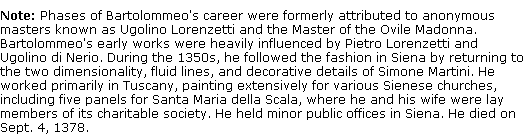
- Note
Often called the Descriptive Note, a note that describes
the career of the artist or other entity, his or her relationship to other artists, or
the usage of his or her names. Some, but not all, ULAN records include
a note. The example below is the Note for Bartolommeo Bulgarini.
- Sources for the note
A controlled reference to the sources used for information in the Descriptive Note, typically published sources. All information in the note must derive from an authoritative source. Notes must be based on facts and scholarly research. See Editorial Guidelines.
- Contributor for the note
A controlled reference to the institution or project that contributed the Descriptive Note.
- Language of the note
The language of the Descriptive Note. Legacy data contains notes primarily in English, however the Descriptive Note is a repeating field and may be translated in other languages.
- Names (required)
Proper names and appellations referring to the artist, corporate body, or other entity, including
a preferred name and variant names. All names in a record (i.e.,
all names linked by a single Subject ID) are considered equivalents
(i.e., synonyms). A ULAN record may contain synonyms in
inverted order for sorting or indexing (e.g., Wren, Christopher),
the natural order name for wall labels and other displays (e.g.,
Christopher Wren), the married name for women, variant spellings,
variations in different languages, nicknames, pseudonyms, and
other appellations.
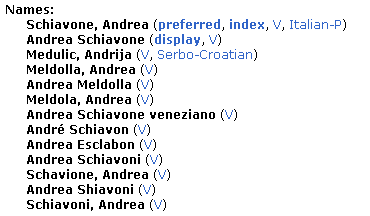
One name is flagged as the preferred name,
which is the indexing form of the name most often found in scholarly
or authoritative publications. If applicable, the preferred name will have a corresponding display name, which is flagged so users may extract it for wall labels or other displays. If the indexing form of the name is the same as the display name, it is flagged as Display Name. In the example below, all names
refer to the same artist, who was born in Dalmatia, but active
in Italy (and who is, therefore, known by his Italian name).
- Term ID (required-default)
Numeric ID that identifies the name in the database
(e.g., in the example above, Schiavone, Andrea has the
following Term_ID: 1500001503). Term IDs are unique; homographs
have different IDs. The Term_ID may be hidden from end-users.
- Sequence number (required-default)
Display order of the namesNames are arranged in a particular sort order by the editors. The preferred
name is positioned first in a list of names for the artist, with
the more commonly-used names at the top of the list.
Implementers should sort the names by the Display_order
number, which is included in the data files, but typically hidden
from end-users.
- Flags for the Names
In the ULAN data, there are various flags associated with each
name. In displays for the end-user, some of the flags may be
suppressed. The Vernacular flag is displayed as a capital letter
"V" in parentheses following the name above. Clicking on the "V" links to an explanation of what the flag
means.
|
|
|
Preferred Name flag (required-default)
The flag preferred following a name indicates that
the name is the so-called record preferred name for the
record. (The flag non-preferred is hidden in the
display.)
Each record has one and only one default preferred name,
flagged in order to provide a default name for the hierarchical
and other displays (see also Language of the Names below).
The preferred name is the inverted form of the name most
commonly used in American English publications (as in
the example below). If there is no inverted form of the
name or the inverted name is not the form most often used,
the natural order form of the name is the preferred name
(as in the example below).
|
Example
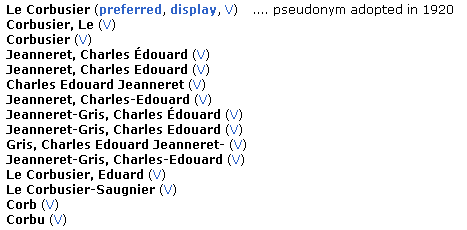
|
Note that users may link to or otherwise use any name in the ULAN record, not only the record-preferred name. Names may be chosen by other flagged preferences, if desired. Perhaps users prefer a name based on contributor, the contributor-preferred name of a given institution, or a name preferred by a given source, the source-preferred name for a source. In some cases in ULAN, the language of the name is noted; users may prefer a language-preferred name. Since not every ULAN record will have all of these preferences flagged, implementors may develop an "if-then" algorithm to choose the name preferred in their application (e.g., if there is a Spanish-preferred name, use that one; if not, use the record-preferred name).
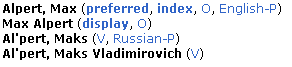
Display Name flag (required-default)
There may be a name flagged Display, meaning that
this name could be used in wall labels and other displays.
It is generally the natural-order form of the preferred
name and usually occurs at position #2 in displays.
If the name is flagged Index, this is the
name preferred for alphabetical lists. The Preferred
Name is the default Index Name. The Index Name and the Display Name may be the same name (e.g., Masaccio); when this occurs, the preferred name is flagged as the Display Name.
|
Y = Yes (i.e., this is the Display Name)
I = Index
NA = Not Applicable
|
Other Flags
Indicates various characteristics of the Name. Included are flags to indicate names used in a particular role, such as Regnal name, and deprecated names that were used historically but are now considered inappropriate or otherwise flagged as Avoid use. Such names are not deleted from the database because they provide access to historical materials, but they should be avoided in new indexing. See the Editorial Guidelines for definitions of the Other Flags.
|
O = Official name
P = Pseudonym
BN = Birth name
AB = Abbreviation
CN = Common name
FN = Full name
S = Signature
SN = Standard name
MN = Married name
AR = Art name
RG = Regnal name
RL = Religious name
PS = Posthumous name
AP = Appellation
CH = Chosen name
AD = Adult name
CG = Changed name
AL = Alternate name
MS = Misspelling
D = Deprecated name
AV = Avoid use
PJ = Pejorative name
NA = Not Applicable
Example

|
LC Flag (AACR flag)
Indicates that this is the name form preferred in the
Library of Congress Name Authority; there should be only one, if any, in each ULAN record. The ULAN preferred name is usually, but not always, the same as the LC authoritative name. For the name flagged as LC authoritative name, include the LOC numeric identifier for this LOC record in the Page field of the linked Source for LOC.
|
LC = Yes (meaning this is the Library of Congress
authoritative name form)
NA = Not Applicable
|
Name Type flag
This flag is currently set to N/A in the ULAN data.
|
U = Undetermined
NA = Not Applicable |
Historical flag (required-default)
Indicates if the name is current or historical. A historical name would be one that was used for a time, but is no longer used to refer to that person or corporate body.
|
Current
Historical
Both current and historical
Not Applicable
Local use
|
Local use (LU) is a special flag indicating names used in archival sources, other local databases, signatures, or other similar sources. These names are useful in retrieval for research purposes. However, it is advised that LU names should be omitted by implementors focused on retrieval in a broad linked environment.
Vernacular flag (required-default)
Indicates if the name is in the vernacular (local) language,
or some other language. There may be multiple vernacular
names. This is pertinent particularly when the source data calls the name vernacular, but does not indicate the language of the name per se. See also Language of the Names below.
|
V = Vernacular
O = Other
U = Undetermined
|
|
|
Part of Speech (required-default)
Indicates the category into which the name would be placed relative to its normal function in a grammatical context. Most names currently in ULAN are proper nouns, however, the Part of Speech flag is currently set to NA in ULAN.
|
- Dates for Names
Dates comprise a Display Date, which is a note referring
to a date or other information about the name, and Start Date
and End Date, which are years that delimit the span of
time referred to in the Display Date. Start and End Dates index
the Display Date for retrieval, but are hidden from end-users.
Note that the dates refer to usage of the name, not to the life
dates of the person. See Birth Date and Death Date for the lifespan of the person or existence of the corporate body.
Start and End Dates are years in the proleptic Gregorian calendar,
which is the calendar produced by extending the Gregorian calendar
to dates preceding its official introduction. Dates BCE are expressed
as negative numbers. If the name is currently used in literature
to refer to the person, the End Date for names is 9999.
- Language for Names (required-default)
Some ULAN records currently include names with language designations.
A single name may have multiple language designations because
it may have the same spelling in multiple languages. Note that most personal names do not have variants in different languages, other than variant transcriptions in other alphabets or writing systems. Exceptions occur with famous artists or rulers, where their name may be translated in different languages (e.g., Raphael for the Italian artist Raffaello). Names of corporate bodies may more often have multiple forms in different languages.
Languages are derived from a controlled list, which includes the
name of the language and a numeric code (e.g., English / 70051), linked to AAT <languages and writing systems by specific type>.
The code is typically hidden from end-users.
- Preferred flag for language (required-default)
Preferred flag for a given language. A "P" following the language in the examples indicates
that this is the preferred name in that language. In the ULAN, where language is an issue,
the preferred name (descriptor) is by default the preferred
American English name (e.g., the preferred name would be Master of the Bambino Vispo, with Maestro del Bambino Vispo as a variant name, which could in turn be flagged as preferred for Italian). For a given language, there is only one preferred name,
although there may be multiple non-preferred names in that language.
- Language status (required-default)
Flag indicating loan words. Values are Undetermined, NA, Loan Term, Literal Translation, Translation N/A). For example, the Native American artist Mato Wanartaka is often known by the translated name Kicking Bear.
- Qualifier
A qualifier
is a word or phrase used to distinguish between homographs or
other confusing names; qualifiers may occasionally be used in the ULAN when the display biography is not sufficient to disambiguate entities with similar or identical names. In the ULAN data files, the Qualifier is stored in a separate
field, not in the Name field, but repeating along with the language for the name.
- Contributor for Name (required-default)
A reference to the institution or project that contributed the name.
- Preferred Flag for Contributor (required-default)
Flag indicating when the name is the one preferred by the contributor. A contributor may contribute multiple names, but prefer only one. Values: Preferred, Non-preferred
- Sources for Names (required)
A link to a controlled reference to the source that was used as warrant for the name, including a published hardcopy source, an unpublished but authoritative database, authoritative online sources such as museum Web sites, verbal scholarly opinions, and other types of sources.
- Page Number for Name Source (required)
A reference to the volume (if applicable) and page number where the name was found in the source. It may also include other information describing the precise place in the source where the name was found (e.g., a URL for an online source). Include any unique indentifiers for a record in another resource, such as LOC control numbers.
- Preferred Flag for Source (required-default)
Flag indicating whether or not this name is the entry-form or otherwise preferred form of the name for this person or corporate body in the source.
Preferred
Alternate preferred
Non-preferred
Unknown
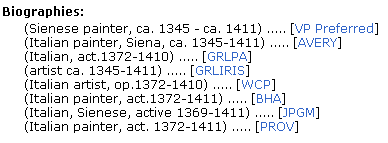
- Display Biography (required)
Display biographies are notes, linked to the contributors
that submitted them. One biography is marked preferred
for the record, to serve as a default for displays, for example,
to create the Label.
The Display Biography typically contains the following information
for a given artist: nationality, major roles, birth and death
dates. Note that biographical information for the same artist
is often expressed differently by the various contributing institutions.
If there is uncertainty regarding the artist's life dates, roles
or nationality, it is expressed in the Display Biography (and—for
longer discussions—in the Descriptive Note). Information
in the Display Biography is indexed by the following controlled
fields: Birth Date, Death Date, Nationality, and Role.
- Birth Date and Death Date (required)
Birth date and death date index the lifespan or dates of existance stated or implied in the Display Biography note. Birth date is the year when the artist was born or the corporate body was founded.
Death date is the year when the artist died or the corporate body disbanded.
For uncertain dates, the contributor or editor must estimate a broadest possible lifespan, intended for use in retrieval. Given that these years may not be actual birth and death dates, the indexed birth date and death date are not displayed to the end-user.
Dates must be represented as numbers corresponding to years in the proleptic Gregorian calendar. Dates BCE are represented as negative numbers.
For the end-user, the birth date and death date are referenced in the free text Display
Biography (see below). Indications of uncertainty (e.g., ca.)
are expressed in the Display Biography. Uncertain life dates are
estimated in Birth Date and Death Date to give each artist a 100-year
lifespan or greater. For living artists, the Death Date is recorded
as a year in the future, such as 2090. End dates for corporate bodies may be 9999.
|
|
|
Example
Birth Date: 1390
Death Date: 1450 |
|
|
- Nationality (required)
This field contains reference to the nationality, culture, ethnic group, religion, or sexual orientation associated
with the person or corporate body. Terminology comes from a Controlled List, that is mapped to the AAT. There may be multiple nationality references to a single ULAN person or corporate body.
Nationality per se does not necessarily indicate citizenship of a particular
nation, empire, or city state. It refers to a prolonged association
of an artist with a given place. Nationality may refer to historical
nations (e.g., Flemish). It may also refer to culture (e.g.,
Frankish) or ethnic groups (e.g., Native American).
Artists may have multiple nationalities, particularly when they
lived for prolonged periods in more than one nation, or when one
so-called nationality is more general than another that also applies
to the artist (e.g., for an ancient vase-painter, Greek
is a broader, general designation, while Attic is more
specific). Values may also represent culture, ethnic group, religion, or sexual orientation.
For modern persons, in identifying nationality, culture, ethnic group, religion, or sexual orientation, care is taken to be sensitive to the self-identification of the living or recently deceased person. However, information published in scholarly sources may be included as non-preferred links, even if it disagrees with the person's preference.
- Preferred flag for Nationality (required-default)
One nationality is flagged preferred for each artist, to
provide a default when creating displays. Preferred following
a nationality in the examples indicates that this is the nationality
most commonly associated with the person or corporate body.
- Sequence number for Nationality (required-default)
The Display Order number (or Sort Order number), indicating the sequence of the Nationality in relation to the other Nationalities of a ULAN record.
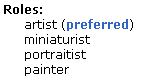
- Roles (required)
Words or phrases describing one or more roles or characteristics
of the person or corporate body. Roles are the major professional roles or activities
performed by the artist throughout his or her lifetime (e.g.,
artist, architect, sculptor). For a corporate body, roles
include the major activities or purpose of the firm, institution,
or other corporate body (e.g., studio, manufactory, workshop). Controlled by the AAT.
- Preferred flag for Roles (required-default)
One role is flagged preferred for each artist, to provide
a default when creating displays. Preferred following a
role in the examples indicates that this is the role most commonly
associated with the artist. It is often the general role, artist,
rather than a specific role (e.g., painter).
- Sequence number for Roles (required-default)
Roles are arranged in a particular order by the editors. Implementers
should sort the names by the Display_order number, which
is included in the data files, but typically hidden from end-users.
- Historical flag for Roles (required-default)
Flag indicating the historical status of the Role.
- Dates for Roles
Dates comprise a Display Date, which is a note referring
to a date or other information about the artist relative to the
role (e.g., for the role lithographer for Hendrik Voogd
below), and Start Date and End Date, which are years
that delimit the span of time referred to in the Display Date.
Start and End Dates index the Display Date for retrieval, but
are hidden from end-users.
Start and End Dates are years in the proleptic Gregorian calendar.
The latest possible End Date for an artist's role would be his
date of death. (In the example above, the artist was a lithographer
only during part of his career, thus the end date is not date
of death.)
- Sex/Gender (required-default)
The sex of the person: male, female, other, or unknown. For
corporate bodies, the sex is not applicable. Although the label "gender" would properly have values such as masculine and feminine, it is used rather than "sex" in displays in accordance with common practice in other biographical databases.
- Birth Place and Death Place
Locations where the artist was born or died, or where the corporate
body was established. The example below illustrates the Birth
and Death Places for Vincent van Gogh.
Place names in ULAN are derived from a controlled list that is mapped to TGN. The places may be current or historical in relation to the ULAN record; they may represent extant or defunct places.
- Event Type
Terminology that refers to pertinent events in the artist's life
or the corporate body's history. An event must always be accompanied
by a place and/or a date. Controlled by AAT, although terms and ULAN Event IDs are used as references.
For a person, events may include the
event active, particularly when the locus of activity differs
from the nationality (as in the example for the German artist
Hans Holbein the Younger below), when an artist was active
only late in life (e.g., for Grandma Moses), or his or
her birth date is unknown. Examples of other events included:
documented, burial, relocation, winner of contest/prize.
- Sequence number for Events
Events are arranged in a particular order by the editors. Implementers
should sort the events by the Display_order number, which
is included in the data files, but typically hidden from end-users.
- Preferred flag for Event
Flag indicating the preferred event type for the ULAN record.
- Event Place
Location where the event occurred. Place names are taken from
a controlled list comprising the place name and its parent string
combined with a numeric code (e.g., from the example above, England
(United Kingdom) / 4601120000), mapped to TGN.
- Dates for Event
Dates comprise a Display Date, which is a note referring
to a date or other information referring to a date or other information
about the artist relative to the event (e.g., for the Polish painter,
Olga Boznanska, below, Winner of the Legion d'honneur in 1910),
and Start Date and End Date, which are years that
delimit the span of time referred to in the Display Date. Start
and End Dates index the Display Date for retrieval, but are hidden
from end-users.
Start and End Dates are years in the proleptic Gregorian calendar.
In the example above, the event took place in a single year, so
Start and End Dates are the same year.
- Proper name of the event [coming soon]
Currently, the proper name of an event, such as a competition or exhibition, is recorded in the Display Date note. However, in future, there should be a link to the IA, where the event and its proper names would be recorded as an authority record.
- Related People or Corporate Bodies
Associative relationships (i.e., non-hierarchical references)
to other persons or corporate bodies in the ULAN, particularly
professional relationships. Familial relationships are included
for families of artists. There may be relationships between and
among people and corporate bodies in the ULAN. For example, an
artist may have a student/teacher relationship with his or her
master. Family relationships are typically noted only if the family
member was an artist (as in the example for Lucas van Leyden
below) or other important historical figure.
Each reference comprises a relationship type plus a link to the
related entity. For end-user displays, the related entity should
be represented by the preferred name, role, parent string, and
subject ID for the related artist.
- Relationship Type
A term or phrase characterizing the relationship between the artist
at hand and the linked artist. In the example above, the Relationship
Type in the record for Lucas van Leyden indicates that
he was a student of Cornelius Engebrechtsz. Relationship
Types are reciprocal (that is, linked to both records), drawn
from a controlled list that comprises the controlled phrase and
a numeric code, as illustrated below. The codes are typically hidden from
end users See the Editorial Guidelines for definitions of the Associative Relationships. .
|
|
|
|
Code
|
Focus Entity
|
Related Code
|
|
1302
|
associate of
|
1302
|
|
1311
|
partner of
|
1311
|
|
1512
|
parent of
|
1511
|
|
1511
|
child of
|
1512
|
|
2828
|
teacher was
|
2829
|
|
2829
|
student was
|
2828
|
|
|
|
- Historical flag for the Related Person or Corporate Body
Indicates if the link between the related concepts is current
or historical.
|
|
|
C = Current
H = Historical
B = Both current and historical
U = Undetermined
NA = Not Applicable |
|
|
- Dates for the Associative Relationship
Dates comprise a Display Date, which is a note referring
to a date or other information about the relationship between
the two artists, and Start Date and End Date, which
are years that delimit the span of time referred to in the Display
Date. Start and End Dates index the Display Date for retrieval,
but are hidden from end-users. The example below illustrates a
related person in the record for the British architect, Herbert
Baker.
Start and End Dates are years in the proleptic Gregorian calendar.
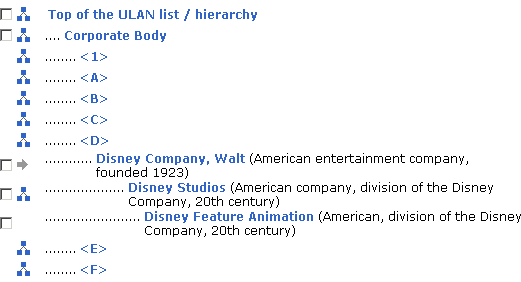
- Hierarchical Positions / Parent ID (required)
As is true of the AAT and TGN, the ULAN is constructed as a hierarchy,
even though the ULAN hierarchy does not have the same amount of
depth as AAT and TGN. The hierarchy of ULAN should be displayed
to end-users as an alphabetical listing that will explode to show
children where necessary. Hierarchies are built by using the Parent_ID,
which is linked to each Subject_ID; the Parent_ID is hidden from
end-users. For individual artists in the Person facet, the broader
context is usually simply Person. In the Corporate Body
facet, there may be some hierarchical depth, for example between
institutions and their divisions or departments.
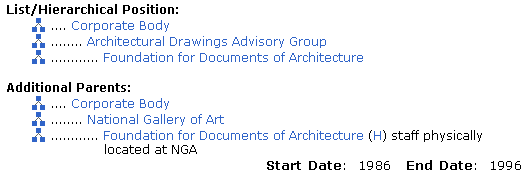
- Multiple parents
The structure of the ULAN is polyhierarchical. Each Subject_ID
may be linked to multiple Parent_IDs. If there are multiple parents,
one is marked as preferred. In displays, the preferred
parent is listed first or otherwise designated. The example below
illustrates the display of parents (i.e., broader contexts) in a Full Record Display for
the Foundation for Documents of Architecture.
In the full hierarchical view, it is recommended that implementers
indicate relationships to non-preferred parents with an "[N]",
as illustrated below.
- Sort order for the hierarchy (preferred-default)
Siblings in the hierarchies are usually arranged alphabetically.
However, it is possible that they could be arranged by another
logical order by the editors.
For siblings at any level, implementers should build displays
using the Sort_order, followed by an alphabetical sort. (In an
alphabetical display all Sort_order designations are "1," and
will therefore be sorted alphabetically in the second sort.) The
Sort_order number is hidden from end-users.
- Historical flag for the Parent (required-default)
Indicates if the link between the child and its parent is current
or historical. If the flag is Current, it is generally not displayed to
end users. If the flag is Historical, it is displayed (e.g., "H"
in the example above). Other flags could be used in future versions
of the ULAN.
- Dates for the parent relationship
Dates comprise a Display Date, which is a note referring
to a date or other information about the link between a child
and its parent, and Start Date and End Date, which
are years that delimit the span of time referred to in the Display
Date. Start and End Dates index the Display Date for retrieval,
but are hidden from end-users. The example above illustrates a
historical relationship between the Foundation for Documents
of Architecture and the National Gallery of Art.
Start and End Dates are years in the proleptic Gregorian calendar,
which is the calendar produced by extending the Gregorian calendar
to dates preceding its official introduction. Dates BCE are expressed
as negative numbers. If the date extends to the current time,
the End Date is 9999.
- Hierarchy Relationship Type (required-default)
Indicates the type of relationship between a hierarchical child and its parent, expressed in the jargon of controlled vocabulary standards. In ULAN, an example of the instance relationship is Rembrandt van Rijn is an example of Person. There may be Whole/Part relationships between corporate bodies in ULAN. An example of a whole/part relationship in TGN is Tuscany is a part of Italy. An example of genus/species relationship is calcite is a type of mineral in AAT.
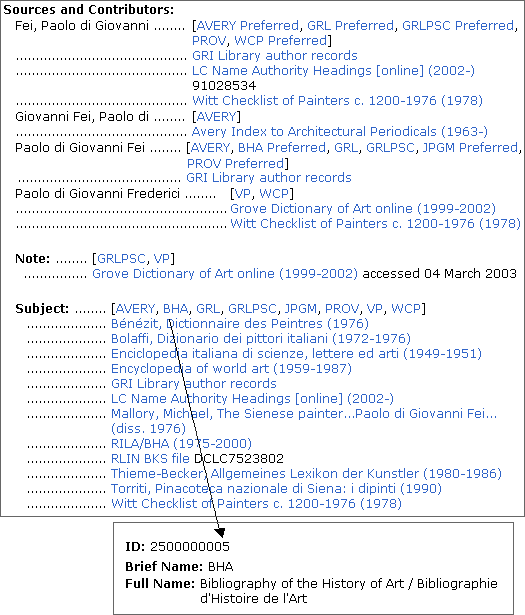
- Contributors
The institutions or projects that contributed information to the
ULAN record. In order to give due credit to the contributing institution,
it is required that implementers display a reference to the contributor
to end-users.
References to contributors are drawn from a controlled list comprising
a numeric ID, a brief name, and a full name. The end-user must
have access to the brief name and the full name. The Brief Name
is the initials, abbreviations, or acronyms for the contributing
projects or institutions (in square brackets in the display below).
Contributors may be linked to the record in three ways: with the
names, with the record as a whole (subject), and with the
note (scope note). In the example below, end users may
click on the initials of the contributor in the Full Record Display,
which produces a fuller description of the contributor name.
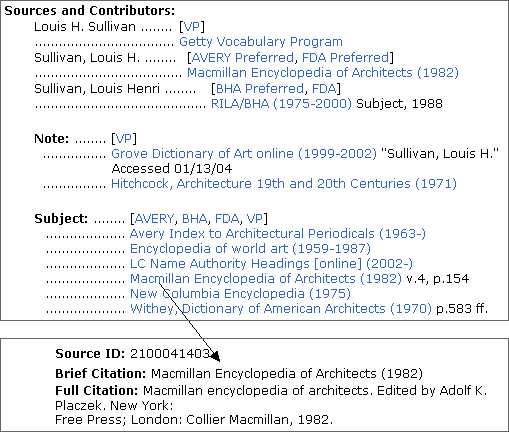
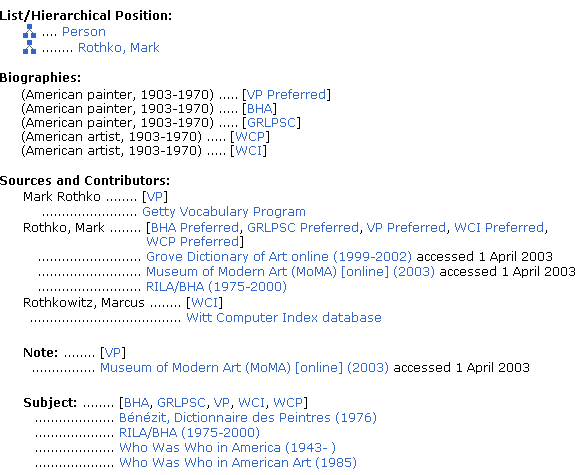
- Sources
The ULAN record generally referenes the bibliographic sources for
the names. Most names were found in authoritative publications
on the given topic, such as scholarly articles or collection records in a repository, or in standard general reference works, including
biographical dictionaries and encyclopedias. In order to give due credit to
sources, it is required that implementers display a
reference to the source to end users.
References to sources are drawn from a controlled list comprising
a numeric ID, a brief citation, and a full citation. The end-user
must have access to the brief citation and the full citation.
Sources may be linked to the record in three ways: with the names,
with the record as a whole (subject), and with the note
(scope note). In the example below, end users may click
on the brief citation in the Full Record Display, which displays
a full citation for that source.
- Page Number
A reference to a volume, page, date of accessing a Web site, or
heading reference in a source (as seen following the brief citation
(in black following the blue citations in the above example).
- Revision History
The editorial history of each ULAN record is captured in the Revision
History, which identifies when records and names have been added,
edited, merged, etc. The Revision History is included with the
licensed files, but hidden from end-users. This information allows
implementers to update the ULAN in their system with each new
release.
Sample Record
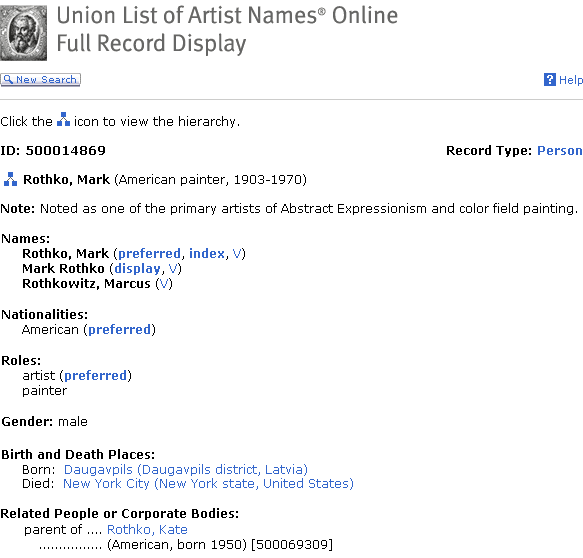
|
|

 Search Tools & Databases