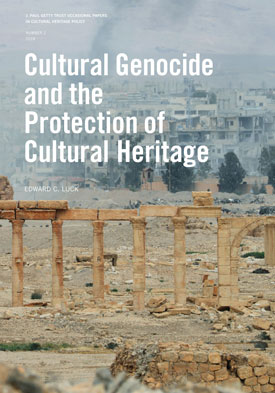
Cultural Genocide and the Protection of Cultural Heritage
2018
34 pages
PDF file size: 1.5 MB
Description
In 2016, in response to recent attacks on cultural heritage sites in Syria, Iraq, and Timbuktu, the J. Paul Getty Trust convened a meeting at the British Academy in London to discuss the need for an international framework to protect cultural heritage in zones of armed conflict. To further explore these questions, the Trust subsequently launched the J. Paul Getty Trust Occasional Papers in Cultural Heritage Policy.
In this second issue, Edward C. Luck, the Arnold A. Saltzman Professor of Professional Practice and Director of the Specialization in International Conflict Resolution in Columbia University’s School of International and Public Affairs (SIPA), explores the importance of terminology, framing, and context when developing an international policy for protecting cultural heritage. Luck outlines the five conceptual frameworks most commonly used when defining this type of policy—legal, accountability, security, counterterrorism, and atrocity prevention. He then introduces cultural genocide as an additional lens through which to examine the destruction of cultural heritage. Raising difficult questions about whether cultural destruction and the loss of human life can be addressed together, Luck traces the history of this term and the possibilities, and potential pitfalls, in its application to policy debates. “Cultural Genocide and the Protection of Cultural Heritage” challenges readers to consider the substantial political impact that terminology and framing can have when discussing cultural heritage protection.
Table of Contents
- Foreword
- Introduction
- 1. Framing
- 2. Cultural Genocide
- Notes
- About the Author
About the Authors
Edward C. Luck is Arnold A. Saltzman Professor of Professional Practice and Director of the Specialization in International Conflict Resolution, School of International and Public Affairs (SIPA), Columbia University. From 2008 to 2012, he served as United Nations assistant secretary-general and as the first special adviser to the UN secretary-general for the responsibility to protect (R2P). In that capacity, he was responsible for the conceptual, political, institutional, and operational development of R2P and for its application to a number of situations in which atrocity crimes appeared to be imminent or were underway. He was the architect of the secretary-general’s 2009 three-pillar strategy for implementing R2P that remains the accepted formulation of R2P principles and practice, and he drafted all of the secretary-general’s related reports, speeches, and statements over those years. Luck is coauthor, with Alex J. Bellamy, of The Responsibility to Protect: From Promise to Practice (Cambridge: Polity Books, 2018). A prolific author, Luck has written extensively on the origins, evolution, and reform of the United Nations, on U.S.–UN relations, and on the UN Security Council, as well as a range of other international security and humanitarian issues. In addition to holding a number of academic posts, he served for a decade as president and CEO of the United Nations Association of the USA. He graduated from Dartmouth College with high distinction in international relations and has a series of graduate degrees from Columbia University, including a PhD in political science.