Grades/Level: Lower Elementary (K–2), Upper Elementary (3–5), Middle School (6–8), High School (9–12)
Subjects: Visual Arts, English–Language Arts
Time Required: Short Activity
20 minutes
Author: J. Paul Getty Museum Education Staff

Activity Overview

Some studies show that a typical viewer spends an average of 30 seconds looking at a work of art. In this activity, students look at a work of art for 30 seconds to determine if this is enough time to absorb all of its details.

Learning Objectives

Students can discover what they're missing if they look at a work of art for only 30 seconds. The purpose of this activity is to get your students looking longer and more carefully so that they feel comfortable engaging in conversations about works of art and relying on their own observations to make meaning.

Materials

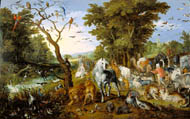
Use any work of art. We suggest Breughel's painting The Entry of the Animals into Noah's Ark. See below.

Activity Steps

1. Ask students to guess how long they think adults at museums look at works of art. Write their responses on a whiteboard or other large surface visible to the entire class. After a few responses, tell them that studies have determined that the average viewer spends about 30 seconds looking at a work of art. Ask them if they think this is enough time to view a work of art.

2. Show your students the transparency of Jan Brueghel's The Entry of the Animals into Noah's Ark (don't read the title to the students just yet), then put it aside after 30 seconds.

3. Ask your students to consider these questions after viewing the transparency:

  • What characters did you see? What else? (People, elephants, turtles, birds.) What are the animals doing? (Fighting, playing, climbing.) What are the people doing? (Working, sitting.)
  • Describe the setting. What is in the foreground (the part of the scene that appears to be the closest) of the scene? The background (the part of the scene that appears the farthest away)? The middle ground (the part of the scene that appears between the closest and farthest points)? (Animals and plants are in the foreground. Water, buildings, and birds are in the background. More animals, plants, and people are in the middle ground.)

4. Show the students the transparency again. Ask students if there are any details they have not discussed yet. Ask them if the second look might help them better see and understand the work of art. Was more than 30 seconds necessary to view all the details in the piece? Why or why not?

5. Continue exploring the painting by discussing answers to the following questions:
  • What elements of the painting attract your attention? (The large horse in the center, the sky, the trees.) Explain that artists use various techniques to draw your attention to elements in the painting. Notice color, size, and space around objects in the painting.
  • What do you think happened before this scene took place? What do you think will happen next? Where do you find evidence that makes you think so?
  • Tell us about your favorite part of the painting. Why?

6. Share some of the background information provided about the piece that you think would be interesting for your students:
  • The title of this painting is The Entry of the Animals into Noah's Ark.

  • This painting is inspired in part by a story from the Bible (the sacred book of the Christian religion). In this story, God resolved to cleanse the earth with a great flood. He spared only the lives of the family of Noah. God instructed Noah to build an ark and to take on board a male and a female of every species of bird and beast.

  • This painting was also inspired by a menagerie, or what we know today as a modern zoo. This menagerie was a collection of exotic animals owned by the artist's patrons. Jan Brueghel was the official painter to Archduke Albert and the Infanta Isabella, rulers of the Spanish Netherlands in the early 1600s (modern Belgium, Luxembourg, and northern France). Albert and Isabella collected exotic animals from around the world. Brueghel observed and drew many of these animals from life.

  • Wealthy Europeans became more interested in natural history and collecting exotic plants and animals after they traveled and set up ports of trade in the New World. Where do we go today to see a collection of wild and exotic animals?

  • As a group, discuss how knowing more details about the work of art and artist changes, or adds to, its previous understanding. Explain to students that they will have similarly in-depth conversations with other works of art during their guided visit at the Getty Museum. You may or may not see this painting during your Guided Visit, but please view it online afterward if you like.

Noah's Ark / Breughel
The Entry of the Animals into Noah's Art, Jan Breughel the Elder, 1613