|
Since the beginning of photography in the 1830s, painters and sculptors took up the new medium as a tool. The theme of the artist and the camera has been an important aspect of the Getty's photographs collection since its inception in 1984 and continues to shape its holdings. This can be seen in the selection for this exhibition of acquisitions made in the last decade, which explores the interconnectedness of art and photography.
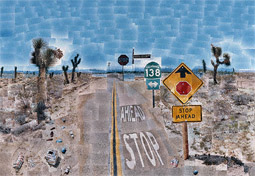
The Museum collects photographs to complement strengths of the existing collection, or to fill a gap—an area lacking work from a time period or by a specific maker. We strongly favor collecting many examples by important photographers to enable exhibitions and publications inspired by the collection. We feel a special duty to hold work by the best photographers with roots in California and the West. The photo collage above, a landscape in California's Antelope Valley, was created by the English painter David Hockney, who arranged individual photographs into an image that is over 9 feet wide—on a scale equal to one of his paintings.
|
 |
|
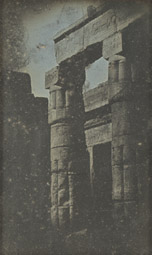
In 1842 Joseph-Philibert Girault de Prangey traveled from his native France to Italy, Greece, Egypt, Asia Minor, Turkey, Syria, and Palestine. His photographs of these ancient sites were fresh and innovative.
The Temple of Seti I is located at the archeological site of Gournah in Egypt. By moving close to the subject, Girault de Prangey conveyed the gravity and drama of the huge decaying stones. No earlier photograph is known in which the visual elements of light and viewpoint are harnessed so skillfully to express essential aspects of an ancient Egyptian monument. Through his unique and prescient vision, Girault de Prangey created among the greatest achievements in the history of photography.
|
|
|
|
|
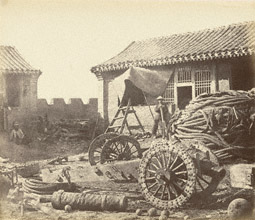
Interior of the Pehtang Fort Showing the Magazine and Wooden Gun, Felice Beato, August 1, 1860
|
 |
|
|
This print by Felice Beato shows the Pehtang Fort taken by European troops in the 1860 Opium War with China. The print is a recent acquisition and was acquired partly as a companion to another print in the collection by Beato of the same site, purchased in 1984. Together, the two prints (displayed together in the exhibition) further understanding of the artist's process, demonstrating that Beato experimented with his negative to create two different images of the same site. His manual intervention moved beyond documentation of the war toward an artistic interpretation.
|
|
|
|
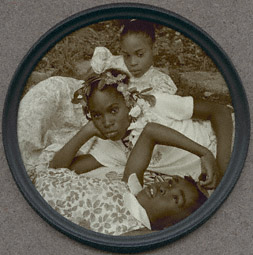
May Flowers, from the series May Days Long Forgotten, Carrie Mae Weems, 2003
© Carrie Mae Weems
|
|
|
|
|
|
Throughout her career, Carrie Mae Weems has used different media to challenge perceptions of race, class, and gender. In order to realize her series May Days Long Forgotten, she enlisted several young women from unemployed, working-class families in Syracuse, New York.
Weems provided the wardrobe for her subjects and directed their poses to establish a fictional tableau that evokes late-19th-century French paintings. The acquisition of Weems's work demonstrates the Museum's commitment to identifying newly important work by leading contemporary photographers.
|
|
 Past Exhibitions