

|
|
||
 |
What is Linear Perspective? The invention of linear perspective dates to the early
1400s, with Filippo Brunelleschi's experiments in perspective painting and
Leon Battista Alberti's treatise on perspective theory. Linear perspective
aims at creating the illusion of spatial depth on a two-dimensional surface.
It does so by following consistent geometric rules for rendering objects as
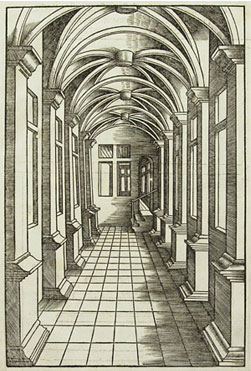
they appear to the human eye. For instance, we see parallel lines as converging
in the distance, although in reality they do not. |
||
|
|
This example comes from Rodler’s German publication of 1539. Click the terms to reveal the underlying geometry of the image. Orthogonals: Straight lines that appear to converge on each other as they recede into space, meeting at vanishing points on the horizon line. Vanishing point: The point on the horizon line where parallel lines appear to converge. Horizon: The vanishing point lies on the horizon line, which corresponds to the eye level of the viewer.
|
|