 |
Education | |
| ||
|
Exhibitions | |
| ||
|
Explore Art | |
| ||
|
Research and Conservation | |
| ||
|
Bookstore | |
| ||
|
Games | |
| ||
|
About the J. Paul Getty Museum | |
| ||
|
Public Programs | |
| ||
|
|
|
Museum Home
 Past Exhibitions Past Exhibitions
|
|
September 10–December 1, 2002 at the Getty Center
|
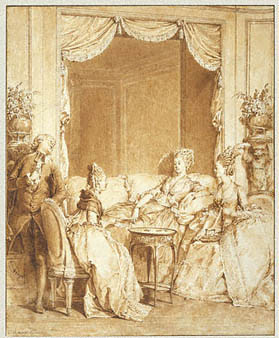
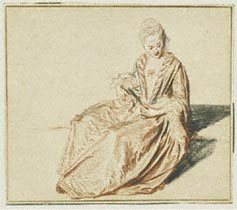
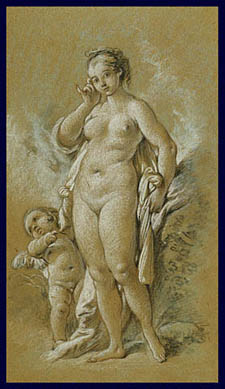
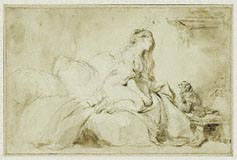
This exhibition, which complements the loan exhibition Greuze the Draftsman, explores French draftsmanship during the 1700s, considered the golden age of drawing in France. Like Jean-Baptiste Greuze, the artists of this fertile artistic period were admired for their technical ability, variety of media and subjects, and sensitive observation of the world. Jean-Michel Moreau the Younger |
||||||
|
||||||
This drawing was one of twelve that Moreau made to illustrate a book describing scenes from the life of a fashionable, newly married young woman. Here, the reclining bride has recently learned that she is pregnant and receives reassurance from her friends. Although Moreau was an accomplished printmaker, he did not engrave this composition himself. Instead, this refined, meticulous model was made for another engraver to translate into a print. |
||||||
|
||||||
Jean-Antoine Watteau Watteau rose to prominence during the early 1700s with his paintings of leisurely gatherings of finely dressed figures in idyllic landscapes. This coy young woman seems effortlessly crafted in red, black, and white chalk, a technique that has become synonymous with Watteau's drawings. Although the figure's formal dress and specific posture might suggest otherwise, Watteau made this study for his own reference and not for a particular composition. |
||||||
|
||||||
François Boucher Boucher's drawings were as sought after as his paintings, and he made many, such as this highly finished sheet, as independent works of art. He modeled the figures of Venus and Cupid using black chalk, then subtly applied white chalk over the buff-colored paper to define their skin tones. Boucher depicted the mythological pair in seemingly endless variations throughout his career. |
||||||
|
||||||
Jean-Honoré Fragonard A woman abandoned by her lover is an unusual scene of heartbreak by an artist more famous for depicting playful bedroom scenarios. Fragonard had trained as a painter of serious historical subjects, and he cleverly adapted those lessons here in the sad young woman's pose, which recalls that of a repentant saint. Fragonard's vocabulary of long undulating lines, in both the pencil underdrawing and the application of wash, emphasizes the soft forms of the bed, the dog, and the figure. |
||||||
|
||||||
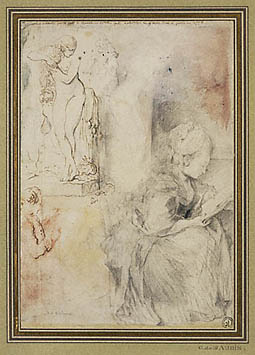
Gabriel-Jacques de Saint-Aubin Saint-Aubin was a fixture on the Parisian art scene, faithfully attending exhibitions and making small drawings of the paintings and sculptures on view. He saw the sculpture The Birth of Venus (at upper left) in 1773 and drew it from the front and side. Although Saint-Aubin used the sheet for several different studies, he unified them into a single composition. He created a relationship between the statue and reading woman by placing them on a diagonal axis, from upper left to lower right, implying a transformation from the mythological figure to the contemporary one. Saint-Aubin also acknowledged the artist's role as the mediator between imagination and reality by placing a draftsman between the figures (at lower left). |
||||||
|
||||||

| |||||||||||
| |||||||||||
|
|
|
|||||||||
|
|||||||||||